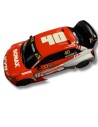
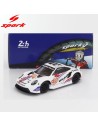
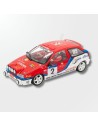
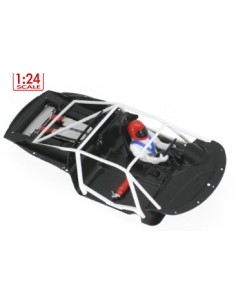
The 1/24 scale holds a very special place within the world of slot racing and competitive modelling. It is not the most widespread in home circuits, but it is one of the most appreciated by those seeking more detail, greater presence on the table, or more space to work on the body. If you are thinking of delving into this scale or already practice it and want to expand your collection or improve your setup, in this section you will find everything you need to know to make the best decision.
The 1/24 bodies represent the car at a size ratio of 1 to 24 compared to the original. This means that a car with a real length of 4.5 meters translates into a model or body of about 18-19 centimeters. That extra size compared to 1/32 is not just aesthetic: it implies a larger surface for painting, more space to add details, more mass to manage on track, and a visual presence that many enthusiasts consider unbeatable.
In the market, you will find 1/24 bodies in different materials —injected plastic, resin, and polycarbonate (Lexan)— and with very different purposes: from competition on wooden tracks to static collecting or display case decoration. Knowing how to distinguish them is the first step to avoid choosing the wrong product.
What are 1/24 bodies and why this scale matters
A 1/24 body is the outer shell that covers the chassis of a slot car or serves as the body of a 1:24 scale model. It defines the silhouette, the visual identity of the model, and, in the case of slot cars, it also influences the aerodynamics, weight, and centre of gravity of the vehicle.
The 1/24 scale is, historically, the "large" scale of competitive slot racing. For decades, it was the standard in the more serious categories of North American and European associations, where routed wooden tracks allowed for maximum exploitation of the size and precision of these models. Today, it remains the reference in many clubs specialised in technical racing.
Compared to 1/32 —more popular in the home market—, 1/24 offers:
- Greater surface detail: more defined body lines, finer grilles, and larger working areas for the painter.
- More preparation options: the interior and chassis have more space, facilitating the installation of electronics, lighting, or internal decorative elements.
- Different weight and handling: the body weighs more, which requires more careful balancing of the whole.
- Specific tracks: 1/24 circuits have a different track width than 1/32; they are not interchangeable without adapters.
For the static modeller, 1/24 is also one of the favourite scales because it allows for the faithful reproduction of details from competition cars, historical touring cars, or prototypes without reaching the bulky size of 1/18.
How to correctly choose a 1/24 body
Before buying a 1/24 body, it is advisable to have several questions clear: what will you use it for —slot competition, static model, or collection—? Do you already have a chassis that it needs to fit? Will you paint it yourself or are you looking for something already decorated?
Compatibility with the chassis
In the world of slot racing, the body must fit the corresponding chassis. Many manufacturers design their bodies for their own chassis, with specific posts and anchor points. If you mix brands, always check the wheelbase measurements (distance between axles) and the position of the mounting posts before purchasing. A mistake of a few millimetres can cause the body not to sit properly or to rub against the wheels.
Material according to use
The material affects the final behaviour of the assembly. It is not the same to prepare a car for competition as to assemble a model for display:
- Injected plastic: this is the usual material for standard bodies. Good rigidity, correct surface finish, suitable for painting with prior priming. Heavier than polycarbonate.
- Resin: allows for greater fidelity in reproducing complex shapes and fine details. Brands like Avant Slot use it in industrial production. It is fragile against strong impacts, but the finish and precision are outstanding. Ideal for collection cars or high-level preparations.
- Polycarbonate (Lexan): lightweight and flexible, very resistant to impacts. It is the preferred material in serious competition because it absorbs impacts without breaking. Requires painting from the inside to maintain the finish. Its transparency allows for spectacular interior lighting effects.
Level of finish and decoration
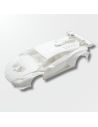
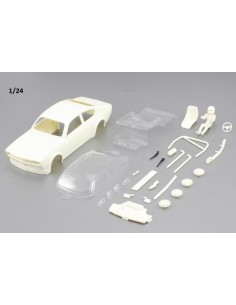
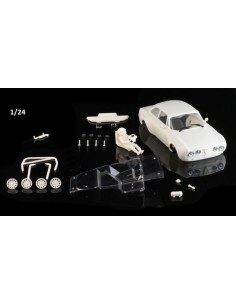
Some bodies are sold in white (unpainted), ready for the modeller or driver to apply their own livery. Others come with standard decoration, with applied decals or direct printing. If you have experience with an airbrush or acrylic paints, a white body gives you total freedom; if you are looking for something ready to run or display, opt for the decorated versions.
Main types and differences of 1/24 bodies
Within the 1/24 scale, the offerings are mainly grouped by discipline or type of competition they represent:
GT and Sport
These are the most common models. They recreate competition cars from the GT3, GT4, IMSA categories or similar. Rounded silhouettes, good downforce, and a profile that is recognisable both on track and in display cases. Very popular in club competitions.
Prototypes and LMP
Bodies with more aggressive lines, featuring pronounced wings, skirts, and diffusers that in the 1/24 scale have an impressive level of detail. Usually associated with classics from Le Mans or endurance competitions.
Touring Cars
BTCC, DTM, Super Touring... The touring car bodies in 1/24 reproduce the fenders, roof, and undercarriage with great detail. They are taller than GTs, which changes the centre of gravity and requires adjustments to the chassis.
Formulas and single-seaters
Less common in 1/24 than in other scales, but they do exist. The width of the body and the side pods require a suitable circuit and very specific chassis.
Classics and historicals
One of the most active categories in collecting. Cars from the 60s, 70s, and 80s reproduced in 1/24 scale with a level of detail that allows for appreciation of even the door handles or period headlights.
Technical aspects we need to know
If the destination of the body is a competitive slot car, there are several technical aspects we cannot ignore:
Weight and mass distribution
The body contributes to the total weight of the car. In 1/24, even a few grams of difference between a resin body and an injected plastic one can be noticeable in cornering behaviour. Ideally, the weight should be evenly distributed between the front and rear axles, and as low as possible relative to the ground.
Height and positioning
The height at which the body is mounted on the chassis influences the centre of gravity. The lower it is, the greater the stability in corners. Adjusting the height using posts or spacers is a common practice in preparation.
Windows and aerodynamics
In competition, it is valued that the windows do not generate turbulence that lifts the car. In polycarbonate, the transparency of the windows does not require additional work; in resin or plastic, it will need to be evaluated whether to add acetate windows or leave them open according to regulations.
Painting and technical finish
A poorly painted body can accumulate unnecessary weight if too many layers are applied. In competition, less paint weight is always better. In polycarbonate, remember to always paint from the inside: the exterior face remains shiny and naturally protected.
Practical tips for painting and preparing a 1/24 body
Whether you are a modeller or preparing a car for competition, the preparation of the body is a process that deserves attention and patience.
Surface preparation
Before painting, clean the body with warm soapy water and let it dry completely. On plastic and resin, apply a thin layer of primer (Vallejo, Tamiya, or similar) to improve paint adhesion. On polycarbonate, do not use primer on the exterior face; work from the inside.
Recommended tools
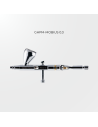
For quality work in 1/24, the airbrush is your best ally: it allows for gradients, precise masking, and very thin layers. For fine details —numbers, colour separation lines, edges—, acrylic paints from Vallejo or Tamiya applied with a fine brush yield excellent results.
Decals and decoration
Decals are the usual method for logos, numbers, and sponsors. Apply them over a layer of glossy varnish to avoid the "silvering" effect around the decal. Once placed, protect with matte or satin varnish according to the desired finish.
Cutting and fitting
On resin or plastic bodies, it is sometimes necessary to lightly sand the edges or adjust the anchor areas with a file or dremel to ensure they fit perfectly with the chassis. Do this calmly and check the dry fit before painting.
Common mistakes we should avoid
Experience teaches that certain mistakes are repeated, especially among those starting in 1/24:
- Not checking chassis compatibility before buying: each manufacturer has its own mounting standards. Always check the chassis to which the body is intended.
- Painting resin without priming: resin has a porous surface and can shed paint if not properly prepared. Priming is not optional.
- Applying too many layers of paint: in competition, every gram counts. In collecting, excess layers can obscure fine details engraved in the body.
- Ignoring weight when adding interior ballast: if you want to add ballast to improve handling, do it in a balanced and calculated manner, not by eye.
- Mixing scales on the same circuit: in slot racing, 1/24 bodies are not compatible with circuits designed for 1/32 without adaptations. Always inform yourself before investing in track and cars.
- Forcing the body if it doesn't fit: if there is resistance when mounting, look for the reason (manufacturing burrs, misaligned posts). Forcing can break the anchor points.
Recommendations for beginners and advanced users
If you are starting with 1/24
The most important thing is to understand that 1/24 has its own ecosystem: chassis, tracks, and bodies that are not directly interchangeable with other scales. Start with a decorated injected plastic body to familiarise yourself with the assembly before diving into painting. If you have doubts about compatibilities, ask: it is much cheaper to ask beforehand than to discover the mistake after purchasing.
For painting, start with solid colours and learn to mask well. Don't worry about achieving the perfect livery on the first attempt; practice in this large scale is a pleasure because you have plenty of workspace.
If you already have experience in 1/24
Explore resin bodies for collection or display: the level of detail is hard to surpass at this scale. In competition, experiment with polycarbonate and work the weight down to a minimum. The combination of a lightweight, well-balanced body with a well-tuned chassis is what makes the difference in lap times.
It is also worth exploring the customization of historical liveries: 1/24 is a scale with a very rich history in competition cars from the 60s to the 90s, and reproducing an original period decoration in this size is one of the most satisfying projects in the hobby.
| Material |
Weight |
Impact resistance |
Surface detail |
Recommended use |
| Injected plastic |
Medium |
Medium |
Good |
General use, beginners |
| Resin |
Medium-high |
Low (fragile) |
Very high |
Collection, high competition |
| Polycarbonate (Lexan) |
Low |
Very high |
Medium |
Competition, maximum lightness |
Frequently asked questions about 1/24 bodies
Are 1/24 bodies compatible with 1/32 circuits?
No, not directly. 1/24 circuits have a different track width than 1/32. There are adapters and mixed circuits, but generally, each scale has its own track system. Always inform yourself before combining materials from different scales.
What is the difference between a white body and a decorated one?
The white body comes from the factory unpainted, ready for the modeller to apply their own livery. Decorated ones come with paint and standard decals. If you want to customise, choose the white version; if you are looking for something ready to use, go for the decorated one.
Can a polycarbonate body be painted with an airbrush?
Yes, but always paint from the inside of the body. The exterior face of the polycarbonate remains intact and shiny. The painting order is the reverse of plastic: first the colours that should appear "on top" visually, and lastly the background colour.
Do resin bodies need special preparation before painting?
Yes. They need to be thoroughly cleaned to remove any release agent residue, lightly sanded if there are imperfections, and primed before painting. Without this process, the paint may not adhere well and could peel off over time.
Which brands manufacture quality 1/24 bodies?
In the competition and collection segment, you will find references from brands specialised in 1/24 slot racing as well as model manufacturers that work in this scale. Avant Slot, for example, is one of the few brands that produces resin bodies at an industrial level with high fidelity to the original.
How much weight does a body add to the slot car?
It depends on the material and size, but in 1/24, an injected plastic body can weigh between 15 and 30 grams, while a polycarbonate one can be below 10 grams. In competition, that difference is significant.
Can I use water decals on any 1/24 body?
Yes, water decals are compatible with any material, as long as the surface is clean and has a prior layer of glossy varnish to facilitate sliding and adhesion. Once dry, protect them with matte or satin varnish.
Is it complicated to adapt a 1/24 body to a chassis from another brand?
It can be if the anchor points do not match. Whenever possible, use body and chassis from the same manufacturer. If you are going to mix brands, check the wheelbase measurements and mounting points before purchasing, or consult with us to avoid incompatibilities.
Is 1/24 a good scale to start in slot racing?
It is a very rewarding scale, but it requires more space (both on track and for storage) and a slightly higher initial investment than 1/32. If you already have basic experience in slot racing and want to take a leap in detail and technical competition, 1/24 is an excellent scale. For an absolute first contact with the hobby, 1/32 is usually more accessible.
Can collection 1/24 bodies also be used on track?
It depends on the type of body. High-fidelity resin bodies are mainly designed for collection or very controlled competition, as they are fragile against impacts. For regular racing, injected plastic or polycarbonate bodies withstand daily use on track much better.
What paints are most recommended for 1/24 bodies?
For plastic and resin, acrylic paints from Vallejo or Tamiya yield very good results when applied with an airbrush. Tamiya enamels are also good for specific finishes. On polycarbonate, use paints specifically for Lexan that maintain the flexibility of the material and do not crack when bending the body.
How much space does a 1/24 circuit occupy?
A medium-sized 1/24 circuit typically requires at least 4-5 square meters, although the most complete club circuits may need significantly more. This is one of the most important practical considerations before deciding on this scale in a home environment.