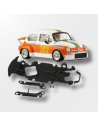
When preparing a slot car for competition —or simply wanting to get the most out of it at home— we tend to first focus on the motor, the crown gear, or the tyres. However, there is a pair of components that often goes unnoticed until something fails or until we finally test it under proper conditions: the rear axle and its bearings. A well-chosen and correctly mounted set can make the difference between a car that vibrates, loses traction, and overheats, and one that runs smoothly, transmits all the motor's power to the track, and withstands long sessions without degrading.
In the world of 1/32 and 1/24 slot racing, there are dozens of possible combinations: ground steel axles, tungsten axles, steel ball bearings, ceramic bearings, sintered bushings… Each choice corresponds to a driver profile, a championship regulation, and a type of track. It is not the same to prepare a GT for a sport track league as it is to fine-tune a Le Mans prototype for a Scalextric circuit. The demands are different, and the components must be as well.
At Ministry of Hobby, we have been supporting drivers of all levels for years: from the enthusiast who has just discovered the hobby to the preparer who takes their cars to national championships. We know what questions are asked, what mistakes are made, and which components really make a difference. This guide is born from that accumulated experience, with the aim of helping you make the best decision before working on the rear end of your car.
What are axles and bearings and why are they so important
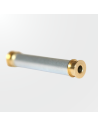
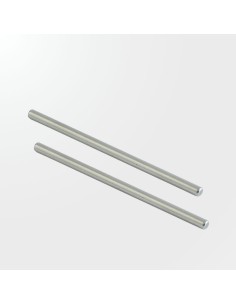
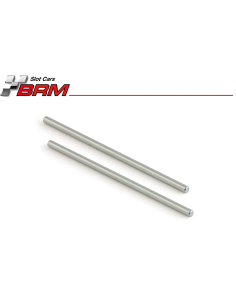
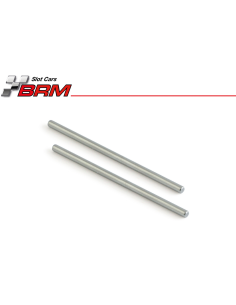
The rear axle is the metal bar on which the crown gear and rear wheels are mounted. Its function seems simple —to rotate— but in practice, it requires extremely high precision. Any thousandth of a deviation in the straightness of the axle translates into vibration, wheel imbalance, and loss of grip. A bent axle, no matter how small the defect, can ruin a perfect setup in every other aspect.
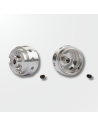
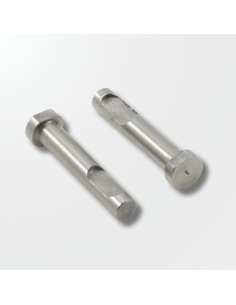
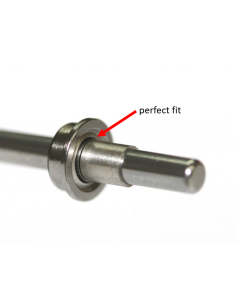
The bearings —also called ball bearings in more general contexts— are the elements that allow the axle to rotate within the chassis with minimal friction. There are two main families: ball bearings, which drastically reduce rotational resistance and are the usual choice in competition setups, and sintered bushings (porous bronze bushings), which are more economical and quieter, self-lubricate, and are very popular in standard cars and more relaxed use configurations.
The relationship between these two components is critical: a quality bearing mounted on an axle with excessive play is useless, and a perfectly straight axle loses all its value if the bearings are worn or poorly seated in the housing. The axle-bearing-housing assembly forms a system that must be understood and treated as such.
How to correctly choose axles and bearings
Before buying, it is advisable to answer three basic questions:
- What track system are you preparing the car for? Cars designed for universal track (Scalextric, Ninco) and those designed for sport track (Scaleauto, Slot.it) have different wheelbase distances, housing heights, and chassis geometries. This affects the diameter and length of the axle you need.
- What level of preparation are you looking for? For a home-use car, a sintered bushing may be more than sufficient. For competition, steel ball bearings —or ceramic ones if the regulations allow— are practically mandatory.
- What is the motor mounting configuration? In a sidewinder configuration (motor parallel to the rear axle), the axle works in a specific way, and the free length between housings may differ from that of an inline (motor in line with the axle, perpendicular) or anglewinder (motor at an angle) setup. This affects the available space and, therefore, the type of axle that fits.
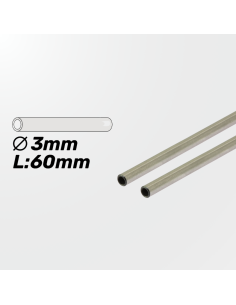
In addition to these three questions, pay attention to the axle diameter: the most widespread standard in 1/32 is 3/32" (approximately 2.38 mm), although there are also 2 mm and 3 mm axles depending on the manufacturer and chassis. Installing an axle of incorrect diameter in a housing or wheel causes excessive play or mounting impossibility, and it is one of the most common mistakes among those starting in preparation.
Main types and differences
Axles by material
- Ground steel: the most common. Offers a balanced combination of price, hardness, and dimensional precision. It is the most widespread choice in both hobby preparation and mid-level competition.
- Tungsten: greater hardness and resistance to deformation than conventional steel. Highly valued in high-level competition because it maintains straightness even after impacts. Its price is higher.
- Aluminium: lighter but less durable. Used in configurations where reducing weight without compromising transmission is a priority, although more care is needed when tightening wheels and crown gears.
Bearings by type
- Sintered bushing (porous bronze): retains lubricant in its micropores, works dry with very little friction, and is very quiet. Perfect for box cars or basic preparations. Requires periodic maintenance with fine oil.
- Steel ball bearing: reduces friction to a minimum thanks to the spheres rolling between the inner and outer tracks. Ideal for competition. There are shielded versions (protected from dust) and open versions (easier to clean and relubricate).
- Ceramic bearing: the spheres are made of ceramic instead of steel, which further reduces friction and heat generated. They are the reference in top-level preparations, although their price is considerably higher.
Reference brands
NSR, Slot.it, Avant Slot, and Scaleauto are the brands with the most complete catalogues of specific axles and bearings for their chassis, although many of their components are interchangeable as long as diameters and lengths are respected. NSR and Slot.it stand out particularly for the variety and dimensional quality of their ground axles and ball bearings.
Technical aspects we should know
Diving into axle and bearing preparation without knowing some basic concepts can lead to poor decisions. These are the most relevant:
- Axial play: longitudinal clearance of the axle within the housings. A minimal axial play is necessary for the axle to rotate freely, but excess play causes the wheels to shift laterally in curves, affecting stability and contact geometry with the track.
- Radial play: clearance between the axle and the inside of the bearing. A bearing with excessive radial play transmits vibration and noise; one that is too tight generates heat and resistance to rotation.
- Concentricity: that the wheels rotate perfectly centred relative to the axle. A concentricity problem —which can come from the axle, the wheel, or the hub— produces the dreaded "wobble" of the rear wheel, which is very visible and detrimental to grip.
- Axle length: determines the track width of the car. Some championship regulations set minimum and maximum widths, so it is important to calculate carefully before cutting or choosing an axle of a certain length.
- Surface finish: an axle with a fine finish (polished, finely ground) generates less friction with the bearing and retains lubricant better. This detail makes a difference in long sessions.
Practical tips for use, maintenance, and preparation
Properly mounting an axle and bearings is not just a matter of fitting the pieces together. These habits make the difference:
- Check the straightness of the axle before mounting. Roll the axle on a flat glass or marble surface. If it wobbles, it is bent: do not mount it. A good verification rule is the reference mounting table, although with practice, the eye and touch on glass are sufficient.
- Clean the bearings before lubricating. New ball bearings often come with thick preservation grease. Clean it with an appropriate solvent (isopropyl alcohol or specific electronic cleaner) and then apply a few drops of fine slot oil.
- Do not overtighten the wheels. Tightening the wheels too much can bend the axle or create tensions that increase friction. Use just the right torque so there is no play, but the assembly rotates smoothly.
- Relubricate periodically. With use, the lubricant degrades and is expelled. A drop of fine oil in each bearing every few race sessions keeps the assembly in optimal condition.
- Check the condition of the bearings after impacts. A strong hit against the rail or another car can damage the spheres or tracks of the bearing. If you notice more noise or more resistance to rotation after an accident, replace it: it is an inexpensive component and not worth keeping damaged.
Common mistakes to avoid
- Mixing axle and bearing diameters without checking. A 3/32" bearing does not fit the same in a housing designed for 2 mm. Before buying, measure or consult the chassis specifications.
- Ignoring axial play. Many preparers adjust the concentricity of the wheels but forget to check that the axle does not have excessive lateral displacement. Add a shim if necessary.
- Using inappropriate lubricants. WD-40 is not a lubricant for ball bearings; it is a degreaser-corrosive inhibitor. Always use specific slot oils or, for sintered bushings, light silicone oils.
- Not checking the concentricity of the wheels after mounting. Even if the axle is perfect, a poorly drilled wheel or an off-centre hub ruins the assembly. Always check before putting the car on the track.
- Buying axles without considering the motor mounting. In an anglewinder chassis, the free axle space may differ from that of a sidewinder of the same model. Consult the technical sheets or ask before buying.
- Neglecting the condition of the axle while focusing on the motor. A spectacular motor mounted on a bent axle or worn bearings will never perform at its real level.
Recommendations for beginners and advanced users
If you are starting in slot preparation
The most sensible approach is to start with the specific components of your chassis brand (NSR, Slot.it, Scaleauto…). Their axles and bearings are sized to fit without surprises and offer more than enough quality to learn how to prepare. Start with shielded steel ball bearings: they are easier to maintain than open ones and last longer in the hands of someone still gaining practice in cleaning and lubrication.
Also, get a flat glass to check axles and a fine slot oil. With those two tools and the right components, you already have everything you need to make a real quality leap compared to a standard car.
If you already have experience and seek maximum performance
At this level, the choice between high-tolerance ground steel and tungsten depends on the type of track and expected impacts. In sport track circuits where accidents are frequent, tungsten quickly amortises its cost. For more technical circuits and careful drivers, high-quality steel is sufficient.
Consider ceramic bearings if your championship regulations allow: the reduction in friction is real and measurable in lap times. Also, invest in a hundredths comparator to check wheel concentricity: it is the tool that separates finely tuned preparations from those that only appear to be.
| Type of bearing |
Friction |
Maintenance |
Relative price |
Ideal use |
| Sintered bushing |
Low |
Occasional relubrication |
Economical |
Home use, box cars |
| Ball bearing (steel) |
Very low |
Clean and lubricate with fine oil |
Medium |
Competition, hobby preparation |
| Ceramic bearing |
Minimal |
Careful cleaning, ceramic oil |
High |
High-level competition |
Frequently asked questions about axles and bearings
What is the most common axle diameter in 1/32 slot racing?
The most widespread standard is 3/32" (approximately 2.38 mm). However, some brands and chassis use 2 mm or even 3 mm, so it is always advisable to consult the chassis specifications before purchasing.
Can I use NSR axles and bearings on a Slot.it chassis?
In many cases yes, as long as the diameters and lengths match. Both brands work with similar standards, but there are variations depending on the chassis model. Check the technical sheets or consult before mounting.
When should I change the ball bearings?
When you notice more noise than usual when turning the axle by hand, resistance to rotation that does not disappear with lubrication, or visible damage to the cage or spheres. After a strong impact, check them even if they seem intact.
Is it necessary to lubricate ball bearings if they come "sealed"?
Shielded bearings come pre-lubricated, but with use, the lubricant depletes. Over time, it is advisable to remove the protective shield (if removable), clean the interior, and add a few drops of fine slot oil.
Are sintered bushings worse than ball bearings for competition?
They are not worse in absolute terms, but they do generate slightly more friction and heat under intensive use conditions. For competition where every tenth counts, ball bearings are the right choice. For home or casual use, bushings are a perfectly valid and quieter option.
Does an anglewinder need a different axle than a sidewinder?
The diameter is usually the same, but the usable length of the axle may vary depending on the chassis. In an anglewinder setup, the motor position affects the available space on the rear axle, so it is advisable to verify the length before purchasing.
How do I know if my axle is bent?
The simplest method is to roll it on a flat glass or marble surface. If it wobbles or does not roll in a straight line, it is bent. You can also mount it on a hand lathe or hold it between two V supports and spin it while observing.
Does the axle material affect the weight of the car?
The weight difference between a steel, tungsten, or aluminium axle in the dimensions of a 1/32 car is minimal in absolute terms, but in competition preparations where every gram is adjusted, the material can indeed be a factor to consider along with its position in the chassis (centre of gravity height).
How often should I lubricate the bearings?
It depends on usage. With frequent racing sessions, a drop of fine oil per bearing every 3-4 sessions is a good practice. If the car has been stored for a while, lubricate it before using it again even if the bearings seem to be in good condition.
What happens if I mount an axle that is too long?
The track width increases more than necessary, which can cause the wheels to rub against the bodywork, the car to fall outside the tolerances of the regulations, or simply that the working geometry is not optimal. Always check the length before mounting.
Do ceramic bearings require a special lubricant?
It is not essential, but specific oils for ceramic bearings are formulated not to degrade the material of the spheres and offer optimised viscosity. If you use a quality conventional slot oil, it also works correctly.
Can I mix ball bearings in the front and sintered bushings in the rear?
Yes, although it is not common. In many cars, the front axle does not exist as such (the wheels rotate independently on pivots), but if your chassis has a front axle, the combination is possible. The important thing is that the rear assembly —where power is transmitted— is optimised with ball bearings.