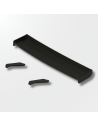
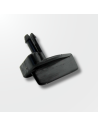
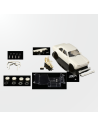
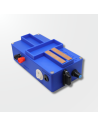
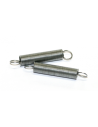
In the world of slot racing, the small details make a difference that can be felt lap after lap. One of those details — often underestimated until experienced on track — is the front or rear suspension system, and within it, the role played by the dampers. If you have ever seen how a car bounces over elevation changes, loses grip in fast corners, or feels twitchy on circuits with imperfections, it is very likely that the solution lies in reviewing (or incorporating) suitable dampers.
Dampers in slot cars are not a universal or mandatory element in all models: there are chassis that work with floating suspension, others with rigid systems, and others with full suspension where the dampers play an active role. But when the mounting allows it — or when the regulations of the category you compete in permit it — incorporating them correctly can significantly transform the car's behaviour.
In this section, you will find dampers compatible with the most common chassis and platforms on the market, both for competitive use and for detailed builds in models aimed at collection or enjoyment on your own track. Brands like NSR, Slot.it, Scaleauto, or Avant Slot have developed specific solutions for their chassis, and here we have them available so you can find exactly what you need without having to search multiple sites.
Whether you are preparing a car to race at a club, fine-tuning your home set-up, or simply want to explore how far the performance of your favourite model can go, this section is designed for you.
What are dampers in slot racing and why do they matter
In a slot car, the suspension has a function analogous to that of a real vehicle: to absorb the irregularities of the track and maintain as much contact as possible between the tyres and the rail. The dampers are the component that controls the speed of compression and extension of that suspension, preventing the car from bouncing uncontrollably.
At 1/32 scale, slot tracks are not perfectly flat: they have joints between sections, elevation changes on bridges, and banked curves that generate forces on the chassis. Without any type of damping, the car tends to "jump" at those transitions, reducing the contact time of the tyres and, consequently, the available traction.
The most tangible benefit of a well-adjusted damping system is cornering stability: the car works more closely to the rail, the tyres maintain better contact with the track, and the driver can manage the power output with more confidence. This translates into more consistent lap times and a more enjoyable driving experience, especially on technical or high-speed circuits.
In models aimed at serious competition, the adjustment of the damping is part of the overall setup of the car, along with tyre hardness, car weight, guide height, or braid tension. It is not an isolated component: it interacts with all the others.
How to correctly choose dampers for your slot car
The correct choice depends on several factors that should be analysed before purchasing:
Compatibility with the chassis
The first filter is always compatibility. Dampers are designed to fit specific anchor points on the chassis. Before choosing, clearly identify the model of chassis you have — or the complete car if you are acquiring the damper as an OEM accessory. Brands like Slot.it or NSR have their own systems that are not interchangeable without adaptations.
Track system
The type of track you will be running on also influences the choice. A circuit with Scalextric/Ninco rail (universal system) has different tolerances and geometry compared to one with Scaleauto/Slot.it rail (sport system). The irregularities and rail profile are different, and the optimal damping setup may vary. Taking this into account is especially relevant if you compete in clubs with different tracks.
Hardness or stiffness of the damper
Some systems allow for adjustment or selection between different hardnesses — analogous to soft or hard springs in a real car. Softer damping favours grip on tracks with irregularities, while stiffer damping provides greater predictability on smooth and fast circuits. If you are new to this, start with a medium hardness and adjust according to your experience on track.
Position on the chassis: front, rear, or both
Not all chassis incorporate damping on both axles. In many competition models, active suspension is only on the front axle or the rear, or on both with different logics. Check your chassis to see where you can intervene.
Main types and differences
Within the world of slot racing, dampers come in different forms and for different purposes:
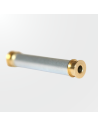
- Suspension springs with damping function: The most common type in slot suspension kits. They are small metal springs that work in compression and act as the first level of damping.
- Full suspension systems with integrated damper: Some high-end chassis incorporate a suspension set where the damper is part of the moving unit of the axle. They offer greater travel and control.
- Technical foams and viscoelastic materials: In more specific applications, soft materials are used that act as elastic stops or secondary dampers to limit bounce without adding mechanical complexity.
- Side or longitudinal mounted dampers: Depending on the chassis design, the damper may work on different axes of movement. Knowing your chassis geometry is essential to determine which type fits best.
In general, leading manufacturers like NSR, Scaleauto, or Slot.it develop their own damping suspension systems specifically designed for their chassis, ensuring compatibility and expected behaviour. Avant Slot also offers solutions for their models, both in standard versions and those aimed at tuning.
Technical aspects we should know
To make the most of a damping system, it is important to have a clear understanding of some technical concepts:
Centre of gravity and damping
The height of the car's centre of gravity directly influences how the suspension responds. A car with inline mounting — motor in line with the rear axle, lower — has a lower centre of gravity than one with sidewinder mounting, and this changes the dynamics of the damping. The anglewinder is positioned at an intermediate point. Adjusting the damping hardness without considering the height of the centre of gravity can lead to counterproductive results.
Preload and ride height
Preload is the initial tension with which the spring or damper operates at rest. A higher preload raises the car and reduces the available travel; a lower preload lowers it and increases the travel. The ride height of the chassis relative to the track is a setup parameter as important as the hardness of the damper.
Interaction with the tyres
A damper that is too stiff can prevent the tyre from working properly on the track, reducing the effective contact surface. Conversely, one that is excessively soft can cause excessive roll that compromises stability. The goal is to find the balance that maximises contact without sacrificing predictability.
Total weight of the car
Optimal damping also depends on the weight of the car. A heavier car generally requires firmer damping to avoid sinking in corners. If you add ballast to adjust the balance, check if it is necessary to readjust the hardness of the damper as well.
Practical tips for use, maintenance, and preparation
- Clean the anchor points before mounting: Any residue of old lubricant, dirt, or manufacturing burrs can affect the free movement of the damper. Use an appropriate cleaner and ensure that the surfaces are clean before mounting.
- Do not over-lubricate: Slot dampers operate with very tight tolerances. Excess lubricant can attract dirt and block movement. Use specific slot lubricants in minimal amounts.
- Regularly check the free travel: With use, the anchor points may wear out or the springs may lose tension. Periodically verify that the damper has the correct travel and that there are no excessive play.
- Adjust during testing sessions, not during races: Any change in damping should be tested with reference laps before competing. What works on one circuit may not work on another.
- Record your setups: If you compete regularly, keeping a record of the configurations that work on each track is a practice that saves time and avoids repeating mistakes.
Common mistakes to avoid
Installing incompatible dampers
One of the most common mistakes is trying to install a damper from one manufacturer on the chassis of another without checking compatibility. The dimensions of the anchors, the diameter of the spring, and the movement geometry may be incompatible even if they visually appear similar. Always check the exact reference.
Ignoring the rest of the setup
Adding a damper without reviewing the rest of the setup — guide height, braid tension, tyre hardness — may not yield the expected result. Damping works in conjunction with all other parameters of the car.
Over-adjusting without reference
Changing several parameters at once without a reference lap between changes makes it impossible to know which modification has improved or worsened the behaviour. Change one at a time and take lap times.
Neglecting maintenance
A damper blocked by dirt or corrosion is worse than having no damping at all. If you cannot perform the minimum maintenance, it is better to opt for a chassis without active suspension until you can dedicate the necessary time.
Recommendations for beginners and advanced users
If you are just starting
If you are new to slot racing and are still getting to know your car and track, it is not essential to incorporate dampers from day one. Many reference cars perform excellently without active suspension, and learning to drive well is more decisive than the setup. Once you have a consistent driving level and start to notice the limitations of the car on certain sections of the track, it will be time to explore damping.
At that point, it is advisable to start with a complete suspension kit from the same manufacturer as your chassis — NSR, Slot.it, Scaleauto, or Avant Slot depending on the case — and follow the assembly instructions to the letter before starting to modify parameters.
If you already have experience
For experienced competitive drivers, dampers are another tuning tool within the overall setup. At this level, it is worth experimenting with different hardnesses, different preloads, and different combinations with the other components. The goal is not only to improve lap times but to achieve a predictable and consistent car throughout the race duration, not just in the first laps with cold tyres.
Advanced drivers can also explore custom solutions: springs of different hardnesses, alternative materials for stops, or modifications to anchor points to change the suspension geometry. In this field, informed experimentation and bench work are your best tools.
| User Profile |
Recommendation |
Reference Brands |
| Beginner / Hobbyist |
Suspension kit from the same manufacturer as the chassis, medium hardness |
NSR, Scaleauto, Slot.it |
| Club Driver / Amateur Competition |
Hardness adjustment according to track, keep a record of setups |
NSR, Slot.it, Avant Slot |
| Advanced Competition |
Experimentation with hardness, geometry, and combinations with ballast and tyres |
NSR, Slot.it, Scaleauto |
Frequently Asked Questions about Slot Dampers
Do all slot cars need dampers?
No. Many slot cars operate with rigid chassis or floating suspension without active dampers. Dampers are mainly relevant in chassis with suspension designed to accommodate them, or in specific competition setups.
Is any damper compatible with any chassis?
No, compatibility is specific. Each manufacturer designs their suspension systems with their own dimensions. Always verify the exact reference of the damper before purchasing.
What is the difference between a suspension spring and a damper?
The spring stores and releases energy (compression and extension), while the damper dissipates that energy by controlling the speed of movement. In slot racing, many systems combine both functions into a single component or work in tandem.
Is it worth installing dampers on a home track car?
It depends on the track and the level of demand. On home tracks with few sections and little elevation change, the benefit is less. On more elaborate circuits or those with elevation changes, the improvement in stability is noticeable.
How do I know if my damper is properly adjusted?
A good adjustment translates to a car that maintains contact with the track over elevation changes without visible bouncing, with consistent lap times and without erratic behaviour in corners. If the car bounces or feels unstable, the damping may be too soft; if it feels stiff and loses traction on imperfections, it may be too hard.
Can I mix dampers from different manufacturers on the same car?
Technically it is possible if the dimensions are compatible, but it is not recommended without prior experience. Each manufacturer calibrates their suspension components to work together, and mixing parts from different sources can yield unpredictable results.
How often should I check the dampers?
In regular club or competition use, a check every few race sessions is sufficient. Check the free travel, the condition of the springs, and the cleanliness of the anchors.
Do dampers affect tyre wear?
Yes, indirectly. A well-adjusted damping system promotes more even tyre wear because it maintains better contact and avoids abrupt sliding. Inadequate damping can accelerate wear in specific areas of the tyre.
What should I do if the damper does not move freely after mounting it?
First, check for any mechanical interference in the mounting or burrs on the anchors. Also, verify that you have not applied too much lubricant, which may have attracted dirt and blocked movement. If the problem persists, the component may have a manufacturing defect.
Are dampers legal in official competition?
It depends on the regulations of each championship. Some allow free suspension modifications, others limit them to OEM components, or prohibit them outright. Always consult the technical regulations of the category before preparing the car.