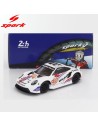
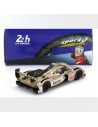
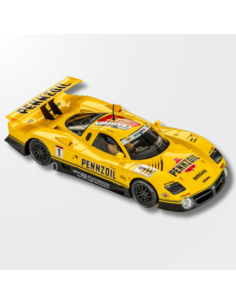
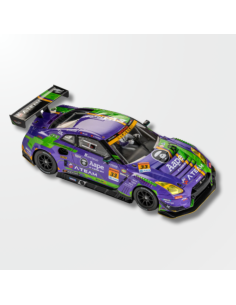
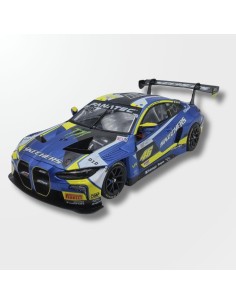
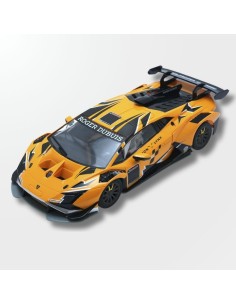
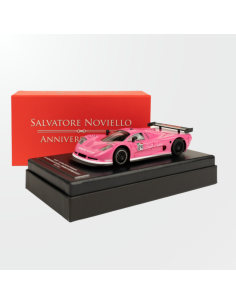
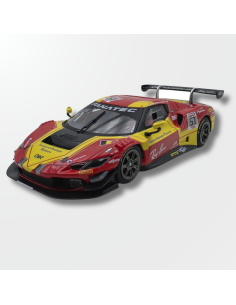
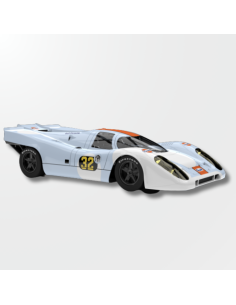
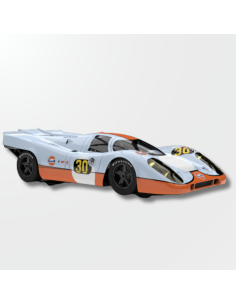
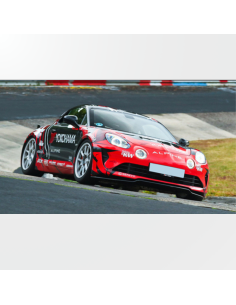
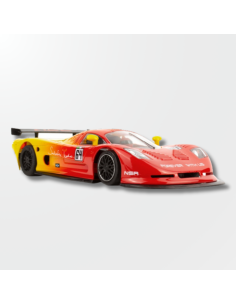
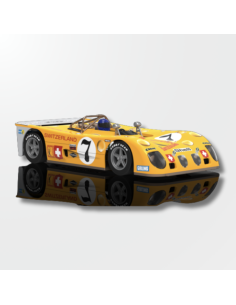
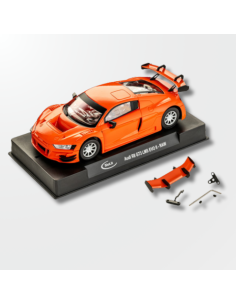
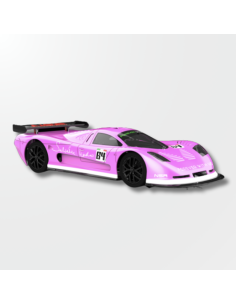
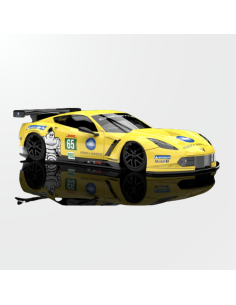
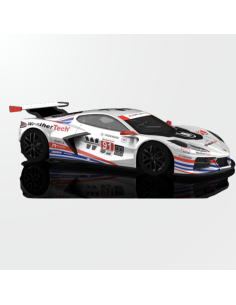
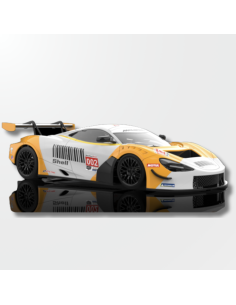
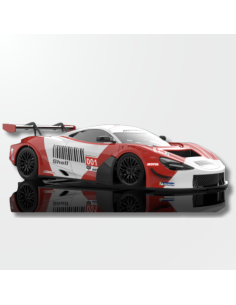
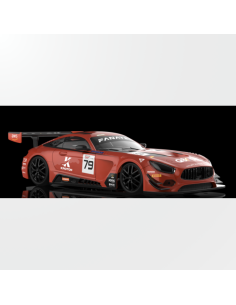
There are cars that perfectly summarise what modern motorsport means: brutal speed, cutting-edge technology, and breathtaking aesthetics. Modern GTs —those Gran Turismo that compete in the GT World Challenge, the 24 Hours of Le Mans, IMSA, or DTM— are precisely that. And in the world of slot racing, reproducing those same cars in scale is one of the most rewarding experiences there is, whether you are looking to compete in a championship or simply want to have a faithful replica of the Ferrari 296 GT3 or the Porsche 911 GT3 R that you saw at Spa last weekend.
In this category, you will find slot cars that replicate the most iconic GTs of the modern era: from the McLaren 720S GT3 to the Lamborghini Huracán GT3, including the BMW M4 GT3, Audi R8 LMS, Mercedes AMG GT3, or Ford Mustang GT3. These models combine collectible detail with real competition performance, manufactured by brands such as NSR, Slot.it, Avant Slot, or Scaleauto, which perfectly understand what a serious enthusiast needs.
Whether you are a regular racer at club events or a collector of miniatures that reflect the motorsport of your era, modern GTs in slot have something special: they are living cars, still racing out there, evolving season by season, and their scale replicas capture that energy in a way that few other segments can achieve.
Next, we will tell you everything you need to know to make the right choice, understand the differences between models, and get the most out of them on track or on display.
What are Modern GTs in slot and why do they generate so much passion
The term GT (Gran Turismo) encompasses a family of high-performance road cars adapted for competition, which maintain a direct relationship with their production versions. Unlike pure prototypes (LMP, Hypercar), GTs retain the silhouette of the original car: if you see a Ferrari 296 GT3 on track, you immediately recognise it as an evolved street Ferrari.
Currently, the most followed GT championships are the GT World Challenge Europe (formerly Blancpain), the GTE and LMGT3 categories of the WEC, the IMSA WeatherTech Sports Car Championship in North America, and national series such as the GT4 European Series or the Spanish GT Championship. The variety of brands and teams is enormous, which directly translates into a rich offering of slot models as well.
In slot, modern GTs are predominantly manufactured in 1/32 scale and represent one of the most active segments of the market. Manufacturers regularly update their catalogues to incorporate the latest technical specifications of each model —changes in aerodynamics, current team liveries— which makes these cars valuable objects for both the driver and the collector.
The passion they generate has a simple explanation: they are cars we see every weekend on television or live, with which we emotionally identify, and being able to reproduce those same battles on a slot track has an appeal that transcends mere modelling hobby.
How to correctly choose a Modern GT in slot
Before you rush to buy, it is advisable to have clear criteria that mark the difference between a good purchase and one that ends up generating frustrations:
1. Define what you are going to use it for
Club competition: Here, performance is key. You need a car with a rigid or semi-flexible chassis according to the regulations, a well-balanced motor, good contact braids, and grippy tyres. Brands like NSR or Slot.it are references in this area.
Collection and display: The level of detail, fidelity of the livery, and finishes are the priority. Avant Slot and Scaleauto excel here, with some resin models that achieve a level of detail that is hard to surpass.
Mixed use: The most common scenario. You want a car that runs well on track but also looks good on the shelf. Most mid-high range modern GTs fulfill this dual role without issue.
2. Check compatibility with your track
This is one of the points that generates the most confusion. Not all slot cars are compatible with all tracks. There are two main systems:
- Universal track: Used by Scalextric and Ninco. The car's guide fits into a wider slot.
- Sport track: Used by Scaleauto and Slot.it. The guide fits into a narrower slot.
Many models come with an interchangeable guide or come with adapters, but it is advisable to verify this before purchasing. If you have doubts, consult us: we have been helping enthusiasts avoid incompatibilities between brands like Scalextric, Scaleauto, Ninco, or Carrera for years.
3. Pay attention to the motorisation
The type of motor mounting directly influences the car's behaviour on track:
- Sidewinder: Motor parallel to the rear axle. Very common in modern GTs. Offers a good balance between traction and handling.
- Inline: Motor in line with the rear axle, more longitudinal. Lowers the centre of gravity and usually provides greater stability in corners.
- Anglewinder: Motor at an angle. Combines characteristics of the two previous types and is common in high-level competition cars.
4. Scale and dimensions
The vast majority of modern GTs in slot are manufactured in 1/32, the dominant scale in the hobby. There are also versions in 1/24 —larger, with greater detail— for specific tracks and enthusiasts with enough space. If you are starting out, 1/32 is the most versatile option.
Types and main differences between Modern GTs in slot
Within modern GTs, there are different categories that are worth distinguishing, both in real competition and in their slot replicas:
GT3
This is the premier category of production GTs. GT3s are high-performance cars homologated by the FIA, developed by manufacturers for customer teams. Ferrari, Porsche, McLaren, Lamborghini, BMW, Audi, Mercedes, or Ford have their own GT3s. In slot, they are the most abundant models and the ones with the most variety of liveries.
GT4
A step below in performance and cost, but equally exciting. The GT4 seeks equality among brands and is the entry point to professional GT motorsport. In slot, there is a more limited offering than in GT3, but brands like Scaleauto or Avant Slot have interesting representatives.
GTE / LMGT3
The cars that compete (or competed, in the case of GTE) in the WEC alongside the Hypercars. The slot replicas of these models are usually very detailed and are aimed at both competition and collection.
Resin versions vs. injected plastic
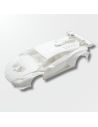
Some modern GTs are produced in resin, allowing for greater fidelity in complex shapes and more refined finishes. Avant Slot is one of the few brands that manufactures in resin on an industrial scale with consistent quality guarantees. Injected plastic cars are more common and tend to be more affordable, with excellent results from brands like NSR or Slot.it.
Technical aspects we should know
If you want to get the most out of a modern GT in slot, there are some technical concepts that are worth mastering:
Chassis and flexibility
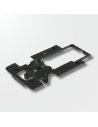
The behaviour on track largely depends on the chassis. Rigid chassis offer more precision on technical circuits; semi-flexible ones better absorb track irregularities and are more tolerant in fast corners. Many modern GTs allow for rigidity adjustment via screws or clips.
Tyres and wheels
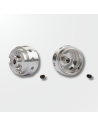
Silicone tyres offer more grip but wear out faster. Polyurethane tyres last longer and are more consistent. Width and hardness influence the car's response. Brands like NSR or Slot.it have a wide catalogue of replacement tyres for their models.
Braid
These are the elements that collect current from the track and transmit it to the motor. Good condition braids are essential for clean, uninterrupted driving. Check them regularly and replace them when you notice a loss of contact.
Guide
The guide keeps the car on the track. Its angle, depth, and material affect behaviour in corners. Some guides are rotating (magnet guide), which improves response in chicanes and tight corners.
Motor and gear ratio
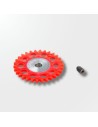
The combination of crown gear and pinion determines the gear ratio. A shorter ratio provides better acceleration; a longer one, higher top speed. In a modern GT aimed at competition, fine-tuning this ratio according to the circuit layout can make a difference.
Practical tips for use, maintenance, and preparation
- Initial run-in: New motors need a progressive run-in. Start at medium speed for the first few minutes before pushing to the max.
- Track cleaning: A dirty track transmits current poorly. Clean the rails regularly to avoid cuts and power losses.
- Lubrication: Apply specific lubricant to the axles, gears, and bearings. Never excessively: excess lubricant attracts dust and dirties the tyres.
- Braid check: Before each session, check that they make good contact. If they are deformed or worn, replace them.
- Weight and balance: Some enthusiasts add ballast to improve stability, especially on circuits with fast corners. Experiment with small amounts until you find the optimal point.
- Storage: Store cars in boxes or display cases protected from dust and direct light. Silicone tyres can deform if they rest in the same spot for too long.
Common mistakes to avoid
Buying without checking compatibility
Mixing cars and tracks from different systems without researching is one of the most common mistakes among newcomers. A car calibrated for sport track may not perform correctly on a universal track, and vice versa. Always check specifications before buying.
Confusing types of motorisation
Sidewinder, inline, and anglewinder are not interchangeable terms. Each mounting has a different behaviour on track, and choosing one or the other according to championship regulations or track type is important. If you have doubts, we can help clarify which is suitable for your case.
Neglecting maintenance
A poorly maintained car not only performs worse: it can be permanently damaged. Worn braids, dirty tyres, or lack of lubrication are the most common culprits of erratic behaviour on track.
Obsessing over motor power
More power does not always mean more speed in a race. A motor that is too powerful for the layout can be unmanageable. The balance between motor, tyres, guide, and chassis is what truly makes a car fast.
Ignoring the gear ratio
Crown gear and pinion are as important as the motor. Don’t neglect them when preparing the car for a specific circuit.
Recommendations for beginners and advanced users
If you are starting with Modern GTs in slot
Opt for a model from a well-established brand —NSR, Slot.it, or Scalextric— that offers good factory performance without the need for many adjustments. RTR (Ready to Race) kits are ready to run from the get-go. Ensure it is compatible with your track and start familiarising yourself with basic maintenance before diving into tuning.
As for the specific car, choose a livery that motivates you: if you are passionate about the Ferrari or Porsche you saw win at Spa, that enthusiasm shows when you drive and when you take care of the car.
If you already have experience
Modern GTs offer a wide margin for preparation: motor change, adjustment of gear ratios, tyre selection, guide modification, addition of ballast. Brands like NSR or Scaleauto have very comprehensive spare parts catalogues that allow you to customise the car to real competition levels.
If you are looking for maximum detail for collection, explore the resin versions from Avant Slot: the level of finish justifies the investment for those who appreciate fidelity to the original model.
| GT Category |
Real Reference |
Presence in slot |
User Profile |
| GT3 |
Ferrari 296 GT3, Porsche 911 GT3 R, McLaren 720S GT3 |
Very high (NSR, Slot.it, Scaleauto, Avant Slot) |
Club racer and collector |
| GT4 |
Porsche 718 Cayman GT4, BMW M4 GT4 |
Medium (Scaleauto, Avant Slot) |
Enthusiast looking for variety |
| GTE / LMGT3 |
Ferrari AF Corse, Porsche Penske Motorsport |
Medium-high (NSR, Slot.it) |
Collector and championship racer |
Frequently asked questions about Modern GTs in slot
What is the difference between a GT3 and a GT4 in slot?
In real competition, the GT3 is faster and more expensive to develop; the GT4 is designed to equalise brands and reduce costs. In slot, the difference is mainly aesthetic and in model availability: there are many more GT3s in the catalogue.
Are all modern GTs compatible with any circuit?
No. It depends on the track system (universal or sport) and the car manufacturer. Always check compatibility before buying or consult us.
What is the most common scale in modern slot GTs?
1/32, by far. It is the standard scale of the hobby and offers the greatest variety of models, tracks, and spare parts.
Which brands manufacture the best modern GTs in slot?
NSR and Slot.it are references for competition. Avant Slot and Scaleauto excel in detail and finishes. Scalextric has more accessible options for beginners.
Can I use a modern collection GT for competition?
It depends on the model. Some are more collection-oriented, but many modern GTs from Slot.it or NSR are perfectly valid for championships if properly adjusted.
What type of motorisation is most common in modern GTs?
The sidewinder (motor parallel to the rear axle) is the most frequent. Some models incorporate anglewinder mounting to improve behaviour on technical circuits.
How often should I change the braids?
It depends on usage. In intense competition sessions, it is advisable to check them after each race. For recreational use, a monthly check is usually sufficient. Replace them as soon as you notice a loss of contact or deformation.
Are resin cars better than injected plastic ones?
Not necessarily better, but different. Resin allows for greater fidelity in complex shapes, but does not imply better performance on track. For collection, resin usually makes a difference in detail and finish.
What livery should I choose if I want a modern GT for competition?
The livery does not affect performance, so choose the one that motivates you the most. However, some championships have restrictions on homologated models: inform yourself before investing in preparation.
Can I mix spare parts from different brands in a modern slot GT?
In general, yes, although you need to check compatibility of measurements (axle diameter, crown and pinion size, type of guide). NSR, Slot.it, and Scaleauto have extensive and well-documented spare parts catalogues.
How much does a quality modern slot GT cost on average?
Models from brands like NSR or Slot.it usually range between €50 and €90. Resin versions from Avant Slot or special editions can exceed that figure. For beginners, Scalextric offers more affordable options.
Where can I find personalised advice to choose my modern GT?
At Ministry of Hobby, we have slot enthusiasts with years of experience who can guide you according to your track, level, and preferences. Consult us without obligation.