When we talk about 1/24 scale in the slot world, we are referring to a category with its own personality. It is not the most widespread scale in home circuits — that role is occupied by 1/32 — but among more experienced enthusiasts and in wooden competition circuits, 1/24 enjoys a solid and well-earned reputation. The cars are notably larger, the chassis more complex, the electronics more accessible, and the scope for preparation and adjustment considerably greater. If you have been in the hobby for a while and want to make a technical leap, or if you are directly starting in wooden track competition, 1/24 is a scale that deserves your full attention.
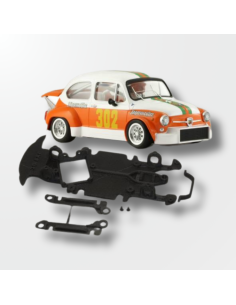
The chassis is the heart of the car in this scale. Unlike 1/32 models where the chassis comes integrated from the factory and the possibilities for modification are more limited, in 1/24 it is common to work with independent chassis that are assembled, adjusted, and custom prepared. This opens up a world of possibilities for enthusiasts who enjoy both building and driving. Choosing the right chassis directly affects performance on track, cornering stability, acceleration response, and the lifespan of components.
In this section, you will find a selection of 1/24 chassis designed to cover different profiles: from the enthusiast building their first car in this scale to the regular championship driver looking to optimise every detail. We have paid special attention to compatibility with the most commonly used motors and components in this scale, as well as the origin and quality of materials. There is no filler here: every reference you will find has a reason.
What is a 1/24 chassis and why is it so important
The chassis is the base structure of the slot car: the motor, axles, wheels, guide, braids, electronics, and finally, the body are mounted on it. In 1/24 scale, this structure takes on dimensions that allow for a level of mechanical precision that is difficult to achieve in smaller scales.
A well-designed chassis serves multiple functions at once: it maintains the correct geometry of the axles, optimally distributes weight, facilitates access for maintenance, and allows for adjustments of key parameters such as ride height, guide tension, or motor position. In 1/24, all these adjustments have a direct and measurable impact on the car's behaviour on the track.
Unlike smaller scales, in 1/24 it is common for the chassis to be a component that is purchased, prepared, and assembled separately, not an integrated and immovable element. This makes the chassis a piece of real technical prominence, not merely structural. Knowing how to choose it is the first step to building a competitive car.
How to correctly choose a 1/24 chassis
Before deciding on a specific chassis, it is advisable to clarify several factors:
- Track type: 1/24 chassis are primarily designed for wooden tracks, where grip and the flat geometry of the circuit allow for maximum exploitation of their characteristics. If you have a plastic track at home, make sure to check compatibility before purchasing.
- Motorisation: The type of motor mounting (sidewinder, inline, or anglewinder) directly affects which chassis is compatible. Not all chassis accept any configuration. Always check the specifications before combining components.
- Body: The chassis must be compatible with the body you intend to mount. In 1/24, there are different standards for mounting and wheelbase; an incorrect combination may cause the body not to fit or to be poorly proportioned.
- Material: Chassis in this scale can be made of technical plastic, aluminium, or fibre. Each material has implications for rigidity, weight, and adjustability. Aluminium is popular in competition for its precision, while quality plastic offers a more economical option suitable for beginners.
- Level of preparation: If you are looking for a chassis ready to run with little work, look for models with factory-adjusted tolerances. If you prefer to prepare it yourself, consider those that offer greater customisation margins.
There is no perfect chassis for all scenarios: the best is the one that fits your motor, your body, and your driving style.
Main types and differences
Within 1/24 chassis, several typologies coexist that respond to different construction and usage philosophies:
Sidewinder chassis
The motor is mounted parallel to the rear axle (transverse position). This is the most common configuration in 1/24 wooden track competition. It offers a direct and efficient transmission, with a favourable weight distribution towards the rear axle. It is the preferred mounting in most championships of this scale.
Inline chassis
The motor is placed perpendicular to the rear axle, in line with the car's longitudinal axis. This position lowers the centre of gravity and can improve stability under certain track conditions, although the transmission requires an additional angle. Less common in 1/24 than the sidewinder, but it has loyal followers.
Anglewinder chassis
The motor is positioned at an angle to the rear axle. It is an intermediate solution that combines advantages from the two previous mountings: slightly more compact than the inline and a different transmission geometry than the sidewinder. Its presence in 1/24 is more minority, although there are interesting proposals.
Open vs. closed chassis
Some chassis have an open design (like a "cage" or profiled) that facilitates access to the motor, axles, and adjustments. Closed chassis offer more structural rigidity. The choice between one and the other depends on whether you prioritise ease of maintenance or rigidity on track.
Technical aspects we need to know
Working with 1/24 chassis involves familiarising yourself with a series of technical concepts that go beyond simple assembly:
- Wheelbase: The distance between the front and rear axles directly affects the car's stability and cornering behaviour. A longer wheelbase provides more stability; a shorter one, more agility.
- Track width: The distance between the two wheels on the same axle. A wider track improves lateral stability.
- Ride height: The distance between the chassis and the track surface. Too high penalises the centre of gravity; too low can cause unwanted rubbing.
- Front axle float: In many 1/24 chassis, the front axle is designed to float slightly, allowing the car to adapt to the irregularities of the wooden track without losing rear traction.
- Braid and guide compatibility: Check that the chassis accepts the size of guide and braids you intend to use. Poor electrical contact can ruin performance even if the rest of the assembly is impeccable.
- Torque and gearing: The ratio between pinion and crown must be well calculated according to the motor you mount. A chassis that facilitates quick changes of this ratio is an advantage in competition.
Practical tips for use, maintenance, and preparation
A well-maintained 1/24 chassis lasts a long time and performs consistently. Some habits that make a difference:
- Regular cleaning of braids and track: Accumulated dirt on the braids is one of the most common causes of poor contact and power loss. Clean it frequently, especially after long sessions.
- Controlled lubrication: Apply lubricant to the axle bearings and the crown/pinion, but in moderation. Excess attracts dirt and can deteriorate the tyres.
- Checking axle parallelism: Twisted axles generate unnecessary friction and asymmetric tyre wear. Check it periodically with a flat reference surface.
- Verification of chassis seating: On wooden tracks, ensure that the chassis sits well on all four wheels. If one wheel lifts, the car will be unstable.
- Guide and spring: Regularly check the guide spring. A fatigued spring reduces the tracking ability of the rail and increases derailments.
- Post-race inspection: After a competition session, disassemble the motor, check the condition of the crown and pinion, and ensure there are no play in the axles. Small problems detected in time prevent larger breakages.
Common mistakes we should avoid
Some of the most common mistakes when working with 1/24 chassis have easy solutions if known in advance:
- Combining incompatible components: Not all motors, pinions, and crowns are interchangeable between brands. Reviewing the technical sheets before assembly avoids disappointments.
- Ignoring compatibility with the body: A chassis can be technically excellent and still not fit well with the chosen body. Always check wheelbase and mounting points before purchasing.
- Over-adjusting without measuring: Adjusting ride height or axle float by eye without using metric references leads to inconsistent results. Invest in a small measuring tool; in 1/24, tenths of a millimetre matter.
- Over-tightening motor mounting screws: This can deform the chassis or create tensions that affect the alignment of the motor with the rear axle.
- Not testing on track before competing: A perfectly assembled car on the table may behave differently on the track. Always run and adjust before a race.
- Neglecting the condition of the tyres: In 1/24, the tyres directly interact with the performance of the chassis. A worn or uneven tyre nullifies the virtues of a good assembly.
Recommendations for beginners and advanced users
If you are starting in 1/24
The most important thing is not to complicate things too much at first. Choose a chassis with a good reputation in the community, compatible with commonly used motors and bodies, and with available documentation. A quality technical plastic chassis is an excellent entry point: it allows you to learn the assembly process without a high investment and gives you room to make mistakes and correct them. Before investing in aluminium variants or more complex configurations, it is advisable to master the fundamentals of assembly and basic adjustments.
If you already have experience
At advanced levels, the choice of chassis is usually dictated by the regulations of the championship you compete in and the common bodies in your category. Machined aluminium chassis offer greater dimensional precision and better fine-tuning possibilities. At this level, it is worth experimenting with different gear ratios, ride heights, and axle configurations to find the optimal setup for each track. Keeping a record of the adjustments made and their effect on lap times is a common practice among the most competitive drivers.
| Feature |
Technical plastic chassis |
Aluminium chassis |
| Weight |
Light |
Variable (can be heavier) |
| Dimensional precision |
Good |
Very high |
| Adjustment margin |
Moderate |
High |
| Price |
More economical |
Higher investment |
| User profile |
Beginners and regular use |
Competition and advanced preparation |
| Ease of assembly |
High |
Requires more knowledge |
Frequently asked questions about 1/24 chassis
Are 1/24 chassis compatible with home plastic tracks?
In general, 1/24 chassis are designed for wooden tracks. Some may work on plastic tracks (like those from Scalextric or Carrera), but ride height, guide, and wheelbase are not always compatible. Always check the specifications before attempting it.
What is the difference between a sidewinder and an inline chassis in 1/24?
In the sidewinder, the motor is parallel to the rear axle (transverse), which facilitates a direct transmission and a favourable weight distribution. In the inline, the motor is perpendicular to the rear axle (longitudinal), lowering the centre of gravity. In 1/24 competition, the sidewinder is the predominant configuration.
Can I mount any motor on any 1/24 chassis?
No. Each chassis has a specific motorisation configuration (sidewinder, inline, or anglewinder) and a specific motor housing size. Always check that the motor you intend to use is compatible with the chosen chassis.
What is front axle float and why does it matter?
It is the front axle's ability to move slightly vertically to adapt to the irregularities of the track. On wooden tracks, where there may be small level variations, a floating front axle helps maintain rear traction and prevents the car from lifting on one side.
How often should I check the chassis?
After each competition session, a quick check is recommended: condition of braids, guide, axle alignment, and play. A more thorough check (disassembly and cleaning of the motor, inspection of crown and pinion) can be done every few sessions or when you notice changes in the car's behaviour.
Which bodies are compatible with the 1/24 chassis in this section?
It depends on each chassis. The key parameters are wheelbase and body mounting points. Always consult the technical sheet of the chassis and the body you want to combine to ensure they are compatible.
Is it difficult to assemble a 1/24 chassis from scratch?
For someone without prior experience, it can be a challenge, but it is completely within the reach of any enthusiast with patience and good references. There is a lot of documentation in the community and in specialised forums. Starting with a quality technical plastic chassis facilitates learning before moving on to more complex assemblies.
What lubricant should I use on the axles and transmission?
The most common in 1/24 is to use specific slot lubricants on the axle bearings, and grease for the crown and pinion. The amount should be minimal: just enough to reduce friction without attracting dirt or contaminating the tyres.
Does the chassis affect the car's electrical consumption?
Indirectly, yes. A well-aligned chassis, with parallel axles and no rubbing, allows the motor to work more efficiently. A poorly assembled chassis can increase the load on the motor and reduce its lifespan.
Can I use a 1/24 chassis for collection or is it only for competition?
1/24 chassis are primarily oriented towards competition and active assembly. If your goal is purely collector-oriented, it is common to work with complete 1/24 scale diecast or resin cars, not with independent chassis.