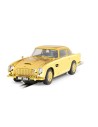
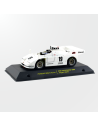
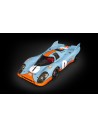
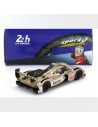
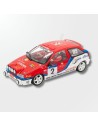
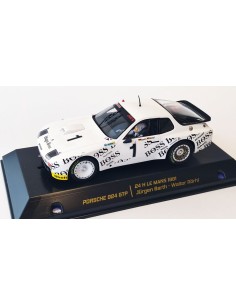
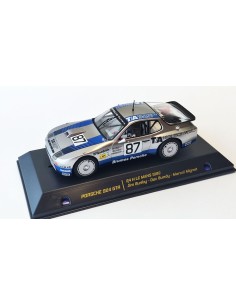
There are times in motorsport that are unforgettable. The 1980s and 1990s at the 24 Hours of Le Mans represent one of the most exciting chapters in motorsport history: the explosion of Group C, the rivalry between brands, the liveries that are now visual icons, and a speed that left the world speechless for years. For many slot and diecast enthusiasts, this period is the benchmark, defining what a true racing car means.
In this category, you will find slot cars and collectible miniatures that were the stars of those two decades on the legendary Sarthe track. From the first Group C cars that began to dominate in the early eighties to the GTs and prototypes that filled the grids in the nineties, passing through the most recognizable liveries in the paddock: Gulf, Silk Cut, Rothmans, Marlboro, Peugeot, Toyota, Jaguar, Porsche, Mercedes, McLaren… names and colours that any fan recognizes at first glance.
If you have that mental image of the Porsche 956 crossing the Maison Blanche curves at night, or the Jaguar XJR-9 in the rain on the Hunaudières straight, or the Peugeot 905 redefining what a French prototype could do, this section is designed exactly for you. Whether you are a collector looking for a faithful piece to display, or a slot driver wanting to race with the cars that marked a generation, here you will find references crafted with the level of detail that these machines deserve.
The selection we maintain at Ministry of Hobby for this period is not random: we prioritise verified liveries, brands with a commitment to historical accuracy, and references that truly existed on track during those years. No generic approximations.
What defines the Le Mans period of the 80s and 90s
Talking about Le Mans in the eighties means talking about Group C. The regulations introduced in 1982 allowed manufacturers to develop cars with closed bodies and limited fuel consumption, which sparked aerodynamic engineering and opened the door to truly revolutionary machinery. Porsche dominated the first half of the decade with the 956 and 962 C; Jaguar responded with the XJR-9 and XJR-12; Mercedes and Sauber burst onto the scene with the C9; Aston Martin, Nissan, and Toyota also made their mark.
The second half of the nineties brought an important transition: the end of high-consumption Group C cars, the arrival of the GT regulations, and the emergence of new generation prototypes like the McLaren F1 GTR, Ferrari F40 LM, and Porsche 911 GT1. It was a period of enormous technical diversity, with cars of very different designs competing on the same track, making collections from this era particularly rich and varied.
The liveries from these two decades are also some of the most celebrated in the world of modelling and collecting: the blue and orange of Gulf on the Mirage or Porsche, the mauve of the Silk Cut Jaguar, the white and blue of the official Peugeot team, the silver of the Mercedes C9 Sauber, or the combination of the Mazda 787B that won in 1991 are immediately recognisable visual references for any motorsport enthusiast.
How to choose the right model from this era
Before adding a reference to your cart, it is important to be clear about what you want it for: is it for racing on track or for display? Although many models in this category work perfectly in both roles, the focus determines which aspects you should look at first.
For racing on slot
The first thing is to check compatibility with your track system. Most 1/32 slot cars in this category are designed for universal track (compatible with Scalextric and Ninco) or sport track (compatible with Scaleauto and Slot.it). Mixing systems without proper knowledge can lead to guide and driving issues, so always check the model specifications before purchasing.
Also pay attention to the type of motorisation: a sidewinder configuration (parallel to the rear axle) behaves differently from an inline configuration (perpendicular to the axle, in line with the car, with a lower centre of gravity), and in the closed prototypes of this period, both solutions have their advocates. Brands like NSR, Slot.it, or Avant Slot offer options for different driving styles.
For collection or display
Here, the level of detail of the body, the fidelity of the livery, and the quality of the finish are the decisive factors. Resin versions usually offer greater definition in shapes; Avant Slot, for example, is one of the few brands that produces resin cars at an industrial level with very careful finishes. For static collection, 1/18 or 1/43 diecast can also be an option if you are looking for display pieces without the need for electronics.
Always check that the livery corresponds exactly to the car and the year you are looking for: during this time, teams changed sponsors and colour schemes between seasons, and the differences between the winning car of 1988 and that of 1989 can be significant for a discerning collector.
Types of models and main differences
The offering within Le Mans of the 80s and 90s can be organised into several groups according to the regulations to which the original cars belonged:
Group C (1982-1993)
They are the undisputed protagonists of the eighties at Le Mans. Closed bodies, active aerodynamics, turbo or large displacement atmospheric engines. The Porsche 956/962, Jaguar XJR, Mercedes-Sauber C9, Nissan R90, or Toyota 90C are some of the models that have been represented in slot and diecast. These are cars with a lot of aerodynamic surface and characteristic shapes that make them unmistakable.
Transition prototypes (1990s)
After the regulatory change from unlimited consumption Group C cars, cars like the Peugeot 905, Toyota TS010, or Mazda 787B appeared. Then came the new generation LMP (Le Mans Prototype) with stricter regulations that opened the door to the modern era.
GT and Grand Touring (mid-late 90s)
The McLaren F1 GTR, Ferrari F40 LM, Ferrari 333 SP, Porsche 911 GT1, or Mercedes CLK GTR are representatives of an era when high-performance GTs took on a huge role in the overall classification. These are cars with a silhouette more recognisable to the general public, making them particularly popular pieces among collectors.
Technical aspects worth knowing
If your interest is competitive slot racing or preparing these models, there are several relevant technical aspects:
- Scale: Most slot models in this category are 1/32, which is the standard in the hobby and allows for a balanced driving experience. Some collectible models appear in 1/43 or 1/18, aimed exclusively at display.
- Chassis: Closed prototypes from this era usually have flat or semi-flat chassis that allow for good stability in corners. Pay attention to the material of the chassis (plastic, reinforced nylon, or metal in competition versions) to understand the dynamic behaviour.
- Guide: The guide is the element that fits into the track and collects the electrical current through the braids. In competition cars, it is advisable to regularly check its play and condition; a worn guide directly affects driving.
- Braids: These are the contact pieces that conduct current from the track to the motor. In competition models, they are replaced with some frequency; consider compatibility with the track system you use.
- Tyres: Cars in this category typically use rubber tyres in various hardnesses. The soft compound offers more grip but wears out faster; the hard compound lasts longer but requires a higher working temperature. For competition, the choice of compound makes a difference.
Practical usage and maintenance tips
Whether you use these cars on track or have them on display, there are some practices that prolong their lifespan and maintain their appearance:
- Track cleaning: A dirty track is the most common cause of electrical problems. Clean the slot and rails regularly before each session to ensure good contact.
- Braid inspection: Periodically check that they make good contact. If the car hesitates or loses power for no apparent reason, the braids are usually the first suspect.
- Lubrication: Apply specific slot lubricant to the axles and gears sparingly. Excess lubricant attracts dirt and can contaminate the tyres, reducing grip.
- Storage: For collection, avoid direct sunlight exposure, which discolours liveries and deteriorates plastics. A closed display case protects from dust and UV rays.
- Tyres at rest: If you are going to store a car for a long period, remove it from the track and support it on the chassis to prevent the tyres from deforming due to continuous weight.
Common mistakes to avoid
With years of experience serving enthusiasts, we have seen some mistakes that are worth knowing before buying or preparing a model in this category:
- Confusing track systems: Not all slot cars are compatible with all circuits. Before purchasing, confirm whether the model is designed for universal track (Scalextric, Ninco) or sport track (Scaleauto, Slot.it). Mixing without checking can lead to a poor driving experience.
- Searching for liveries without verifying the year: As mentioned, during this time, colour schemes changed from season to season. If you are looking for the winning car from a specific year, check that the reference corresponds exactly to that edition.
- Ignoring scale in diecast: A 1/18 is significantly larger than a 1/43. If you have limited space or want to mix pieces from different brands in the same display case, ensure they are all of the same scale for visual coherence.
- Over-lubricating: More lubricant is not better. Excess lubricant stains the body, contaminates tyres, and attracts dust particles that end up damaging the mechanisms.
- Not checking the guide before competing: A loose or worn guide causes unnecessary derailments. It is a two-minute check that can save a competition session.
Recommendations for beginners and advanced users
If you are starting out
If you have just joined the hobby and this era of Le Mans has captivated you, we recommend starting with a model from brands that offer a good balance between price and performance, such as Scalextric or Ninco, which provide accessible references from this era that are easy to drive. Don’t complicate yourself with preparations until you have logged a few hours and understand the car's behaviour. The important thing at first is to enjoy the model and the driving experience.
For collection, 1/43 diecast is an economical entry point with a good representation of iconic cars from this period; if you want to step up to something more spectacular, 1/18 from leading brands offers a level of detail that is hard to surpass.
If you have experience
For experienced drivers, references from NSR, Slot.it, or Avant Slot in this category offer a technical level that allows for serious preparations: motor changes, braid adjustments, tyre selection by compound and profile, guide play adjustments… These are cars that respond well to tuning and can make real time differences in competition.
For advanced collectors, seeking limited editions, liveries from lesser-known private teams, or uncommon car variants (qualifying versions, prototypes that did not finish the race, test liveries) adds additional interest to the collection and usually appreciates over time.
| Period |
Regulation |
Representative Cars |
Common Use in Slot/Diecast |
| 1982–1987 |
Group C (limited consumption) |
Porsche 956, Lancia LC2, Jaguar XJR-6 |
Collection and display slot |
| 1988–1991 |
Group C (free) |
Porsche 962, Jaguar XJR-9/12, Mercedes C9, Mazda 787B |
Competition slot and collection |
| 1992–1994 |
Transition / new prototypes |
Peugeot 905, Toyota TS010 |
Collection and slot |
| 1995–1999 |
GT and first generation LMP |
McLaren F1 GTR, Ferrari 333 SP, Porsche 911 GT1, Mercedes CLK GTR |
High-end slot and diecast |
Frequently asked questions about Le Mans 80's - 90's
What does Group C mean and why is it so important for Le Mans?
Group C was the technical regulation that governed the World Sport Prototype Championship and the 24 Hours of Le Mans between 1982 and 1993. It limited fuel consumption (in its first stage) and allowed great aerodynamic freedom, which led to some of the most advanced competition cars in history. Almost all the major brands of the time developed a Group C for Le Mans, making that period one of the richest in technical diversity.
What is the most common scale in slot models of this category?
The 1/32 scale is the standard in the slot world and the one you will find in the vast majority of references in this category. It allows for a balanced driving experience and is compatible with the main track systems on the market.
Are slot cars in this category suitable for competition or just for collection?
It depends on the model and the brand. There are references primarily aimed at historical fidelity and collection, and others —especially those from NSR, Slot.it, or Avant Slot— designed with a technical level that makes them perfectly valid for federated competition. Check the specifications of each reference or ask us if you have any doubts.
What is the difference between the Porsche 956 and the 962 C?
The 956 was the original model, with the pedal box in front of the front axle, which was prohibited in the IMSA regulations in the United States. The 962 was the evolution with the pedal box moved back to comply with that rule, with a slightly longer wheelbase. In Europe, the 962 C (with a twin-turbo 2.65-litre engine) was raced alongside the 956. Both are iconic of the first half of the eighties at Le Mans.
Is the Mazda 787B the only Japanese car that won Le Mans?
Yes. The Mazda 787B, with its characteristic four-rotor rotary engine, won the 24 Hours of Le Mans in 1991, being the only Japanese manufacturer to achieve this to date. Its orange and green livery is one of the most recognised in the paddock and one of the most sought-after models by collectors from this period.
What track system do I need to race with these slot cars?
It depends on the specific model. Always check whether the car is designed for universal track (compatible with Scalextric and Ninco) or sport track (compatible with Scaleauto and Slot.it). You will find that information in the product sheet; if you have any doubts, feel free to contact us.
Can I mix slot cars from different brands on the same circuit?
Yes, as long as they are from the same track system. The problem arises when mixing different systems (for example, a universal track car on a sport track circuit) without having checked beforehand. Within the same system, coexistence between brands is common and does not present problems.
Which liveries from this era are the most sought after by collectors?
Among the most in demand are the Gulf on Porsche or Mirage, the Silk Cut Jaguar, the Rothmans Porsche, the Team Peugeot Total 905, the Mercedes-Sauber C9 in silver, and the Mazda 787B in its orange and green livery. Limited editions or specific race numbers from winning editions are especially valued.
What is the difference between a resin slot model and a plastic one?
Resin allows for the reproduction of more complex and thinner shapes with greater fidelity, and usually offers a more detailed finish in areas such as mirrors, air intakes, or diffusers. Injection plastic is more resistant to impacts on track. For pure collection, resin has the advantage in detail; for intensive use on the circuit, plastic withstands incidents better.
Is the reference number or specific edition important when buying?
For discerning collectors, yes. Within the same car model, there can be several editions that represent different racing years, different drivers, or different sponsorship schemes. If you are looking to reproduce a specific car from a specific Le Mans edition, verify that the reference corresponds exactly to that version.
How do I properly preserve a diecast model from this category?
Store it in a closed display case, away from direct sunlight and heat sources. Dust and UV rays are the main enemies of diecast finishes. If the model includes rubber parts (tyres, seals), check them periodically as they tend to degrade over time even if the car is not used.
Is there a difference between models aimed at the European market and those from IMSA?
Yes, and it is relevant for more meticulous collectors. Some cars like the Porsche 962 had specific versions for the IMSA championship in North America (with differences in chassis, engine, and sometimes aerodynamics) compared to the European versions. If you are looking for a specific version, check that the reference clearly specifies which variant it corresponds to.