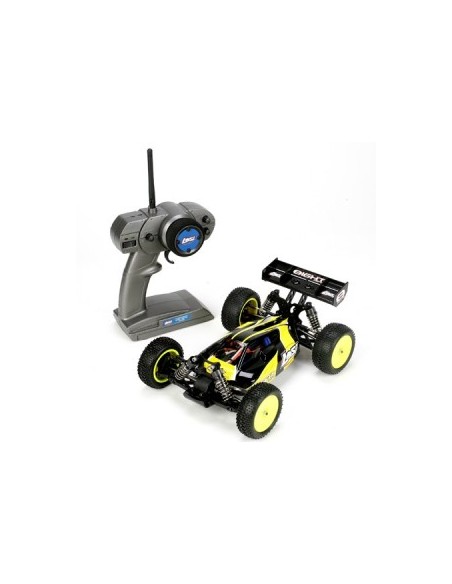
There are brands that need little introduction among radio control enthusiasts. Team Losi is one of them. Since it emerged on the scene in the late 1980s with a groundbreaking technical proposal, its cars have been in the hands of competitive drivers and hobby enthusiasts worldwide. Decades later, that reputation remains intact, supported by a design philosophy where performance and technical innovation are not empty words, but concrete decisions that are felt on the track.
If you have arrived here looking for a buggy, a truggy, a short course, or any other RC model from the Losi range, you are in the right place. At Ministry of Hobby, we work with this brand because we know it well and because we understand that those who seek it usually have a clear idea of what they want: a car that responds, that endures, and that can be tuned. Whether you are a driver with experience or considering your first quality RC, here you will find what you need to make the best decision.
Team Losi is now part of the Horizon Hobby universe, one of the most influential companies in the global RC sector, which ensures access to spare parts, updates, and ongoing support. Its models range from beginner platforms to demanding competition proposals, with scales from 1/18 to 1/5, electric and combustion, and a variety of off-road disciplines that few other brands on the market can match.
Throughout this page, we explain what makes Team Losi special, how to choose the model that best fits your profile, what types of vehicles you will find in its catalog, the technical aspects you should know before buying, and the most common mistakes we see new users make. If you already have experience, we also provide recommendations to get the most out of your car and avoid shortcuts that can be costly in the long run.
What is Team Losi and why is it still a reference
Team Losi was born in California in 1988 with a very specific goal: to bring competition technology to the hobby radio control market. Its first major milestone was the JRX-2, a buggy with independent suspension on all four wheels that redefined what was expected from an RC car at that time. Before Losi, rigid rear suspension was the norm; after Losi, the standard changed forever.
This applied engineering mentality has been the constant of the brand over the years. They have not limited themselves to iterating on known designs: they have bet on proprietary solutions, advanced materials, and suspension geometries that favour stability and ease of adjustment. The result is cars that perform well out of the box and can be seriously tuned if the driver requires it.
The integration into Horizon Hobby has meant, among other things, a more robust global distribution network and better availability of spare parts. For the end user, this translates into peace of mind: buying a Losi is not buying an orphaned car. There is a spare parts catalog, an active community, and accessible technical documentation.
The brand has a strong presence in off-road categories: 1/10 and 1/8 buggies, truggies, short course, and some larger scale models like the legendary 5IVE-T. But it has also invested in more accessible proposals with the Mini range and 1/18 models, designed for those who want to start without sacrificing the build quality that characterises the brand.
How to choose correctly from the Team Losi catalog
The variety of models offered by Team Losi can be overwhelming if you are not clear about what you are looking for. Before deciding on a specific model, it is advisable to ask yourself some basic questions that will greatly influence your choice.
Electric or combustion?
Electric models are easier to maintain, quieter, and more immediate in terms of response. They are the recommended option for most users, especially if there is no prior experience with combustion engines. Models with combustion engines — nitro or gasoline — offer a different, more visceral experience, with longer run times and a mechanics that many enthusiasts find appealing. They require more dedication and knowledge.
What scale do I need?
The scale determines the size, weight, power, and overall cost of the system. A 1/18 or 1/10 is comfortable to transport and roll in more limited spaces. A 1/8 is already a large car, with a lot of power and requires tracks with sufficient space. 1/5 models are a completely different category: cars that impress in size and performance, but demand proportional space, investment, and dedication.
RTR or kit?
RTR (Ready To Run) models come assembled and ready to run with a minimal additional investment in battery and charger. They are the natural entry point for those who do not want to spend hours in the workshop before taking their first lap. Kits, on the other hand, are designed for those who enjoy the assembly process and want to customise from the first screw. Losi offers both options in several of its lines.
Competition or hobby?
Within the Losi catalog, there are models clearly oriented towards competition — with adjustable suspension geometries, competition-grade parts as standard, and broad compatibility with high-performance spare parts — and others designed for recreational use without aspirations for the podium. Knowing which category you are in will help you avoid paying for features you won’t need or, conversely, not falling short if you intend to compete.
Main types and differences in the Team Losi range
The Team Losi catalog is structured into several product lines, each with its own identity and target audience.
Buggies
The buggy is Losi's most iconic model. The low, aerodynamic body, thin-profile wheels, and suspension optimised for dirt tracks make the buggy the reference car in off-road competition categories. The 22 line in 1/10 scale and the 8IGHT models in 1/8 scale are the most established within this segment.
Truggies
The truggy is a hybrid between the buggy and the monster truck: it combines the high body and large wheels of the monster with the platform of a competition buggy. The result is a very versatile car, capable of absorbing uneven terrain with great ease without losing the agility of a buggy. Models like the 8IGHT-T are references in this category.
Short Course
Short course cars replicate the format of off-road truck races, very popular in the United States. They have a characteristic pick-up style body, wide wheels, and a more stable and predictable driving experience than a pure buggy. They are an excellent option for users who are starting in RC without sacrificing dynamism.
Monster Trucks
Losi's monster trucks, such as the LMT (Losi Monster Truck) line, are designed to jump, climb, and roll on practically any surface. They are very robust cars, with long-travel suspension and mechanics designed to withstand impacts. The 1/8 scale is predominant in this range.
Mini range and beginner models
For those who want to start with something more compact in size and price, Losi offers the Mini range, with 1/18 scale models that maintain the brand's build quality but with a much more affordable initial investment. They are perfect for children with prior RC experience or adults who want to explore the brand without excessive commitment.
Technical aspects we should know
Knowing some technical concepts before buying or preparing a Losi avoids surprises and helps to get the most out of the car.
Electronics and transmission system
Losi's electric models mostly use brushless motors, which are more efficient and durable than brushed ones. The motor speed is expressed in KV: the higher the KV, the higher the speed but lower the torque. For off-road use, especially in larger scale models, lower KV values with higher torque are preferable. The ESC must be compatible with the motor in terms of voltage and maximum current.
Batteries: voltage and capacity
1/10 models typically work with 2S or 3S LiPo batteries. 1/8 models can go up to 4S or 6S. Higher voltage means more power, but also greater demands on all components. The capacity (mAh) determines the run time. It is advisable not to exaggerate with the voltage if the car is not prepared for it: standard components have their limits.
Suspension and geometry
One of Losi's historical strengths is the quality of its suspension system. Competition models allow for adjustments to the length of the links, camber angle, and toe to adapt the car's behaviour to different types of tracks. Understanding these parameters makes the difference between a car that runs well and one that runs exceptionally.
Spare parts and compatibilities
Losi maintains a reasonably consistent compatibility policy within its product lines, although not all spare parts are interchangeable between models. Before purchasing replacement or upgrade parts, it is essential to verify the exact model reference. At Ministry of Hobby, we can help you identify the correct spare part if you have doubts.
Practical usage and maintenance tips
A well-maintained RC car lasts much longer and performs better. These are the habits that make a difference in the long run with a Losi.
- Cleaning after each session: dust, dirt, and moisture are the main enemies of bearings and gears. Basic cleaning after each outing significantly extends the car's lifespan.
- Checking screws: vibration and impacts loosen screws faster than it seems. A systematic check before each session prevents loss of parts on the track.
- Differential lubrication: the differential is one of the components that most influences the car's behaviour. Using oil of the correct viscosity and changing it regularly keeps the differential functioning optimally.
- Correct battery charging: charging LiPo batteries with the appropriate profile and not storing them fully charged for long periods extends their lifespan and avoids risks.
- Inspection of the body and suspension: after hard impacts, check links, ball joints, and bolts. A bent or cracked part can subtly but progressively affect performance.
Common mistakes we should avoid
Both in purchasing and usage, there are mistakes that frequently recur among new Team Losi users.
- Choosing the model for aesthetics without considering actual use: a monster truck is not better than a buggy or vice versa; each is optimised for a type of use. Choose based on what you will do with it, not by what looks most impressive in videos.
- Buying incompatible batteries: too high voltage for the ESC or the car's motor can damage components in the first session. Always check the specifications before changing batteries.
- Not breaking in the new car: new models, especially combustion ones, need a break-in period for the components to settle. Skipping this step shortens the motor's lifespan.
- Ignoring the user manual: Losi manuals are quite comprehensive and contain adjustment and maintenance information that is not immediately obvious. Reading it in full before running is not a waste of time.
- Buying generic spare parts without checking compatibility: not all third-party parts are equal in quality or dimensions. In case of doubt, original Losi spare parts are always the safest option.
Recommendations for beginners and advanced users
If you are starting
The Mini range from Team Losi or RTR models in 1/10 scale are the most sensible entry point. They offer a real driving experience, are easy to maintain, and the cost of spare parts is manageable. Before investing in upgrades, it is advisable to run enough hours to understand the car's behaviour well and know what you want to change and why.
Do not rush into high-voltage batteries: start with the manufacturer's standard setup and increase when you master the car. Extra power is useless if it is not controlled.
If you already have experience
The models from the 22 range in 1/10 or the 8IGHT in 1/8 are serious competition platforms that allow for a high level of tuning. The suspension geometry is fully adjustable, access to competition spare parts is broad, and the user community is active both in international forums and local clubs.
If you intend to compete, it is worth reviewing the category regulations before purchasing: some championships have restrictions on electronics, tyres, and other parts that may affect which model or configuration is legal.
| Model Type |
Common Scale |
User Profile |
Main Use |
| Buggy |
1/10, 1/8 |
Intermediate / Advanced |
Off-road Competition |
| Truggy |
1/8 |
Intermediate / Advanced |
Competition and hobby on varied terrain |
| Short Course |
1/10 |
Beginner / Intermediate |
Hobby, initiation to competition |
| Monster Truck |
1/8 |
All levels |
Hobby, uneven terrain, jumps |
| Mini Range |
1/18 |
Beginner |
Initiation, small spaces |
Frequently asked questions about Team Losi
Is Team Losi a good brand to start in RC?
Yes, especially with its RTR models and the Mini range. They offer good build quality, accessible spare parts, and a reasonable learning curve. They are not the cheapest on the market, but the difference in quality and durability is noticeable from the start.
Where are Losi cars manufactured?
Team Losi is part of the Horizon Hobby group. Production is primarily located in Asia, as is the case with the vast majority of RC brands in the sector. Design and engineering remain the responsibility of the brand's team.
Are Losi spare parts compatible between different models?
Compatibility exists within some product lines, but it is not universal. For example, certain parts from the 8IGHT range may be compatible between versions, but they will not be with a model from the 22 range. Always verify the specific reference before purchasing.
What is the difference between a Losi RTR and a kit?
An RTR comes factory assembled and ready to run with a minimal additional investment (battery and charger). A kit comes in parts for the user to assemble from scratch. The kit allows for customisation from the beginning but requires time, tools, and prior knowledge.
What battery does a Losi 1/10 electric need?
It depends on the specific model, but most Losi 1/10 electrics work with 2S (7.4V) or 3S (11.1V) LiPo batteries. Always consult the model specifications to avoid exceeding the limits of the ESC and motor.
Can I use a Losi to compete in official championships?
Yes. Several Losi models are homologated or common in radio control championships. Before registering, check the category regulations, as there may be restrictions on electronics, tyres, or other parts.
How long does it take for a Team Losi order to arrive from Ministry of Hobby?
Delivery times depend on available stock and destination. For specific inquiries about availability and times, you can contact us directly through the store.
What Losi model do you recommend for a 10-year-old child?
The Mini range models in 1/18 scale are the most suitable for starting at that age. They are more manageable, more resistant to impacts, and more economical to maintain than larger scale models.
Are Losi combustion cars difficult to maintain?
They require more dedication than electric ones: carburettor tuning, engine break-in, air filter cleaning, and regular oil changes. They are not impossible to maintain, but it is advisable to have some mechanical experience or a willingness to learn before taking the plunge.
What is the most popular Losi model in competition?
Historically, the 8IGHT line in its buggy and truggy versions has been very common in 1/8 scale championships. In 1/10 scale, the 22 range has a prominent presence in national and international competitions.
Can I upgrade the electronics of a Losi RTR?
Yes. RTR models are designed with standard spaces for receivers, ESCs, and servos, making upgrades easier. Motor, ESC, steering servo, and receiver are the components most frequently replaced when users want to enhance performance.
What differentiates Team Losi from other RC brands on the market?
The combination of history, proven technical innovation, a wide range of models, availability of spare parts, and support from Horizon Hobby is hard to match. It is not the only quality option on the market, but it is one of the most comprehensive and with a well-established track record in competition.