When we talk about adjusting a slot car, the transmission is one of the areas that makes the most difference between a car that runs well and one that truly flies. We are not just referring to changing a crown gear or a pinion because it has broken: we are talking about understanding the gear ratio, choosing the right materials, balancing the rear end, and making the most of the motor we have installed. Whether you are preparing a car for competition or looking to improve performance on a home track, the transmission is the link that connects the power of the motor to the ground. And that connection matters much more than it seems at first glance.
In this category, you will find crown gears, pinions, axles, universal joints, and all the components that are part of the transmission system for 1/32 and 1/24 scale slot cars, with references from brands such as NSR, Slot.it, Avant Slot, and Scaleauto, among others. Each component has its function, its range of application, and its direct influence on the car's behaviour. Below, we break down everything you need to know to make the right choice.
What is the transmission in a slot car and why is it important
The transmission is the set of mechanical parts responsible for transferring the rotational movement from the motor to the drive wheels. In a slot car, this system mainly consists of the pinion (which is attached to the motor shaft), the crown gear (which meshes with the pinion and is attached to the rear axle), and the rear axle itself with its bearings. In some configurations, universal joints or intermediate axles are also involved.
The reason this system is so relevant is simple: even if you change the motor, adjust the electronics, or fit new tyres, if the transmission is not properly sized, none of the above will work as it should. An inappropriate gear ratio can make a powerful motor feel slow on the straight, or a car that could be very manageable in corners feel abrupt and uncontrollable. In other words: the transmission is the translator between theoretical power and actual performance.
Moreover, the quality of the materials directly influences durability and consistency of performance. A worn plastic crown gear or a pinion with excessive play generates efficiency losses and noises that indicate something is wrong. In contrast, a well-adjusted transmission is almost silent and conveys a sense of solidity that is immediately noticeable on the controller.
How to correctly choose the transmission for your slot car
The correct choice of transmission depends on several factors that should be analysed before purchasing. There is no universal combination valid for all cases, but there are clear criteria that help make the right decision.
Gear ratio
The relationship between the number of teeth on the pinion and the number of teeth on the crown gear determines how many turns the wheel makes for each turn of the motor. A longer ratio (larger crown gear relative to the pinion) favours top speed but sacrifices acceleration. A shorter ratio (relatively larger pinion compared to the crown gear) offers more acceleration but limits maximum speed. The type of track is key: tracks with many curves and few long straights benefit from shorter ratios; fast and technical layouts with long straights allow for longer ratios to be exploited.
Compatibility with the motor and chassis
Not all crown gears and pinions are interchangeable. You need to consider the module (tooth pitch measurement, generally module 0.5 for 1/32 slot), the number of teeth available for each reference, and the position of the motor in the chassis (sidewinder, inline, or anglewinder), which determines the type of gearing needed and the axle it operates on.
Material of the components
Pinions and crown gears can be made of technical plastic, nylon, or metal. Plastic and nylon are quieter and smoother, ideal for home use or on delicate surface tracks. Metal offers greater durability and precision, being the preferred option in competition. Some combinations mix a metal pinion with a nylon crown gear to balance durability and smoothness of operation.
Axle diameter and bearings
The rear axle must be compatible with the wheels, the chassis bearings, and the crown gear. The most common diameters in 1/32 are 2.38 mm (3/32") and 3 mm. Always check the chassis specifications before changing any component of the rear end.
Main types and differences
Within what we call transmission in slot, we find several types of components with differentiated functions:
Pinions
The pinion is the small toothed wheel mounted on the motor shaft. Its number of teeth (usually between 9 and 12 in 1/32) is one of the parameters that define the gear ratio. They are available in high-strength plastic, nylon, and metal. NSR and Slot.it offer a wide variety of pinions in different materials and tooth counts.
Crown gears
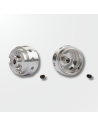
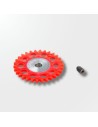
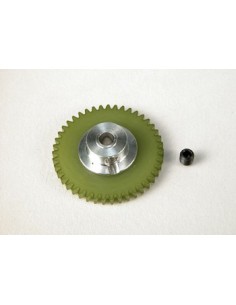
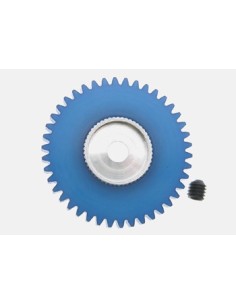
The crown gear is the large toothed wheel that meshes with the pinion and is attached to the rear axle. It can be straight (for inline and anglewinder configurations) or conical (in some special configurations). The number of teeth generally ranges between 27 and 36 in 1/32 scale. Brands like NSR, Slot.it, and Scaleauto offer nylon, AW (anglewinder), and metal crown gears for various applications.
Rear axles
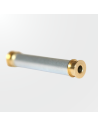
The rear axle is the piece on which the rear wheels, bearings, and crown gear are mounted. They can be standard steel axles or high-precision axles made of hardened steel or aluminium. The straightness of the axle is fundamental: any deviation generates vibrations that negatively affect the car's behaviour.
Bearings
Bearings replace the original plastic bushings in many cars and allow the axle to rotate with minimal friction. The most commonly used in slot are 3/32" ball bearings, available in open or closed (sealed) versions. Quality bearings are one of the best cost-benefit improvements you can make to a slot car.
Universal joints and articulated transmissions
In some competition chassis, especially in front-wheel drive cars or special configurations, universal joints are used that allow the transmission of movement even when there is an angle between the motor shaft and the wheel axles. They are more specialised components but highly valued in advanced setups.
Technical aspects we should know
To get the most out of the transmission, it is advisable to understand some technical concepts that go beyond simply assembling the parts.
The gear module
The module is a measurement that defines the size of the tooth and determines compatibility between pinion and crown gear. In 1/32 scale, the standard is module 0.5. It is essential that the pinion and crown gear are of the same module for them to mesh correctly. Mixing different modules causes accelerated wear and loss of efficiency.
Axial and radial play
Play is the free space between parts. Excessive play between the pinion and crown gear generates noise, wear, and power loss. Insufficient play causes friction, heating, and can block the transmission. The correct adjustment allows the parts to rotate smoothly but without noticeable play.
The alignment of the rear end
A bent axle, misaligned bearings, or an off-centre crown gear cause the car to vibrate, consume more energy, and wear out prematurely. Correct alignment is as important as the choice of components themselves.
Influence of motor type
The position of the motor in the chassis conditions the entire transmission system. In an inline configuration (longitudinal motor, in line with the rear axle), the pinion directly attacks the crown gear without needing to change the angle of attack. In a sidewinder configuration (transverse motor, parallel to the rear axle), the pinion also directly attacks the crown gear but from a lateral position. In an anglewinder configuration, the motor is angled relative to the rear axle, requiring specific crown gears designed to absorb that angle of attack.
Practical tips for use, maintenance, and preparation
- Regularly clean the transmission: tyre dust and accumulated lubricant residues degrade the gearing. Periodic cleaning with a dry brush and, if necessary, with a specific cleaner keeps the transmission in optimal condition.
- Lubricate wisely: apply a minimal amount of lubricant (a drop is sufficient) directly onto the gearing. Excess lubricant attracts dirt and can contaminate the tyres, reducing grip. Use specific slot lubricants, not household oils.
- Check the gear play before each competition session: a gear that was working well may lose adjustment after several intensive use sessions. Take a moment to check it before serious running.
- Inspect the condition of the bearings: if you notice that the axle does not rotate smoothly or hear strange noises, it is likely that a bearing is dirty or damaged. Bearings are low-cost components whose replacement can transform the car's behaviour.
- Initial running-in: when fitting a new transmission, especially with metal components, it is advisable to run it in at low speed so that the parts settle properly before demanding maximum performance.
Common mistakes we should avoid
Mixing different gear modules
This is one of the most common mistakes among those starting in slot car preparation. Although visually two pinions or two crown gears may seem the same, if they are of different modules they will not mesh correctly. Always check that all components are module 0.5 (in 1/32).
Ignoring the gear ratio
Many enthusiasts directly copy the configuration of another car without considering that the track, motor, or driving style may be completely different. The optimal ratio depends on your specific setup, not on what works in another context.
Tightening the gearing too much
Out of fear of play, some preparers tighten the gearing until it almost does not turn. This generates heating, premature wear, and power loss. The correct adjustment allows the axle to turn smoothly with your fingers, without excessive play but without friction.
Neglecting the rear axle
An axle with a bend (not perfectly straight) is a constant source of vibrations and wear. If you suspect that an axle is bent, replace it: the cost is minimal compared to the problems you avoid.
Not considering the motor position when choosing the crown gear
Each motor configuration (sidewinder, inline, anglewinder) requires the appropriate type of crown gear. Using a crown gear designed for inline in an anglewinder chassis, for example, can cause the gearing to be incorrect and the car to not function well.
Recommendations for beginners and advanced users
If you are starting out
The most sensible approach is to keep the original transmission of the car during the first sessions and focus on understanding how it responds. When you start to notice its limits or when wear requires it, take the step to higher quality components. A good first upgrade is the bearings: replacing the original bushings with ball bearings makes a noticeable difference immediately and does not require advanced technical knowledge.
To choose the gear ratio, a good starting point is to use the factory configuration of the car (generally balanced for general use) and adjust from there based on your experience on the track.
If you already have experience
Fine-tuning the transmission is one of the areas where advanced preparers make real differences compared to others. Exploring different gear ratios for different layouts, combining materials (for example, a metal pinion with a nylon crown gear) to optimise smoothness and durability, or working on the alignment of the rear end with specific tools are steps that can make an already fast car truly competitive.
Brands like NSR, Slot.it, and Scaleauto offer very comprehensive catalogs with multiple options for pinions, crown gears, and axles that allow for very precise configurations. Avant Slot also has specific spare parts for its models.
| Component |
Common Material |
Recommended Use |
Reference Brands |
| Pinion |
Technical plastic, nylon, metal |
All types of configurations |
NSR, Slot.it, Scaleauto |
| Straight Crown Gear |
Nylon, metal |
Inline, sidewinder |
NSR, Slot.it, Avant Slot |
| Anglewinder Crown Gear |
Nylon, metal |
Anglewinder |
NSR, Slot.it |
| Rear Axle |
Steel, hardened steel |
All chassis |
NSR, Slot.it, Scaleauto |
| Bearings |
Steel with balls |
Replacement of bushings |
NSR, Slot.it |
Frequently asked questions about slot transmission
What gear module should I use in a 1/32 slot car?
The standard module for 1/32 scale is module 0.5. It is essential that the pinion and crown gear are always of the same module for them to mesh correctly and without premature wear.
How many teeth should the crown gear and pinion have?
It depends on the type of track and the motor. A common ratio for general use in 1/32 is an 11-tooth pinion with a 32-tooth crown gear. For tracks with many curves, it is advisable to shorten the ratio (more teeth on the pinion or fewer on the crown gear); for layouts with long straights, it can be lengthened.
What is the difference between a crown gear for inline and one for anglewinder?
The crown gear for anglewinder is designed to receive the pinion's attack at an angle, with the tooth profile adapted to that working angle. Using a straight crown gear in an anglewinder configuration causes poor contact between the teeth and accelerates wear.
Is it worth changing bushings for bearings?
Yes, it is one of the improvements with the best cost-benefit ratio. Ball bearings significantly reduce friction, improve the car's response, and prolong the lifespan of the axle and crown gear.
How often should I lubricate the transmission?
There is no fixed rule, but a check every 3-5 hours of running is a good practice. If you notice noise or loss of smoothness, check beforehand. Remember that excess lubricant is as harmful as a lack of it.
Can I mix components from different brands?
Yes, as long as the module is the same (0.5) and the axle diameter is compatible. In fact, many preparers combine, for example, an NSR pinion with a Slot.it crown gear without any problem. The important thing is to verify compatibilities before assembly.
How do I know if my rear axle is bent?
Roll the axle on a flat, smooth surface: if you see the ends wobbling or there is a "wobble" movement, the axle is bent and should be replaced. You can also spin it with your fingers in the chassis and check if the crown gear visibly wobbles.
What if the gearing makes noise?
Noise usually indicates lack of lubrication, wear on the teeth, excessive play, or incompatible modules. First, clean and lubricate; if the noise persists, check the condition of the teeth and the gear play. If they are worn, it is best to replace the components.
Does the transmission affect current consumption?
Yes. A transmission with friction or poorly adjusted consumes more current to move the car at the same speed. An efficient transmission allows the motor to work with less effort, resulting in less heating and better overall performance.
Are there differences between transmissions for 1/32 and 1/24?
Yes, mainly in the diameter of the axles, the size of the bearings, and the usual number of teeth in crown gears and pinions. In 1/24, the components are generally more robust due to the larger size and weight of the cars. Always check compatibility with your car's scale before purchasing.
What gear ratio is used in competition?
In competition, the ratio varies depending on the regulations of each category and the specific track. Many competition categories establish fixed or limited ratios to equalise performance. Check your championship regulations before preparing the car.