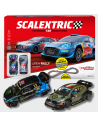
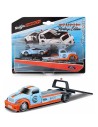
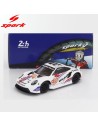
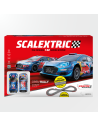
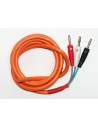
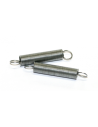
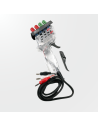
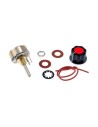
The F104 is one of the most recognisable single-seater categories within the world of competitive slot racing. If you are looking for cars, chassis, spare parts or specific accessories for this class, you probably already know what it's about: a specific regulation, defined measurements, and a tuning philosophy that demands precision. At Ministry of Hobby, we gather all the material related to F104 so you can find what you need without going in circles.
Whether you have just discovered this category or have been competing with it for seasons, here you will find everything from complete cars to every small component that makes a difference on track. Because in F104 —as in any serious competition category— detail matters.
What is the F104 and why is it so significant in slot competition
The F104 is a category of slot cars with Formula 1 single-seater bodies, specifically designed for competition. Its name directly refers to the technical regulation that defines the vehicle's characteristics: chassis dimensions, allowed motor type, minimum weight, track width, and other parameters that ensure equal conditions among participants.
What sets the F104 apart from other categories is its balance between accessibility and technical demand. It is not a class for casual home racing: it is designed for competition tracks, with smooth surfaces, technical layouts, and drivers looking to shave tenths of a second off with every adjustment. At the same time, its regulation is sufficiently defined so that the difference between cars is minimal and the result largely depends on the driver's skill and tuning.
The single-seater silhouette also has an undeniable collector and aesthetic component. The finishes of these cars replicate the aesthetics of the great Formula 1 single-seaters, making them attractive pieces even off the track.
How to correctly choose F104 material
Before purchasing any F104 component, it is important to clarify the context in which it will be used:
- Official competition: if you are going to participate in championships with F104 regulations, always check the current rules before acquiring a motor, chassis, or any part. Some components are homologated and others are not. A mistake here can lead to technical exclusion.
- Training and preparation: for running and developing tuning without the pressure of regulations, you have more freedom to try different motors, tyres, or geometries.
- Introduction to the category: if this is your first F104, the most sensible approach is to start with a complete car and run a lot before making modifications. The category rewards consistency as much as top speed.
The rail system is also relevant. Always check if the car or chassis you are going to buy is designed for universal rail (Scalextric, Ninco) or sport rail (Scaleauto, Slot.it), as the guide and track width may vary. Mixing systems without proper knowledge —for example, using a car designed for Scaleauto on a Scalextric or Carrera track— can lead to driving issues or physical compatibility problems.
Main types and differences within the F104
Within this category, you will find different types of material according to their function and level:
Complete cars
Ready to run or with minimal assembly, they are the most direct entry option. They include chassis, body, motor, guide, braids, tyres, and wheels. Ideal for those starting out or wanting a solid base to work from.
Chassis and construction kits
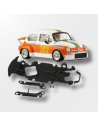
For experienced drivers who prefer to build the car piece by piece and adjust each element from scratch. The chassis is the heart of the F104: its rigidity, geometry, and materials condition all behaviour on track.
Bodies
The single-seater bodies for F104 are usually made of plastic or resin, with different levels of detail and weight. Some are factory painted; others require decoration work, allowing for the customization of the car's livery.
Spare parts and loose components
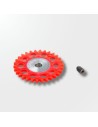
Motors, crown gears, pinions, axles, braids, guides, tyres, wheels… Each piece has its role in the whole. In competition, having spare parts on hand is essential to avoid losing a heat due to a mechanical failure.
Technical aspects we need to know
The F104 does not forgive a lack of technical attention. Here are the key points to master:
Motorisation
The F104 regulation usually specifies the type of motor allowed. In terms of layout, the single-seaters in this category typically operate with an inline configuration (motor in line with the rear axle, longitudinal), which helps lower the centre of gravity and improves stability in corners. Confusing this with a sidewinder configuration (transverse motor, parallel to the axle) is a common mistake among those coming from other categories.
Gear ratio
The combination of crown gear and pinion determines the gear ratio: more teeth on the crown or fewer on the pinion means more torque but less top speed, and vice versa. Adjusting this ratio according to the track layout is one of the first settings a competitive driver learns.
Tyres and grip
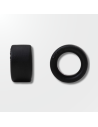
In F104, the compound and diameter of the tyres directly influence grip and the car's response speed. Some drivers treat the tyres with specific treatments to improve grip depending on temperature and track type.
Guide and braids
The guide must fit correctly in the rail and move freely. The braids must make clean and constant contact with the rail to avoid power cuts. Checking both elements before each session is a habit that makes a difference.
Weight and balance
The minimum weight is usually regulated. Distributing it correctly between the front and rear axles affects braking behaviour and acceleration out of corners.
Practical tips for use, maintenance, and preparation
- Clean the braids and the rail before each session. Dirt accumulated on the rail causes contact losses that translate into cuts and loss of control. A clean track is an advantage for everyone.
- Lubricate judiciously. Excess lubricant on the motor or drivetrain can attract dirt and degrade performance. Apply only what is necessary at the points indicated by the manufacturer.
- Check the tightness of crown gears and pinions. A loose pinion in the middle of a heat has no solution in the pits. Always check it before competing.
- Check the lateral play of the guide. Too much play causes imprecise trajectories; too tight causes resistance to movement. Find the middle ground.
- Run before adjusting. The car needs a minimum of running to allow the tyres to settle and the motor to reach its optimal performance. Do not draw tuning conclusions in the first laps.
- Bring spare parts to championships. Spare braids, a replacement guide, an additional set of tyres, and a pinion or crown are the minimum kit to avoid relying on luck.
Common mistakes we should avoid
Buying components without verifying regulation compatibility
In regulated competition categories, a motor or body out of specification can invalidate the car during technical verification. Always consult the updated regulations of the championship you are going to participate in.
Ignoring the rail system
As mentioned earlier, a car designed for one system may not work correctly on another. Before buying, confirm what type of track you will be racing on.
Modifying too soon
The temptation to start changing parts before fully understanding the base car leads to not knowing what is improving and what is worsening. First, run, take references, then modify in a controlled manner.
Neglecting the braids
They are one of the most worn parts and one of those that most affect performance. Changing them when they start to show signs of wear is much cheaper than losing a championship due to a power cut.
Applying excessive lubricant
More lubricant does not mean better lubrication. Excess spreads across the track, reduces grip, and dirties the system. Use minimal amounts and specific products for slot.
Recommendations for beginners and advanced users
If you are starting in F104
Start with a complete car from a recognised manufacturer, run a lot, and learn to interpret the behaviour of the single-seater before touching anything. Pay special attention to the cleanliness of the car and the rail. Talk to the more experienced drivers in the club: in the world of slot, sharing knowledge is the norm, not the exception.
Do not obsess over top speed in the first weeks. Consistency —completing heats without crashes or cuts— is worth more than a second more on the straight.
If you already have experience in the category
The leap in level in F104 usually comes from fine-tuning the gear ratio for each track, optimising the tyre compound, and working on weight balance. If you have been using the same car for a while, a complete review of braids, guide, and bearings can yield unexpected improvements without changing any performance parts.
Exploring different motors within the regulations —and knowing their power curve well— is another path that advanced drivers work on in detail. The difference between homologated motors can be subtle but real on circuits with many rhythm changes.
| Aspect |
Beginner |
Advanced User |
| Starting point |
Complete car ready to run |
Kit or chassis with selected components |
| Initial priority |
Consistency and running |
Specific tuning by track |
| Maintenance |
Basic review before each session |
Complete review and monitoring of wear |
| Transmission |
Standard factory ratio |
Crown/pinion adjustment according to layout |
| Tyres |
Standard manufacturer compound |
Selection and treatment according to conditions |
| Motor |
Motor included in the car |
Selection within the regulations and controlled running |
Frequently asked questions about F104
Is the F104 compatible with any slot track?
It depends on the rail system. Check if the car is designed for universal rail (Scalextric, Ninco) or sport rail (Scaleauto, Slot.it) before purchasing. Not all F104 cars are universal.
What motor is used in F104?
The specific championship regulations define which motors are allowed. Always consult the current rules of the club or federation before acquiring or changing the motor.
What is the difference between inline and sidewinder in an F104?
In inline configuration, the motor is in line with the rear axle (longitudinal), which lowers the centre of gravity. In sidewinder, the motor is parallel to the axle (transverse). F104 single-seaters typically operate in inline configuration.
Can I use an F104 for recreational running or is it only for competition?
You can use it in any context, but its design and philosophy are oriented towards competition. For recreational running, there are categories with less technical demand and greater versatility.
How often should the braids be changed in an F104?
It depends on the intensity of use and the condition of the rail. Inspecting them before each session is a good habit. If they show visible wear or the car starts to cut out for no apparent reason, it is time to change them.
What minimum spare parts should I bring to an F104 championship?
At a minimum: spare braids, guide, additional set of tyres, and a couple of pinions/crowns. Some drivers also carry a spare motor if the regulations allow it.
Do F104 cars come ready to compete or do they require preparation?
Complete cars usually need a minimum of adjustment (motor running-in, guide checking, transmission ratio verification) before being competitive. Kits require complete assembly.
How does weight affect the behaviour of the F104?
The minimum weight is usually regulated. Its distribution between axles influences the balance of the car: more weight at the front improves stability under braking; more weight at the rear favours traction out of corners.
What is the difference between a plastic body and a resin body in F104?
Resin usually offers greater detail and finer surfaces but requires more care in handling. Plastic is more resistant to everyday impacts on track. In competition, the weight of the body can also be relevant.
Can I customise the livery of an F104?
Yes. Unpainted bodies are the most common for customization. They are worked with acrylic paints (Vallejo, Tamiya, Kaleido) and specific decals. It is one of the most rewarding parts of the hobby for those who enjoy modelling.
What lubricant should I use in the F104?
Always use specific products for slot, in minimal amounts and at the points indicated by the manufacturer of the car or component. Avoid generic lubricants that may attack plastics or degrade tyres.
Is the F104 a recommended category for starting in slot competition?
It is a demanding category, but with clear regulations and an active community. If you have access to a club with an established F104 championship, it can be a very comprehensive entry into slot competition. If you are looking for something more gradual, consult us on which categories are more common in your area.