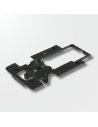
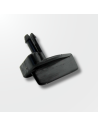
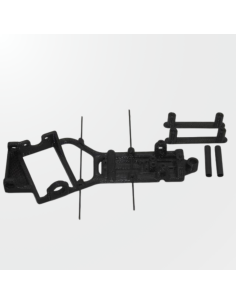
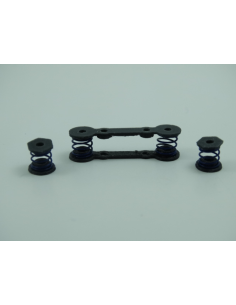
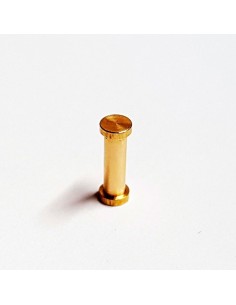
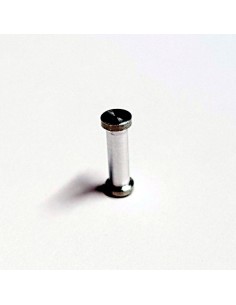
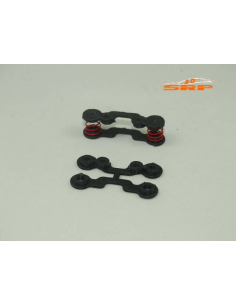
When discussing advanced preparation in slot racing, the concept of anglewinder inevitably arises. It is not just a way to position the motor: it is an engineering decision that directly affects the car's behaviour on track, its centre of gravity, and how it responds in corners. Choosing the right bracket or support for this type of mounting is one of the most important steps in tuning any competition car.
In this section, you will find brackets, supports, and everything necessary to build or upgrade a drivetrain in anglewinder configuration, with different finishes and materials adapted to various chassis and regulations. Whether you are preparing a car for a club category or seeking maximum performance in a federated race, here are the components used by serious racers.
The choice of bracket is not trivial. It influences the exact angle of the motor, the power transmission to the crown gear, the rigidity of the assembly, and consequently, the reliability throughout a long race. A poorly chosen support can cause an excellent motor to perform below its potential or lead to vibrations that compromise traction. Therefore, it is worth understanding what differentiates one from another before making a purchase.
Brands like NSR, Slot.it, or Scaleauto have been developing specific solutions for anglewinder for years, with very tight tolerances and materials that withstand the demands of competition. In our catalogue, you will find their most sought-after references, as well as options from other manufacturers specialising in high-performance spare parts.
What is anglewinder and why does it make a difference
Anglewinder is a motor mounting configuration where the motor is positioned at an intermediate angle to the rear axle. It is neither parallel — as in the sidewinder, where the motor is transverse to the axle — nor perpendicular — as in the inline, where the motor runs longitudinally, in line with the car and lower. The anglewinder occupies a diagonal position that combines advantages from both configurations.
This arrangement allows for a lower centre of gravity compared to the classic sidewinder, improving stability in corners, but without reaching the ultra-low ground clearance of the inline. In return, it offers a very compact and efficient drivetrain, with a gear ratio that favours acceleration out of corners. It is no coincidence that many competition cars in the 1/32 category with advanced technical regulations have adopted anglewinder as the reference configuration.
The bracket is the structural element that makes all this possible: it fixes the motor to the chassis at the correct angle, ensures alignment with the crown gear of the rear axle, and absorbs the traction forces during acceleration. A well-designed and well-fitted support makes the difference between a smooth and quiet transmission and an assembly that vibrates, loses efficiency, and wears out parts prematurely.
How to choose the correct anglewinder bracket or support
Before choosing, several factors that condition the compatibility and performance of the mounting must be clear:
- Target chassis: not all brackets are universal. Many are designed for specific chassis from NSR, Slot.it, Scaleauto, or Avant Slot. Always check the product specifications.
- Motor you are going to mount: the diameter and length of the motor determine if it fits in the bracket. Standard can motors (like the 24,000 rpm, Shark, or King) have established measurements, but confirm before combining.
- Mounting angle: the usual angle in anglewinder is around 20-30 degrees, but there are variations depending on the manufacturer and chassis. Some brackets allow angle adjustment; others are fixed.
- Material: high-rigidity plastic, machined aluminium, or brass. Each material has implications for total weight, rigidity, and the ability to dissipate heat from the motor.
- Screws and fastening: some supports include adjustment screws; others require additional parts. Check what you need for the complete assembly.
- Regulations of your championship: in organised competition, the regulations may limit the type of bracket or the allowed angle. Always consult before preparing the car.
If you have doubts about which bracket is compatible with your chassis and motor, do not hesitate to consult us. It is better to ask before buying an incompatible part.
Main types and differences of anglewinder supports
The market offers an interesting variety of anglewinder brackets and supports. Knowing their differences helps make the right decision:
By material
- Technical plastic (nylon, delrin, high-density ABS): lightweight, economical, and sufficiently rigid for amateur and semi-professional use. Slightly dampens vibrations. It is the most common option in prepared production cars for anglewinder.
- Machined aluminium: maximum rigidity and dimensional precision. Promotes heat dissipation from the motor. Heavier than plastic, but offers superior durability in intense competition conditions. Preferred by advanced tuners.
- Brass: high density, used in cases where adding weight in specific areas of the chassis is beneficial for mass distribution. Less common, but present in very specific preparations.
By fastening design
- Bracket integrated into the chassis: some anglewinder chassis from NSR or Slot.it come with the motor position already defined. In these cases, the support is the chassis structure itself.
- Independent bolted support: allows for the installation of an anglewinder motor in chassis that were not originally designed for that configuration. Offers flexibility but requires more attention to adjustment and alignment.
- Adjustable support: designed to modify the motor angle or the position of the pinion axis. Ideal for fine-tuning the gear ratio and the motor height above the chassis.
Technical aspects we need to know
Correctly mounting an anglewinder requires understanding how the various components of the drivetrain interact:
Pinion-crown alignment
This is the most critical point. The motor pinion and the rear axle crown gear must mesh with minimal play but without excessive pressure. A too-tight mesh generates heat, noise, and premature wear. A too-loose mesh causes loss of efficiency and skips under hard acceleration. The bracket defines this distance; a poorly manufactured or poorly mounted bracket ruins any powertrain, no matter how good it is.
Motor angle and height
The angle of the anglewinder directly affects the transmission line. A steeper angle lowers the motor more, reducing the centre of gravity, but can create non-optimal meshing angles if not compensated with the correct crown and pinion. The height of the motor above the chassis also influences the car's behaviour over track bumps.
Gear ratio
In anglewinder, the pinion-crown ratio determines top speed and acceleration. A shorter ratio (more teeth on the crown compared to the pinion) favours acceleration but limits maximum speed. A longer ratio does the opposite. Adjusting this ratio according to the track layout is a fundamental part of technical preparation.
Compatibility with the track system
Do not confuse the motor configuration with the track rail system. Cars with anglewinder mounting can run on universal rail (Scalextric, Ninco) or sport rail (Scaleauto, Slot.it), depending on the chassis. What matters is that the guide and braids are compatible with the system where the car will compete.
Practical tips for use, maintenance, and preparation
- Check the mesh before each session: ensure that the pinion and crown gear turn smoothly without excessive play. A simple turn with your fingers before putting the car on track can save you a breakdown.
- Lubricate wisely: a small drop of specific slot gear lubricant at the pinion-crown contact point is sufficient. Excess lubricant attracts dust and can reach the braids, affecting current capture.
- Carefully tighten the bracket screws: they should be firm, but in plastic supports, excessive torque can damage the threading. If the support comes with nylon screws, do not replace them with steel without checking first.
- Inspect the bracket after falls or accidents: a strong impact can misalign the support without being visible at first glance. If the car starts making more noise than usual after an accident, check the alignment before continuing.
- Store spare brackets in a labelled bag: in competition, it is advisable to always carry a spare bracket of the same model, already mounted and adjusted, to be able to replace it quickly in the pits if necessary.
Common mistakes to avoid
Mixing incompatible components
Not all crowns and pinions fit with all brackets, even if they look similar visually. Before combining parts from different manufacturers, verify modules (M50, M48…) and axle distances. A mesh with different modules wears out the parts quickly and produces a characteristic noise that does not disappear no matter how much you adjust.
Ignoring the mounting angle
Installing an anglewinder bracket at the wrong angle because "it was what was available" is a classic mistake. If the angle is not suitable for your chassis and motor, the mesh will never be optimal. Always check that the bracket is designed for the assembly you are going to mount.
Not verifying the torque
Over-tightening (deforming the support, especially in plastic) and under-tightening (bracket moving on track under hard acceleration) are real problems. In competition, a moving bracket can ruin an entire heat.
Confusing anglewinder with sidewinder or inline
This seems basic, but it is more common than it appears, especially among those starting in advanced preparation. Remember: the sidewinder is transverse to the axle, the inline is perpendicular (in line with the car), and the anglewinder is at an angle. Each requires its own bracket and they are not interchangeable.
Buying the cheapest bracket without checking compatibility
In slot racing, saving on a motor support can be costly. A bracket with loose tolerances forces you to spend hours adjusting that are never fully recovered. Investing a little more in a quality component is usually the most cost-effective decision in the medium term.
Recommendations for beginners and advanced users
If you are starting with anglewinder
The most sensible approach is to start with a chassis that already incorporates the anglewinder bracket from the factory, such as those offered by NSR or Slot.it in some of their models. This way, you save the most delicate part — alignment from scratch — and can focus on learning how the gear ratio affects the car's behaviour before delving into structural modifications.
If you already have a chassis and want to convert it to anglewinder, look for an independent support from the same manufacturer or a recognised one in the sector, and follow the assembly instructions to the letter. Do not improvise on the pinion alignment.
If you already have experience
Machined aluminium supports with high precision are your natural territory. They allow for fine adjustments that plastics do not offer, and their rigidity ensures that the mesh does not vary over a long session. Experiment with different pinion-crown ratios according to the type of layout and keep a record of which combinations work best on each circuit.
It is also worth exploring options for supports with small angle adjustments, which allow for slight modifications to the motor position without changing the entire bracket. This level of tuning makes a real difference on the stopwatch.
| Bracket Material |
Weight |
Rigidity |
Heat Dissipation |
Usage Profile |
| Technical plastic |
Very light |
Medium |
Low |
Amateur / semi-professional |
| Machined aluminium |
Medium |
High |
High |
Advanced competition |
| Brass |
High |
High |
Medium |
Specific weight preparations |
Frequently asked questions about anglewinder brackets and supports
What is the difference between anglewinder and sidewinder?
In the sidewinder, the motor is parallel to the rear axle (transverse). In the anglewinder, the motor is inclined at an angle to that axle. This positional difference affects the car's centre of gravity and the geometry of the drivetrain.
Can I convert any chassis to anglewinder?
Technically yes, as long as there is enough space in the chassis and a compatible support exists. However, some chassis are not designed for this conversion, and the result may not be optimal. It is better to start with a chassis designed for anglewinder.
What pinion and crown should I use with my anglewinder bracket?
It depends on the angle and distance between axles of the bracket, as well as the module (M50 or M48 are the most common in 1/32). Check the specifications from the bracket manufacturer; many directly indicate which combinations are compatible.
Does the aluminium bracket improve performance compared to plastic?
In demanding competition conditions, yes. The greater rigidity better maintains alignment under strong traction loads, and heat dissipation better protects the motor. For amateur use, a good quality plastic bracket is perfectly valid.
Do I need to change the bracket if I change the motor?
Not necessarily, but you must check that the new motor fits in the bracket (diameter and length) and that the pinion is correctly aligned with the crown. If the new motor has a different diameter, you will likely need a specific bracket.
Is anglewinder suitable for all competition categories?
Not universally. Some championship regulations limit the type of mounting allowed. Always check the technical regulations of your category before preparing the car.
How do I know if my bracket is well aligned?
The mesh should rotate smoothly and quietly. If you hear a squeak or feel resistance when turning the axle with your fingers, there is an alignment or play issue. You can also use a bit of blue marking grease on the teeth to see the contact pattern.
How often should I check the bracket?
In competition, before each session. In regular track use, every few sessions or whenever you notice a change in the motor sound or the car's behaviour.
Can I use the same anglewinder bracket on universal rail and sport rail?
The bracket is internal to the car and does not depend on the type of rail. What must be compatible with the track system is the guide and braids of the car, not the bracket.
What brands of anglewinder brackets do you have available?
In our catalogue, you will find references from NSR, Slot.it, and Scaleauto, among others. Availability varies by season; if you are looking for something specific and do not see it, please consult us.