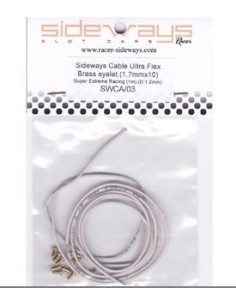
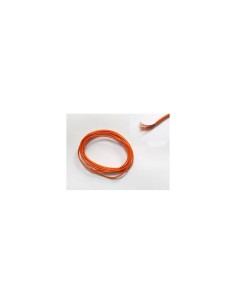
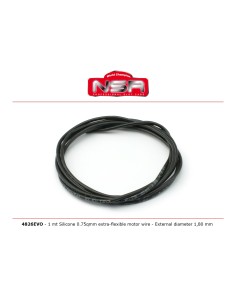
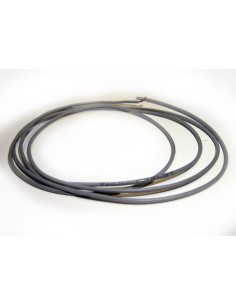
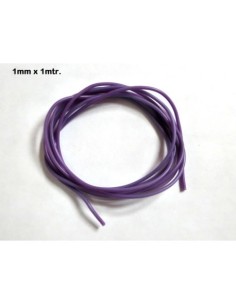
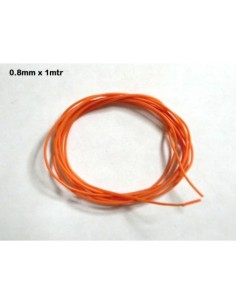
When preparing a slot car for competition, we often obsess over the motor, tyres, or guide, and overlook one of the factors that silently robs us of performance: the wire. Poor quality wiring, with insufficient gauge or high resistance, causes voltage drops that the motor never recovers from, delayed responses to the controller, and, in the most extreme cases, power losses that we wouldn't find in any other component. Here you will find specific wire for slot and electric modelling applications, chosen with technical criteria and designed to ensure that the energy coming from the source reaches its destination intact.
The usual use ranges from connecting the braids to the motor, through direct power supply to the motor from the contact points, to the internal wiring of track circuits or the installation of LEDs. In all these cases, the type of wire, its cross-sectional area, and the quality of the insulation make measurable differences on the power bench and noticeable differences on the track.
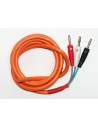
We work with low-resistance flexible silicone wire, available by the metre or in pre-cut kits, in different gauges depending on the application. If you are going to renew the wiring of your car, replace a damaged section, or build a circuit from scratch, in this category you will find what you need without having to search through general electronics catalogues that do not understand the specifics of slot.
What is wire in slot and why does it matter so much
The wire is the conductor that carries the electric current from the contact points —braids and guide— to the motor, and from there completes the circuit back. It seems simple, but any extra resistance along that path directly translates into power loss. Physics is relentless: the voltage that reaches the motor is the track voltage minus the drops across each element of the car's internal circuit. A wire that is too thin or of poor conductivity can steal several tenths of a volt, enough to notice a clear difference in the motor's response.
In a domestic car, this may seem irrelevant. But in competition, where adjustments are measured in grams, millimetres, and tenths of a lap, wiring is part of the setup. Many tuners check the wiring as the first step before touching any other component, precisely because it is the most common cause of performance losses that are difficult to diagnose at first glance.
In addition to electrical performance, the flexibility of the wire influences the car's mechanics. A rigid wire can create internal tensions that affect the suspension or the free movement of the guide. Silicone wire, due to its soft and malleable nature, allows installations that do not interfere with the vehicle's dynamic behaviour.
How to correctly choose the wire for your application
The first criterion is the cross-sectional area, expressed in square millimetres (mm²) or in American wire gauge (AWG). The larger the cross-section, the lower the resistance and the greater the current-carrying capacity, but also the greater the weight and rigidity. In slot cars, it is common to work with sections between 0.35 mm² and 0.75 mm², finding the balance between conductivity and lightness.
- Thin section (0.35 mm² / 26-28 AWG): ideal for secondary connections such as LEDs, signals, or short sections where weight is a priority.
- Medium section (0.50 mm² / 24-26 AWG): the most versatile, suitable for most motor installations in 1/32 cars.
- Thick section (0.75 mm² / 22 AWG or higher): recommended for high-demand motors, applications in 1/24, or long sections where voltage drop can accumulate.
The second criterion is the type of insulation. Silicone is the recommended standard in slot due to its flexibility at room temperature and its resistance to heat generated by demanding motors. Avoid wires with rigid PVC insulation in installations where the wire needs to bend repeatedly.
Finally, consider the colour. Although it does not affect electrical performance, using different colours for positive and negative makes diagnosing problems much easier and reduces errors during assembly.
Main types and differences
Within the wire for slot and electric modelling, we can distinguish several types based on their construction and use:
Flexible multi-strand silicone wire
This is the most common in slot car preparation. It consists of multiple very fine copper strands twisted together, giving it exceptional flexibility and good conductivity. It withstands vibrations and repeated bends well without degrading. This is what we recommend for motor-braid and motor-guide connections.
Silicone wire on reel (by the metre)
This allows you to cut exactly the length needed for each installation, minimising excess material inside the chassis. It is the preferred option for tuners who optimise every gram and every millimetre of internal run.
Pre-cut kits
Sets with standard lengths designed for 1/32 or 1/24 cars. Ideal for renewing the complete wiring of a car without the need to measure or cut, and very practical for those starting to prepare cars who want immediate results.
Wire for track circuits
With a larger cross-section, designed to power track sectors, connect controllers, or distribute current in larger installations. Here, the priority is to reduce resistance in long sections so that all points of the circuit receive the same voltage.
Technical aspects we need to know
The electrical resistance of a wire depends on three factors: the conductive material (copper is the standard, tinned copper adds resistance to oxidation), the cross-sectional area, and the length of the run. For practical purposes, in a slot car, the runs are so short that length hardly influences; the cross-section and the quality of the copper are the determining factors.
The operating temperature is another relevant parameter. Competition motors can reach high temperatures, and the wire running close to them must have insulation that does not degrade or become brittle. Silicone withstands these environments well, while some cheap PVC wires can harden or crack over time.
The termination style also matters. A poorly tinned wire at its ends or a poor pressure connection can generate more resistance than the wire itself. Whenever possible, we tin the ends before soldering and avoid unsoldered connections inside the car.
Regarding mass and balance, in highly prepared cars, even the routing of the wire inside the chassis is taken into account. A wire that hangs or accumulates on one side can shift the centre of gravity or interfere with the suspension. Routing it close to the chassis and securing it with small drops of glue or kapton tape is a common practice among meticulous tuners.
Practical installation and maintenance tips
Before starting any wiring changes, it is advisable to measure the exact lengths we need and cut with a little margin. Extra wire is not a problem, but it should not be so tight that it complicates assembly or creates mechanical tensions on the solder points.
Tinning the ends is a step we must never skip. Apply a small amount of solder to the stripped wire before soldering: it improves conductivity, facilitates soldering, and prevents the fine strands from fraying with use.
To solder to the motor, work quickly and without applying excessive heat. The pads on slot motors are small and sensitive; a long soldering job can damage the winding. A regulated soldering iron at temperatures between 300 and 350 °C and a fine solder wire (0.5-0.8 mm) are sufficient.
Check the wiring periodically, especially after long competition sessions. Solder points can fatigue with vibrations and repeated accelerations. A wire that has partially detached can go unnoticed but generate significant resistance.
If the car has LEDs installed, use thin wire for that circuit and keep it separate from the main power circuit. This will avoid interference and simplify diagnosis if something goes wrong.
Common mistakes we should avoid
Using wire with insufficient gauge thinking that since it is short, it doesn't matter. In very short runs, the effect is less, but in high-demand motors, any extra resistance counts.
Not tinning the ends before soldering. It may seem like a minor detail, but it makes the difference between a solid connection and a failure point that will appear by the third competition weekend.
Leaving loose wire inside the chassis. Wire that is not secured moves with accelerations and braking, can get tangled in axles or gears, and in the worst case, cause a short circuit.
Mixing wires of different gauges indiscriminately in the same circuit. The section with the smallest gauge sets the limit for the entire circuit; if there is a thin section between two thick ones, that is the bottleneck.
Ignoring polarity during assembly. In a slot car, reversing positive and negative makes the motor run in reverse. It does not damage the motor in most cases, but it costs unnecessary diagnostic time. Always use the same colour coding.
Buying generic electronics wire that is not suitable for this application. Flexible silicone wire for slot has specific characteristics of flexibility and conductivity that household electrical wires do not meet.
Recommendations for beginners and advanced users
If you are just starting
The most practical option is to choose a pre-cut kit with differentiated colours. It allows you to renew the complete wiring of a car without the need to calculate measurements or handle reels. Practice soldering on a piece of old copper before touching the real car, and always use solder flux to achieve clean joints.
Don't complicate yourself choosing gauges: for a standard 1/32 car, 0.50 mm² silicone wire in red and black covers 90% of situations. Start there.
If you already have experience
It is worth working with reels and cutting to size, optimising the run of each section to minimise weight and avoid mechanical interference. Consider using different gauges depending on the run: thinner for auxiliary circuits (LEDs, sensors) and thicker for the main power circuit.
In high competition cars, some tuners also replace the wiring from the braids to the guide with very low resistance wire and soldered terminations instead of factory connectors. The improvement is small, but in tight competition, it can make the difference between winning and finishing second.
If you prepare cars in 1/24, go directly to 0.75 mm² or more: motors in this scale demand more current and the length of the runs is greater, which makes the resistance of the wire have more impact.
| Section |
Approx. AWG |
Recommended use |
Common scale |
| 0.35 mm² |
26-28 AWG |
LEDs, signals, auxiliary runs |
1/32, 1/43 |
| 0.50 mm² |
24-26 AWG |
Standard main power circuit |
1/32 |
| 0.75 mm² |
22 AWG |
High demand motors, long runs |
1/32 competition, 1/24 |
| 1.00 mm² or more |
18-20 AWG |
Track power supply, distribution |
Circuit tracks |
Frequently asked questions
What is the difference between silicone wire and PVC wire for slot?
Silicone wire is much more flexible, withstands heat better, and does not harden over time. PVC is stiffer and can crack near hot motors. For slot, silicone is always the recommended option.
How much wire do I need to wire a 1/32 car?
Generally, between 15 and 25 cm of each colour (red and black) is sufficient for the complete circuit of a 1/32 car. If you add LEDs, add another 10-15 cm of thin wire.
Can I use the same wire for the track and for the car?
It is not ideal. For the track, you need larger gauges (1 mm² or more) due to the length of the runs. For the interior of the car, thinner gauges are sufficient and add less weight.
Does the colour of the wire affect its electrical performance?
No, the colour is only for insulation and has no effect on conductivity. We use it solely to identify polarities during assembly.
Is it necessary to tin the ends of the wire before soldering?
Yes, it is highly recommended. Pre-tinning joins all the fine strands of the wire, facilitates subsequent soldering, and ensures a connection with lower contact resistance.
What happens if I use wire with too thick a gauge?
It is not electrically dangerous, but it adds unnecessary weight and can be difficult to install in tight spaces. Additionally, a very rigid wire can interfere with the car's mechanics if not routed properly.
What soldering temperature should I use for silicone wire?
Between 300 and 350 °C is sufficient for most applications. Higher temperatures can damage the silicone insulation and the motor pads.
How often should I check the wiring of my car?
It depends on the intensity of use. In regular competition, a check after each race day or championship is advisable. In domestic use, checking every few long sessions is sufficient.
Does the wire influence the return of the guide?
Indirectly, yes. If the wire going to the guide is too rigid or poorly routed, it can create mechanical tension that hinders the free movement of the guide, affecting cornering performance.
Can I use household electronics wire instead of specific wire?
Technically it works, but it is not recommended. Household wire tends to be stiffer, heavier, and its insulation is not designed for heat or repeated bends in a slot installation.
Is it worth changing the wiring of a stock car?
In competition cars or serious preparations, yes. Stock cars usually have the minimum necessary in terms of wire quality. Replacing it with low-resistance silicone wire is a cheap and effective improvement.
Which reference brands use quality wire in their stock cars?
NSR, Slot.it, and Scaleauto pay considerable attention to wiring in their competition references. Still, in advanced preparations, it is common to renew it to ensure the best possible result.