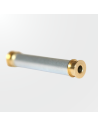
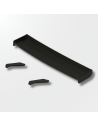
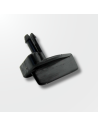
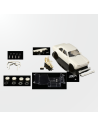
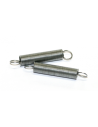
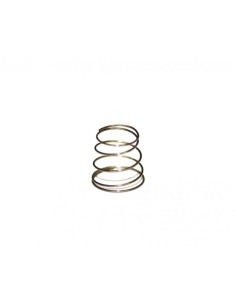
There are parts that go unnoticed until you really start fine-tuning. The guide spring is one of them. Small, simple in appearance, but capable of making a notable difference in how the car behaves on track: how it follows the rail during elevation changes, how it responds to track irregularities, or how stable the guide remains during a long session of running. When someone is looking for springs for slot cars, they have usually already gone through that phase of discovering that not all cars use the same spring, that there are different hardnesses and lengths, and that choosing well can mean the difference between a planted car and one that gets distracted as soon as the track has any imperfections.
At Ministry of Hobby, we work with springs designed for the demands of competition and for the user who wants to get the most out of their setup, whether they are running at home or competing on a circuit. On this page, we explain exactly what a guide spring does, how to choose it, what types exist, and what mistakes to avoid to ensure your investment makes sense.
What is the guide spring and why is it so important
The guide spring is the spring that works under tension between the guide —also called a leg or comb in slang, although at Ministry of Hobby we prefer to always call it a guide— and the car chassis. Its main function is to keep the guide in constant contact with the track rail, absorbing the small height variations presented by the layouts, especially plastic ones with heavy use or those mounted on modules.
When a car loses contact with the rail, the guide "jumps" and the vehicle derails or loses electrical traction. A well-chosen spring drastically reduces those situations because it acts as a damper between the rigidity of the chassis and the imperfections of the track. It does not replace a good guide, good braids, or a well-leveled chassis, but it complements everything else and takes the whole setup to another level.
In competition setups, the guide spring is one of the first parts that preparers adjust. The hardness of the spring directly affects how much pressure the guide exerts on the rail: too soft and the guide may dance; too hard and the car does not absorb bumps well, losing grip on the braids or generating vibrations that affect the stability of the whole.
How to correctly choose the spring
The choice of spring depends on several factors that should be evaluated together before deciding:
- The type of track: Plastic tracks (Scalextric, Ninco) usually present more height variations between modules than wooden or resin tracks. On layouts with many slopes or pronounced joints, a spring with a bit more travel and medium-low strength usually works better.
- The weight of the car: A heavy car, like certain resin models or large 1/24s, needs a spring with a bit more tension so that the guide does not sink excessively. In lighter cars, a spring that is too hard may cause the guide not to work well.
- The type of guide and its housing: Not all chassis have the same guide mounting system. It is essential to ensure that the chosen spring is compatible with the diameter and length of the housing. Brands like NSR, Slot.it, or Scaleauto have their own standards, although many aftermarket springs are designed to be as universal as possible.
- The hardness: It is usually expressed in terms of tension or simply by colours according to the manufacturer. It is advisable to have several hardnesses on hand and test them on the actual track, as the conditions of each layout are different.
- The travel: The free travel allowed by the spring determines how much the guide can move up and down. A short travel limits the absorption of irregularities; an excessive one may cause the guide to work with too much play.
The best way to get it right is to start with a medium hardness and make progressive adjustments. There is no universal formula: each car, each track, and each driving style has its optimal point.
Main types and differences
Guide springs for slot cars do not form a very complex family, but there are relevant differences between the formats available on the market:
Standard compression springs
These are the most common. They work in compression: when the guide rises over an irregularity, the spring compresses and returns the guide to its working position. They are found in practically all standard cars and are also the most used in setups.
Tension or pull springs
Less common, they work in the opposite direction: they pull the guide downwards. They are used in specific setups where the chassis design does not allow for a conventional compression spring.
Soft, medium, and hard springs
The most practical classification is by hardness. Soft springs allow for greater travel and adapt well to irregular tracks but may be too permissive on smooth, fast tracks. Hard springs are more precise on wooden or resin tracks with perfect joints, but they penalise on bumpy layouts. Medium springs are the starting point for most applications.
Reduced diameter springs
Some competition chassis, especially those made of plastic or fibre from brands like NSR or Slot.it, have very tight guide housings. For these cases, there are springs with reduced outer diameters that fit without the need to modify the chassis.
Technical aspects we should know
Beyond hardness, there are some technical concepts that are important to clarify before making any adjustments with the springs:
- Preload: This is the initial tension that the spring has when the guide is in the resting position. If there is too much preload, the guide will not have upward travel; if there is too little, the guide will be practically floating. Adjusting the preload is as important as choosing the correct hardness.
- Spring fatigue: With use, springs lose tension. It is one of the parts that is often forgotten during maintenance, but a fatigued spring can ruin the behaviour of a car that seemed well-tuned. It is advisable to replace them periodically, especially in competition cars.
- Interaction with the braids: The pressure exerted by the spring on the guide directly affects the electrical contact of the braids with the rail. A guide that works well thanks to a good spring ensures more stable contact and reduces power cuts.
- Compatibility with the track system: The spring itself is not exclusive to any system, but the guide that mounts it may be. Remember that the guide for universal rail (Scalextric, Ninco) is not the same as for sport rail (Scaleauto, Slot.it). The spring may be the same, but ensure that the entire guide-spring-chassis assembly is designed for the same system.
Practical tips for use, maintenance, and preparation
With springs, maintenance is straightforward but must be systematic:
- Check the spring in every competition session. Before going on track, check that the spring is not crushed, deformed, or rusted. A ten-second glance can prevent a problem during the race.
- Always carry spares. They are small and inexpensive parts. There is no sense in arriving at a competition without a spare set of springs. A spring that fails during a race can cause you to lose several laps in the pits.
- Do not lubricate the spring. Unlike other parts of the car, the spring does not need lubrication. Applying oil or grease can attract dirt and alter the tension of the spring unpredictably.
- Test on track before deciding. If you are in doubt between two hardnesses, the only valid criterion is the actual behaviour on the layout. Make several laps with each option and decide based on data, not intuition.
- Combine the spring adjustment with the rest of the setup. A new spring does not solve a twisted chassis or worn braids. Ensure that the rest of the car is in good condition before attributing grip or contact problems solely to the spring.
Common mistakes we should avoid
- Forgetting the spring in routine maintenance. It is the part that is most often forgotten to check. Many enthusiasts change guides, braids, and tyres without noticing that the spring has hundreds of hours of use and no longer works as it should.
- Using the same spring regardless of the track. What works on a wooden circuit with perfect joints may be totally inadequate on a plastic track with uneven modules. Adapt the hardness to the layout.
- Installing the spring without checking the preload. Installing the spring and considering the car ready without verifying how much travel the guide has is a common mistake. Always check that the guide can move freely up and down within the correct margins.
- Mixing springs from different manufacturers without criteria. Not all "standard" springs are the same. Diameter and length tolerances vary, and a spring that seems to fit may not provide the expected tension if it is not designed for that specific housing.
- Ignoring spring fatigue in collection or occasional use cars. Cars that are not used much can also have a fatigued spring if they have been stored for years. Before competing again with a stored car, it is advisable to check the condition of the spring.
Recommendations for beginners and advanced users
If you are just starting
If you are taking your first steps in slot car preparation, the spring is a part you can start with without fear of making serious mistakes. Start with a medium hardness, the one included as standard by your car's manufacturer, and learn to observe how the guide behaves on track. Over time, you will develop the criteria to understand what each car needs to adjust on each circuit.
Brands like NSR or Scaleauto include good quality springs in their standard cars, which are a good starting point. Before changing anything, ensure that the problem you want to solve is really with the spring and not with another part of the front end.
If you already have experience
For advanced users and preparers, springs are one more variable within a complete tuning process. The correct combination of hardness, preload, and travel, adjusted to the weight of the car, the type of layout, and the conditions of the day, can make a difference in tenths of a lap.
Some preparers experiment with combinations of two springs (one inside the other with different hardnesses) to achieve a progressive response curve. It is a technique that requires trial and error, but it can yield very interesting results on mixed layouts with both fast and irregular sections at the same time.
In any case, always keep a record of the adjustments you have tried and the results obtained. The accumulated knowledge car by car and circuit by circuit is the real advantage of the experienced preparer.
| Type of spring |
Hardness |
Recommended track |
Usage profile |
| Soft |
Low tension |
Plastic with irregularities, modules with elevation |
Domestic use, layouts with bumps |
| Medium |
Standard tension |
Plastic in good condition, basic wood |
General use, recommended starting point |
| Hard |
High tension |
Wood with perfect joints, resin |
Competition on high-quality circuits |
| Reduced diameter |
Variable |
Any type |
Chassis with narrow housings (NSR, Slot.it…) |
Frequently asked questions about slot springs
How often should the guide spring be changed?
There is no fixed rule, but in competition cars, it is advisable to check them every ten to fifteen hours of running and replace them if we notice a loss of tension. In cars used occasionally, it is advisable to check them before each season or before an important competition.
Do all springs work for any car?
No. Although many springs have standard dimensions, the diameter, length, and tension vary according to the manufacturer and chassis model. Before buying, check the specifications of your guide housing.
Does a harder spring always provide more grip?
Not necessarily. A spring that is too hard prevents the guide from adapting to irregularities, which can cause the car to bounce over bumps instead of absorbing them. Grip depends on many factors; the spring is just one of them.
Does the spring affect electrical contact?
Yes, indirectly. A spring that keeps the guide in constant contact with the rail helps ensure that the braids also work stably. If the guide dances, the braids lose contact and the car suffers power cuts.
Can I use the stock spring or should I change it from the start?
The stock spring from brands like NSR, Slot.it, or Scaleauto is usually of good quality and is a valid starting point. It is not necessary to change it immediately; do so when you have a specific technical reason to do so.
Are springs compatible between different track systems?
The spring itself does not interact directly with the track system, but the guide that mounts it must be compatible with the rail (universal or sport). Ensure that the entire assembly is designed for the same type of track.
What happens if the spring is fatigued?
A fatigued spring loses tension and stops pushing the guide with enough force against the rail. The result is a guide that works with play, a greater risk of derailment, and less stable electrical contact.
Can two springs be combined to achieve an intermediate hardness?
Yes, it is a technique used by advanced preparers. A softer spring is placed inside a harder one to obtain a progressive response. It requires compatible diameters and that the total resulting travel is suitable for the chassis housing.
Should I lubricate the spring?
No. The spring does not need lubrication, and applying oil or grease can attract dirt and alter its behaviour. Keep it clean and dry.
Where will I notice the most difference when changing the spring?
Mainly in elevation changes, at the joints between modules, and in sections where the track has any warping. On perfectly flat and uniform tracks, the difference between springs is less noticeable.