When we talk about preparing a slot car for real performance, there is one component that concentrates a good part of the technical decisions: the short gearbox. It is one of those elements that, at first glance, may seem like a secondary detail, but in practice, it determines the car's behaviour on track in a decisive way. Whether you are building a competition car from scratch, replacing a worn part, or testing a different configuration to improve your lap times, choosing the right short gearbox makes the difference between a car that drives with precision and one that disappoints.
In this category, you will find short gearboxes from the most valued brands in the industry, selected for different levels of demand, types of assembly, and track systems. Whether you are mounting a motor in sidewinder configuration or working with an inline or anglewinder setup, the short gearbox is the element that connects the motor, axle, and transmission, and its geometry determines how torque is distributed, how the car behaves under acceleration, and how much margin you have to adjust the gear ratio.
The profile of those looking for a short gearbox is very varied: from the enthusiast who is starting to prepare their first car with some seriousness to the competition driver looking to gain tenths with a more efficient configuration. That’s why we have organised this section so you can quickly identify which short gearbox suits your project, which brands are compatible with your chassis, and what technical aspects you should consider before purchasing.
Throughout this guide, we will explain exactly what a short gearbox is, how it influences performance, what differences exist between the available models, what mistakes are most frequently made, and what we recommend based on your level and type of use. All from real experience in the hobby.
What is a short gearbox and why is it important
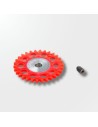
The short gearbox —also called a short transmission or simply a gearbox— is the mechanical assembly that houses the pinion, crown gear, and, in many designs, the rear axle, integrating the transmission of motion from the motor to the wheels. The term "short" refers to the reduced distance between the motor shaft and the transmission shaft, allowing for a more compact arrangement within the chassis and greater efficiency in torque transfer.
Its importance lies in several factors:
- Transmission efficiency: a well-designed gearbox minimises energy losses between the motor and the wheels, resulting in higher top speed and better acceleration response.
- Stiffness and precision: the quality of the fit between the pinion and crown gear within the gearbox directly influences mechanical play, vibration, and component wear.
- Configuration flexibility: many short gearboxes allow for changing the gear ratio by modifying the pinion or crown gear, adapting the car to faster or more technical tracks.
- Compatibility with motor type: depending on whether the motor is mounted in sidewinder, inline, or anglewinder configuration, the geometry of the gearbox varies, and choosing the correct type is essential for the assembly to function well.
In summary, the short gearbox is not a neutral element: it affects the car's balance, its behaviour in corners, and its responsiveness. Ignoring it or choosing it randomly is one of the most common mistakes among those who start preparing cars with greater seriousness.
How to correctly choose a short gearbox
The choice of a short gearbox depends on several factors that should be analysed before purchasing. There is no universal option valid for all cases, and what works perfectly in one car may be counterproductive in another.
Motor type
This is the first criterion. If the motor is mounted in sidewinder (transverse to the rear axle), the short gearbox has a specific geometry that allows for that lateral arrangement. In inline configuration (longitudinal, in line with the rear axle), the gearbox has a different design that favours lowering the centre of gravity. And in anglewinder (motor at an angle to the axle), the gearbox must accommodate that inclination while maintaining proper torque transmission. Confusing the type of gearbox with the motor configuration is a mistake that can render the assembly unusable.
Compatibility with chassis and motor
Not all short gearboxes are universal. Before purchasing, it is necessary to verify that the gearbox is compatible with the specific chassis of the car and with the motor you are going to install. Brands like NSR, Slot.it, or Scaleauto offer gearboxes designed for their own models, although in some cases there are interchangeable solutions between platforms.
Material
Short gearboxes are usually made from high-strength plastic or combinations with metal inserts. For recreational use, technical plastic is sufficient. For demanding competition, a gearbox with greater stiffness and tighter tolerances can make a real difference in performance and durability.
Gear ratio
Some gearboxes allow for varying the gear ratio by changing the pinion or crown gear. If the circuit you are competing on has many long straights, you will want a ratio that favours top speed. If it is a technical track with many curves, a shorter ratio improves acceleration response. Check what combinations the gearbox supports before deciding.
Main types and differences
Not all short gearboxes are the same, and the differences go beyond price. Here are the main types you will find on the market:
Sidewinder short gearbox
Designed for motors mounted transversely. It is the most common configuration in standard production cars and also in many modified ones. The motor is parallel to the rear axle, which facilitates mounting and allows for balanced weight distributions. Brands like NSR offer highly precise sidewinder gearboxes that are highly valued in competition.
Inline short gearbox
In this arrangement, the motor is in line with the rear axle, which allows for lowering the car's centre of gravity. It is especially useful in low-bodied cars or in setups aimed at improving corner grip. It requires greater mounting precision to ensure correct alignment.
Anglewinder short gearbox
The motor is placed at an angle to the rear axle. This solution seeks to combine the advantages of the two previous configurations: a lower centre of gravity than the sidewinder and greater compactness than the inline. It is common in high-level competition cars.
Integrated vs. modular gearboxes
Some gearboxes come as a closed unit ready to install, while others allow for disassembling and replacing individual components (pinion, bearings, axle). The latter offer greater flexibility for the preparer but require more technical knowledge for proper configuration.
Technical aspects we should know
To get the most out of a short gearbox, it is advisable to master some technical concepts that directly influence performance:
Gear play
The space between the teeth of the pinion and crown gear should be the minimum necessary for them to rotate without friction, but without excessive play. Too small a play generates heat and rapid wear; too large a play produces vibrations and loss of efficiency. Correctly adjusting this parameter is one of the most delicate tasks in preparation.
Bearings
The quality of the bearings housed in the gearbox influences the smoothness of rotation and the durability of the assembly. Precision ball bearings reduce friction and improve response, especially at high revolutions.
Axle alignment
A well-mounted short gearbox must ensure that the rear axle is perfectly perpendicular to the car's longitudinal axis. Any deviation generates vibrations, uneven wear on the tyres, and loss of grip.
Pinion/crown gear ratio
The combination of pinion and crown gear determines the final gear ratio. In general, a large crown gear with a small pinion provides more torque and better acceleration, while a small crown gear with a large pinion favours top speed. This adjustment should be made based on the motor, the circuit, and the driving style.
Module compatibility
The module is the measure that defines the size of the teeth of the pinion and crown gear. It is essential that the pinion and crown gear have the same module for them to mesh correctly. The most common in the slot world are module 48 and module 64, although there are others. Always check that the module matches before combining parts from different brands.
Practical tips for use, maintenance, and preparation
A well-maintained short gearbox lasts much longer and performs better. Here are the habits we recommend:
- Lubricate wisely: apply specific gear lubricant at the contact point between the pinion and crown gear. Use just the right amount; excess attracts dirt and can end up affecting the track or the braids.
- Check the play periodically: with use, the gears wear out and the play may increase. Check the fit after each intense running session.
- Clean before lubricating: if the gearbox has been in use for a while, remove any old lubricant residue and accumulated dirt before applying new lubricant. A contact cleaner or mild degreaser is sufficient.
- Check the pinion to motor tightness: a pinion that moves on the motor shaft is a source of vibrations and performance loss. Ensure it is securely fixed, with the retention screw or specific adhesive as appropriate.
- Do not overtighten the gearbox screws: excessive tightening can deform the casing and alter the gear play. Adjust firmly, but without overdoing it.
Common mistakes we should avoid
Experience in the hobby has taught us that certain mistakes are repeated more frequently than they seem, especially among those who start preparing cars with more seriousness:
- Mixing incompatible modules: putting a module 48 pinion with a module 64 crown gear is one of the most common mistakes. The result is poor meshing that destroys the teeth of both parts in no time.
- Installing the gearbox without checking compatibility with the chassis: not all gearboxes fit all chassis. Check the specifications before purchasing.
- Confusing motor type: mounting a sidewinder gearbox on a setup designed for inline, or vice versa, creates alignment problems that are difficult to correct once the car is assembled.
- Neglecting lubrication: running without lubricant or with inadequate lubricant accelerates wear and can melt the gears during long sessions.
- Not checking axle alignment: a misaligned axle, even slightly, generates erratic behaviour on track that can be mistaken for a chassis or tyre problem.
- Overtightening the bearings: bearings should rotate freely. If you tighten them too much in their housing, you increase friction and lose efficiency.
Recommendations for beginners and advanced users
If you are just starting
The first step is to correctly identify the motor type of your car and the brand of the chassis. Do not try to combine parts from different manufacturers until you clearly understand how the transmission works. Start with a gearbox from the same brand as your car: NSR, Slot.it, Scaleauto, or Avant Slot offer specific gearboxes for their models that guarantee direct compatibility. Before mounting, make sure you understand how to adjust the gear play; there are good resources in specialised forums and in the Ministry of Hobby community.
If you already have experience
The next step is to optimise the gear ratio based on the circuit and the motor. Try different combinations of pinion and crown gear and measure the results on track. You can also explore more precise gearboxes with higher quality bearings or tighter tolerances. In competition, the difference between a standard gearbox and a high-performance one can be several tenths per lap, especially on circuits with a lot of speed variation.
Comparative table: types of short gearbox by use
| Type of gearbox |
Motor configuration |
Usage profile |
Main advantage |
| Sidewinder |
Transverse motor to the axle |
Recreational and competition |
Easy mounting, balanced distribution |
| Inline |
Longitudinal motor to the axle |
Technical competition |
Lower centre of gravity |
| Anglewinder |
Motor at an angle to the axle |
Advanced competition |
Combines compactness and low CoG |
| Modular |
Varies by model |
Custom preparation |
Total configuration flexibility |
Frequently asked questions about the short gearbox
What is the difference between a short gearbox and a long gearbox?
The distance between the motor shaft and the transmission shaft. The short gearbox reduces that distance, allowing for a more direct and compact transmission. The long gearbox may offer more space for certain types of assembly, but in the slot world, the trend is towards more compact configurations.
Can I use a short gearbox from one brand with a motor from another?
It depends on the diameter of the motor shaft and the type of pinion attachment. Before mixing brands, check that the measurements are compatible. Brands like NSR and Slot.it have very specific specifications that are not always interchangeable without adaptation.
How often should I lubricate the short gearbox?
It depends on the intensity of use. In frequent running sessions, a review and lubrication every two or three sessions is a good practice. In collection cars or occasional use, it is sufficient to check before each use.
How do I know if the gear play is well adjusted?
The pinion and crown gear should rotate together smoothly, without jerks or metallic noises, and without noticeable play when moving the assembly by hand. If you hear a clicking sound or notice that the rotation is not smooth, check the adjustment.
What module is most common in modern slot racing?
Module 48 is the most widespread standard in 1/32. Module 64 offers smaller and finer gears, preferred in some competition setups for their greater precision. The pinion and crown gear must always match.
Does the short gearbox affect cornering behaviour?
Yes, indirectly. Through the gear ratio and how torque is distributed during acceleration out of corners, the gearbox influences traction and stability. Proper adjustment improves the overall behaviour of the car.
Can I change just the pinion or the crown gear without replacing the entire gearbox?
In most modular models, yes. This is one of the advantages of gearboxes designed for preparation: they allow for adjusting the gear ratio without disassembling the entire assembly.
Which brands have the best reputation for competition short gearboxes?
NSR and Slot.it are references for high-precision gearboxes for 1/32. Scaleauto and Avant Slot also offer quality solutions for their own chassis and for more customised preparations.
Is it necessary to use quality bearings in the short gearbox?
For recreational use, standard bearings are sufficient. For competition, precision ball bearings reduce friction in a measurable way and improve consistency in performance throughout the session.
How does the short gearbox affect the heat generated by the motor?
Poorly adjusted gear play or inadequate lubrication generates additional friction that translates into heat. This heat can affect motor performance and accelerate wear on the components of the gearbox. Proper assembly minimises this problem.