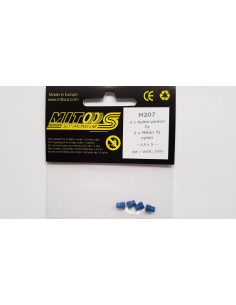
When we talk about technical materials in the world of slot racing, model making, and miniature manufacturing, nylon occupies a place that is rarely explained rigorously. It is omnipresent —found in gears, guides, motor mounts, motor supports, bushings, and numerous structural parts— but it rarely receives the attention it deserves. Here, we want to change that.
If you are preparing a competition car and looking for parts that can withstand heat and stress without deforming, if you are a model maker needing printed or machined components with tight tolerances, or if you simply want to understand why certain manufacturers choose this polymer over others, you are in the right place.
Nylon —technically polyamide (PA)— is one of the most widely used engineering thermoplastics in the manufacture of small precision components. Its popularity is no coincidence: it combines notable mechanical strength with some elasticity, allowing it to absorb impacts without breaking suddenly. Additionally, it has a low coefficient of friction, making it ideal for parts that continuously rub against each other, such as gears or sliding guides.
In the context of slot racing and scale modeling, where tolerances are measured in tenths of a millimeter and the weight of each component influences performance, choosing the right material is not a minor detail. A poorly sized nylon gear can create play in the transmission; a guide made with the wrong variant can deform due to the heat from the motor and ruin a practice session. Knowing the material is, ultimately, knowing the hobby better.
What is nylon and why is it important in this sector
Nylon is a family of synthetic polymers within the polyamide group. In the industry, several variants are distinguished —PA6, PA6.6, PA12, among others— each with slightly different characteristics regarding moisture absorption, rigidity, working temperature, and ease of machining or 3D printing.
In the world of slot racing, nylon mainly appears in parts such as:
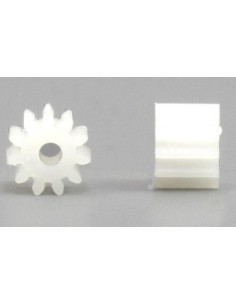
- Gears and crowns: many spare parts manufacturers use nylon or reinforced polyamides for the toothed crowns, especially in versions aimed at durability rather than maximum competition response.
- Guides and guide supports: the body of the guide —the piece that fits into the track and collects electrical current through the braids— is usually made of nylon or similar plastics due to its sliding capability and lightness.
- Motor mounts and supports: in custom preparations or 3D printed chassis, nylon is a reference material due to its dimensional stability under load.
- Bushings, sleeves, and small structural parts: where wear resistance is needed without adding unnecessary weight.
In static modeling, figures, and dioramas, nylon also appears in the form of thread to simulate cables, ropes, or scale tensioners, and as a base material in 3D printing for structural parts or custom accessories.
Its importance lies in the fact that it is an accessible, durable engineering material with predictable behaviour, making it the first choice when standard plastic is not enough but metal is excessive or too heavy.
How to correctly choose nylon components
Not all nylon is the same, and in precision applications, the specific variant makes a difference. Before choosing, it is advisable to ask the right questions:
What application do you need it for?
A part that will be subjected to continuous friction —like a gear in a competition car— is not the same as a structural support that barely moves. For friction parts, a nylon with a low coefficient of friction and good wear resistance is desirable. For supports or mounts, dimensional stability and temperature resistance are paramount.
How much heat will the part withstand?
Slot motors generate heat, especially in long sessions or high-power configurations. Standard nylon (PA6) has a reasonable working temperature, but if the motor is very close to the part, it may be advisable to opt for PA6.6 or variants with fiberglass filler, which better withstand high temperatures without deforming.
Is the part factory original or a third-party replacement?
Spare parts from brands like NSR, Slot.it, Avant Slot, or Scaleauto are made with tested materials and controlled tolerances. When using 3D printed or machined parts from third parties, we must verify that the material used is suitable for the specific application, as the quality of the nylon filament or granulate can vary considerably.
Does weight matter?
In competition, every tenth of a gram counts. Nylon is light compared to metal, but denser than some more modern engineering plastics. If weight is critical, it is advisable to compare with alternatives like Delrin (POM) or polycarbonate before deciding.
Main types and differences
Within what we typically find in the slot and modeling sector under the "nylon" label, we can distinguish several groups:
PA6 (Nylon 6)
The most common and economical. Good mechanical strength, easy to machine, and with moderate moisture absorption. It is the basis for many standard parts. Its main limitation is that it absorbs moisture from the environment, which can slightly alter its dimensions over time.
PA6.6 (Nylon 6.6)
Slightly stiffer and with better performance at high temperatures than PA6. It is the preferred option for parts that will be close to heat sources. It is also somewhat more difficult to 3D print due to its higher melting temperature.
PA12
Lower moisture absorption than PA6 or PA6.6, giving it greater dimensional stability in humid environments. Widely used in industrial 3D printing (SLS) for precision parts. It is more flexible than the previous ones.
Nylon with fiberglass filler (PA-GF)
The addition of fiberglass significantly increases rigidity and temperature resistance, at the cost of greater wear on machining tools and 3D printing nozzles. Ideal for mounts or supports that must maintain strict geometry under demanding conditions.
Nylon thread
Especially used in dioramas, naval and military models to simulate ropes, antenna cables, tensioners, or scale ropes. Choosing the right diameter according to the working scale is essential for a convincing result.
Technical aspects we should know
Working with nylon —whether as a component of a slot car or as a modeling material— involves understanding some properties that directly influence the result:
Moisture absorption
Nylon is hygroscopic: it absorbs moisture from the environment. This has two practical implications. First, parts may swell slightly over time, which can affect very tight tolerances. Second, nylon filament for 3D printing should be stored in dry conditions (ideally in airtight bags with desiccant), and sometimes it is advisable to dry it before printing to achieve good results.
Coefficient of friction and self-lubrication
Nylon has a low coefficient of friction and some self-lubricating capability, making it ideal for parts in dynamic contact. However, in high-performance applications like competition gears, it may be advisable to add a small amount of specific lubricant to reduce long-term wear.
Chemical resistance
Nylon withstands most oils and lubricants commonly found in the slot workshop. However, it can be affected by strong acids and some solvents. Care should be taken when applying release agents or paint solvents near nylon parts.
Machining and 3D printing
Nylon can be machined with conventional tools, although it requires appropriate cutting speeds to avoid melting the material. In FDM 3D printing, it needs high extrusion temperatures and a heated bed to adhere properly. The PA12 variant processed by SLS offers the best results in precision parts.
Practical tips for use, maintenance, and preparation
Getting the most out of nylon components in slot racing or modeling involves following some simple but important guidelines:
- Check tolerances before assembly. Especially in gears and guides, ensure that the fit is correct before forcing the assembly. Nylon has some elasticity, but forcing a poorly sized part can create internal stresses that lead to breakage.
- Lubricate wisely. In gears and sliding parts, a small amount of specific lubricant (avoid excess) improves the lifespan of the part and reduces noise during operation.
- Store filament dry. If you print your own nylon parts, keep the spool in an airtight bag with silica gel when not in use. Moist filament produces porous and fragile prints.
- Clean parts carefully. To clean nylon components, use water or mild alcohols. Avoid aggressive solvents like acetone, which can attack the surface.
- Check for wear periodically. In competition gears, nylon wears with use. A crown with worn teeth transmits less efficiency and can create play in the transmission. Replace it before performance is compromised.
- Paint with caution. If you need to paint a nylon part in a diorama or model, first apply a specific adhesive primer for plastics. Acrylic paints from brands like Vallejo, Tamiya, or Ammo adhere well to properly prepared nylon.
Common mistakes to avoid
Over the years, we have seen certain mistakes repeated when working with nylon in the workshop. These are the most common:
- Assuming all nylon is the same. As we have seen, there are variants with very different properties. Using PA6 where PA6.6 or PA-GF is needed can result in deformed or prematurely broken parts.
- Printing with wet filament. The result is parts with bubbles, poor layer adhesion, and mechanical strength well below expectations. Always dry the filament if it has been unused for a while.
- Forcing the fit of parts. Nylon can withstand some elastic deformation, but forcing a gear onto an overly thick shaft can create stresses that cause cold breakage, sometimes hours or days after assembly.
- Forgetting hygroscopicity in humid environments. If you store nylon parts in a humid workshop without protection, they can suffer dimensional variations that affect precise fits. Store them in closed bags or containers.
- Over-lubricating. Excess lubricant on nylon parts can attract dust and particles that act as abrasives, accelerating wear instead of reducing it.
- Not verifying part compatibility. In the world of slot racing, not all guides, mounts, or supports are universal. Always check the manufacturer's specifications and the track system for which the part is designed.
Recommendations for beginners and advanced users
If you are starting out
The most important thing is not to complicate things too much at first. If you are assembling or preparing a slot car and need to replace a guide or a crown, opt for original spare parts from brands like NSR, Slot.it, or Avant Slot: they are made with tested materials and the tolerances are correct. It is not worth experimenting with parts of unknown origin when learning to prepare a car.
In modeling, if you are going to use nylon thread to simulate cables or ropes in a model, start with standard diameters for your scale and practice knots and tensions before permanently gluing anything.
If you already have experience
Advanced users can make the most of 3D printing in nylon to create custom parts: motor mounts adapted to specific geometries, optimized mounts for weight distribution, or diorama accessories with a level of detail difficult to achieve otherwise.
In competition, it is worth knowing the differences between polyamide variants well to choose the right material according to the category and championship regulations. Some regulations specify restrictions on the materials of the parts, especially in slot categories with free chassis.
For advanced car preparation, combine knowledge of the material with fine-tuning of the other variables: chassis geometry, type of braids, hardness of the tyres, and motor configuration (sidewinder, inline, or anglewinder) to achieve maximum performance from the set.
| Variant |
Mechanical strength |
Working temperature |
Moisture absorption |
Typical use in hobby |
| PA6 |
High |
Medium (up to ~80 °C) |
High |
General parts, standard gears |
| PA6.6 |
Very high |
High (up to ~120 °C) |
High |
Parts near motors, mounts |
| PA12 |
Medium-high |
Medium |
Low |
SLS 3D printing, precision parts |
| PA-GF (fiberglass) |
Very high (rigid) |
Very high |
Moderate |
Structural supports, competition |
| Nylon thread |
Variable depending on diameter |
— |
Low |
Dioramas, models, scale tensioners |
Frequently asked questions
Is nylon better than Delrin (POM) for slot gears?
It depends on the application. Delrin has lower moisture absorption and is slightly stiffer, making it very dimensionally stable. Nylon, on the other hand, is tougher and better withstands impacts without breaking. For competition crowns, many preparers prefer Delrin; for parts with some impact load, nylon may be more suitable.
Can I 3D print nylon parts at home for my slot car?
Yes, but it requires a printer with a high-temperature extruder and a heated bed. Nylon is more demanding than PLA or PETG. The result can be very useful for custom mounts and supports, although for critical parts like gears or guides, it is advisable to compare the result with original reference parts.
Does nylon filament for 3D printing always need to be dried?
If the spool has been open for a while or has been stored without protection, yes. Drying for 6-8 hours at 70-80 °C in a dehydrator or in the oven at low temperature significantly improves print quality and the mechanical strength of the parts.
What lubricant should I use with nylon parts in slot racing?
Silicone lubricants or those specifically for plastic gears are the most recommended. Avoid aggressive lubricants that may attack the polymer. Always apply in small amounts.
Do nylon parts withstand the solvents in the paints I use in modeling?
It depends on the solvent. Nylon withstands water and mild alcohols well. Water-based acrylic paints from brands like Vallejo, Tamiya, or Ammo usually do not present problems. Avoid using acetone or esters near nylon parts.
How do I know which nylon variant a part from a slot manufacturer uses?
In most cases, manufacturers do not specify the exact variant. If you need this information for a critical application, the most practical approach is to contact the manufacturer directly or to manufacture the part yourself with verified material.
Does nylon change dimensions with temperature during a racing session?
The thermal expansion of nylon exists but is moderate in the usual temperature range of slot racing (ambient to 80-100 °C). In very tightly fitted parts, there may be some variation, especially in PA6 parts exposed to continuous heat. The PA6.6 and PA-GF variants are thermally more stable.
Can I use nylon thread in dioramas of any scale?
Yes, but the diameter of the thread must be proportional to the scale. For scale 1/35 or 1/48, for example, a real naval mooring cable of 30 mm in diameter would be represented with a thread of less than 1 mm. Always calculate the real diameter based on the scale before purchasing.
Are nylon crowns suitable for slot racing competition categories?
It depends on the regulations of each championship. Some categories allow any material for the crown; others restrict to approved materials or manufacturers. Always check your championship regulations before mounting non-original parts.
Why does a nylon part that should last longer get scratched or worn quickly?
The most frequent causes are insufficient lubrication, using an unsuitable variant for the application, incorrect tolerances (forced part), or contamination with abrasive particles. Check these factors before attributing wear to the material itself.
Can I paint 3D printed nylon parts for dioramas or models?
Yes, but nylon is difficult to paint directly due to its low surface adhesion. First, apply a specific primer for plastics or a spray primer (brands like Vallejo or Tamiya have valid options) and then work with acrylic paints as usual.
What is the difference between nylon and "plastic" in the context of slot racing?
In the colloquial language of the sector, "plastic" can refer to any polymer, including nylon. Technically, nylon is an engineering plastic with superior mechanical properties compared to general-use plastics (ABS, PS, PP). When a manufacturer specifies "nylon" or "polyamide," they are indicating a technical material with specific characteristics, not a generic plastic.