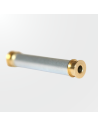
The rear axle is one of the quietest components in a slot car assembly and, at the same time, one of the most influential on track behaviour. When everything else is adjusted — motor properly mounted, concentric tyres, level chassis — an axle with dimensional variation or minimal eccentricity can ruin cornering stability, cause vibrations at high speed, or prevent the crown gear from meshing properly with the pinion. It is not a component that usually comes up in regular discussions about tuning, but experienced enthusiasts know perfectly well that a quality axle makes a difference.
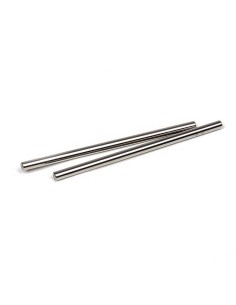
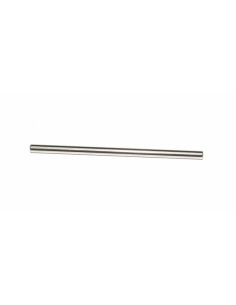
In this category, you will find calibrated steel axles in the most commonly used diameters for 1/32 and 1/24 slot cars: the nominal standard of 2.38 mm (equivalent to 3/32 inches, an Anglo-Saxon measurement that dominates the sector) and 2.36 mm (NSR Recommended Size, the diameter that NSR specifies for its own bearings and supports). Knowing that difference of two hundredths is essential before purchasing: it is not a catalogue error, but an engineering decision.
If you are preparing a competition car, mounting a new chassis, or simply replacing an axle that has become worn with use, here you have everything you need to make the right choice without going off on tangents.
What is a steel axle and why does it matter so much
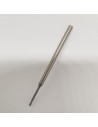
The rear axle of a slot car is the metal bar on which the rear wheels (or the rear wheel in split axle configurations) and the crown gear that receives the motor's movement are mounted. It is the link between the transmission and the ground. Therefore, any imperfection in it is amplified and noticeable.
Calibrated steel is machined to maintain very tight tolerances along the entire length of the bar. This ensures that the bearings seat concentrically, that the crown does not develop orbital movement, and that the tyres do not lose contact with the track at any point during the lap. In a car travelling at real scale speeds of over 300 km/h equivalent, that concentricity is not a luxury: it is the difference between a car that grips and one that vibrates.
Steel as a material is the predominant choice for slot axles for several reasons: a good balance between stiffness and weight, precise machinability, and sufficient strength to withstand the torsional and bending stresses generated by the motor. Some manufacturers work with steels of higher surface hardness to reduce wear in the contact area with the bearings.
How to correctly choose a steel axle
The first criterion is diameter. The two dominant diameters in the market are:
- 2.38 mm (3/32"): the historical standard of the sector, compatible with the vast majority of bearings, supports, and crowns on the market. It is the reference diameter for Slot.it, Scaleauto, Avant Slot, and most tuning accessories.
- 2.36 mm (NSR Standard): the preferred diameter of NSR for its own bearings and supports. NSR designs its components with this measurement to ensure a precise fit without radial play. If you are mounting an NSR chassis or using its bearings, this is the axle you need.
Mixing diameters is the most common mistake among those starting in tuning. A 2.38 mm axle in an NSR bearing designed for 2.36 mm will have more play than desired; a 2.36 mm axle in a standard support may be too loose. Always check the specifications of the chassis and bearings you are using before ordering.
The second criterion is length. Axles are sold in standard lengths that are then cut to size according to the car's track width. Ensure that the length you purchase is sufficient for your scale and configuration; it is better to have excess length and cut than to be short.
The third criterion is the quality of finish. A well-calibrated axle should have the same measurement along its entire length and should not show machining marks, surface rust, or curvatures. Some manufacturers offer precision-ground axles for competitive use.
Types and main differences
Although at first glance all steel axles for slot cars may seem identical smooth bars, there are relevant differences depending on the manufacturer and intended use:
- Standard calibrated axles: the most common. Correct tolerances for sporting and recreational use. They are the most economical option and perform well in most setups.
- Precision ground axles: finer machining, tighter tolerances. Used in competition setups where maximum concentricity is a priority. The difference with the standard axle is small on paper but noticeable on track at high speeds.
- Split or two-piece axles: these are not continuous bars, but two semi-axles that are managed independently. They allow for differential traction configurations or specific setups. They are covered in other categories, but it is worth keeping them in mind when discussing axles in general.
Regarding brands, NSR, Slot.it, and Scaleauto are the main manufacturers of calibrated steel axles with documented catalogues and published tolerances. Each has its own reference diameters and common lengths, which reinforces the importance of verifying compatibilities before combining parts from different manufacturers.
Technical aspects we need to know
To get the most out of a steel axle, it is important to understand how it interacts with the rest of the drivetrain:
Bearing and radial play
The axle rotates supported by ball bearings housed in the chassis supports. Radial play (the clearance between the axle and the inner track of the bearing) directly influences stability. Excessive play causes the axle to "dance" and the crown not to maintain a constant distance from the pinion, resulting in noise, loss of efficiency, and accelerated wear. Therefore, the exact diameter of the axle and the inner diameter of the bearing must be perfectly coordinated.
Concentricity and balancing
A perfectly straight and concentric axle is the starting point for balancing the wheel-rim-tyre assembly. If the axle has even a slight curvature, no subsequent balancing will fully compensate for it. Always check the straightness of the axle by rolling it on a flat surface before mounting it.
Crown fixation
The crown is fixed to the axle using a grub screw, adhesive, or interference depending on the design. In any case, the dimensional precision of the axle in the crown support area is critical for uniform meshing with the pinion throughout the lap. An axle with variation at that point causes what is colloquially known as "cam effect": the meshing tightens and loosens rhythmically with each turn of the axle, prematurely wearing the pinion and crown.
Transmission of movement depending on motor configuration
The type of motorisation affects how the rear axle works. In a sidewinder configuration (motor parallel to the rear axle), the crown receives movement directly from the pinion with the motor mounted transversely, allowing for larger crown diameters and optimising the reduction. In an inline configuration (motor perpendicular to the axle, longitudinal), the pinion is at the end of the crankshaft and the crown is in the centre of the axle, with a different meshing geometry. In an anglewinder configuration, the motor works at an angle, requiring special attention to the alignment of the axle to maintain correct meshing. In all three cases, the axle is the central link: any inaccuracy is amplified.
Practical tips for use, maintenance, and tuning
- Check the diameter before mounting. Although it may seem obvious, measuring the new axle with a micrometer before installing it avoids many headaches. Axles nominally the same from different manufacturers can have tenths of a millimetre difference.
- Check straightness on a reference surface. Roll the axle on a flat table or plate before installing it. If it describes a wavy trajectory, it is bent and should be discarded for competition.
- Clean the axle before mounting the bearings. Machining particles or remnants of anti-corrosion protection can affect the fit. A clean cloth with a little degreaser is sufficient.
- Lubricate the bearings, not the axle. Oil goes in the bearings, not directly applied to the axle in the contact area with the track. Excess lubricant on the axle can migrate to the tyres and ruin grip.
- Check axial play. In addition to radial play, the axle should not have excessive lateral movement within the supports. A little axial play is normal and necessary, but if the axle moves several tenths of a millimetre side to side, the crown shifts relative to the pinion and performance drops.
- Change the axle if you detect unexplained vibration. When you have balanced wheels and tyres and the vibration persists, the axle is usually the culprit. Axles can bend from impacts or accumulated heat during long sessions.
Common mistakes we should avoid
- Mixing diameters without checking compatibilities. We have already mentioned this, but it deserves repetition: a 2.38 mm axle in NSR bearings (designed for 2.36 mm) will not yield the expected results. Always consult the specifications of the chassis or bearing manufacturer.
- Over-tightening the crown screw. The grub screw is meant to fix the position, not to compress the axle. Over-tightening can deform the axle or create a mark that complicates future disassembly.
- Using the same practice axle in competition. Axles used in long sessions accumulate wear in the contact areas with the bearings. For an important race, it is worth mounting a new axle.
- Not checking straightness after an impact. A strong hit against the curb or a high-speed accident can bend the axle without it being visible to the naked eye. If the car starts to vibrate after an accident, check the axle before looking for another culprit.
- Confusing nominal diameter with actual diameter. "3/32 inches" theoretically equals 2.381 mm, but the actual finish varies by manufacturer. A nominally 3/32" axle from a generic brand is not the same as one from NSR or Slot.it with documented tolerances.
Recommendations for beginners and advanced users
If you are just starting
If you are assembling your first car or doing your first preparations, the simplest thing is to buy the axle recommended by the manufacturer of the chassis you are using. NSR specifies 2.36 mm for its components; most of the rest of the market works with 2.38 mm (3/32"). Do not try to mix components from different systems until you clearly understand how each one works. A good quality standard calibrated axle is more than sufficient to start and learn to assemble properly.
If you already have experience
In competition preparations, the choice of axle begins to have finer nuances. Some tuners prefer precision-ground axles with tighter tolerances to reduce play in the bearings to the minimum possible. Others work with steel axles of higher surface hardness to reduce wear in long-distance sessions. If you use anglewinder configuration, pay special attention to the crown support area and check the meshing more frequently, as the angular geometry is more sensitive to dimensional variations in the axle. In any case, always carrying spare axles in the race bag is a practice that veteran enthusiasts never abandon.
| Diameter |
Equivalence |
Main Use |
Manufacturer Reference |
| 2.38 mm |
3/32" nominal |
General standard of the sector |
Slot.it, Scaleauto, Avant Slot |
| 2.36 mm |
NSR Standard (NSR) |
NSR chassis and bearings |
NSR |
Frequently asked questions about steel axles for slot cars
What is the real difference between a 2.36 mm axle and a 2.38 mm axle?
They are two hundredths of a millimetre, but in precision engineering, that is significant. NSR designs its bearings and supports to work with 2.36 mm; using them with a 2.38 mm axle implies more interference than expected, which can complicate assembly and affect the lifespan of the bearings. Conversely, a 2.36 mm axle in standard bearings may have more play than desirable.
Can I cut a steel axle with the tools I have at home?
Yes, but with precautions. The cleanest way to cut a calibrated steel axle is with a disc cutter or a rotary tool with a fine cutting disc. Avoid shears or cutting pliers: they deform the end of the axle and can cause a slight curvature. After cutting, smooth the end with a fine file to remove burrs.
How do I know if my axle is bent?
The quickest test is to roll it on a flat reference surface (a glass plate or a metrology surface is ideal, but a well-levelled table will suffice). If the axle describes a wavy trajectory or bounces, it is bent. You can also mount it between points and spin it by hand while observing the central area: any visible oscillation indicates eccentricity.
How often should I change the axle?
It depends on usage. In collection cars or occasional recreational use, the axle can last for years without issue. In competition cars with many track sessions, it is advisable to check the axle each season or after significant impacts. The clearest indicator that the axle needs changing is the appearance of vibrations that do not resolve by balancing wheels and tyres.
Does the axle steel influence the weight of the car?
The rear axle weighs very little in absolute terms, but its position (low and centred in the car) positively contributes to lowering the centre of gravity. In terms of weight adjustment, the most significant changes are achieved with ballast, not by replacing the axle with lighter materials.
Can I use the same axle for sidewinder and inline configurations?
Yes. The axle itself is the same; what changes is the position of the motor relative to it and, therefore, the point where the crown and pinion are mounted. What matters is that the axle is of the correct diameter for the bearings of the chassis you are using, regardless of the motor configuration.
Are axles from different brands interchangeable?
In principle, yes, as long as the diameter is compatible with the chassis bearings. That said, mixing an axle from one brand with bearings from another requires checking diameters and tolerances. Do not assume automatic compatibility between brands: always check the specifications.
What lubricant should I use on the axle?
The lubricant goes in the bearings, not directly on the axle. Use the specific oil for slot bearings recommended by the bearing manufacturer or a low-viscosity oil suitable for precision bearings. Avoid thick greases: they reduce rolling efficiency and can stain the tyres if they migrate.
Is there a performance difference between a standard axle and a precision ground one?
In recreational use, the difference is imperceptible. In high-speed competition, a ground axle with tighter tolerances can reduce vibration at high RPM and improve cornering stability. It is a marginal but real improvement for demanding setups.
Can I straighten a bent axle?
Technically, it is possible with precision tools, but in practice, it is not advisable. A calibrated steel axle is so inexpensive that it is not worth trying to correct it: the risk of introducing internal stresses that may cause later breakage is greater than the savings. Replace it directly.
What length of axle do I need for a 1/32 car?
It depends on the track width of the car and the chassis. Axles are sold in lengths that usually cover most 1/32 configurations with room to cut. Check the chassis manual or the manufacturer's measurements to know exactly how much you need before cutting.
Do slot axles work for 1/24 scale cars?
The axle diameters are similar in many cases, but the necessary length is greater in 1/24 due to the wider track. Always verify the available length and specifications of the 1/24 chassis you are mounting before purchasing.