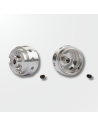
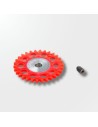
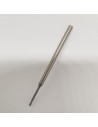
When you start to seriously tune a slot car, there comes a time when conventional steel axles fall short. Not because they fail, but because carbon opens a different dimension: less rotating mass, controlled stiffness, and a response you can feel from the first lap. Carbon axles have been the benchmark material in high-level competition for years, and today they are within reach of any enthusiast looking to maximise their setup.
At Ministry of Hobby, we work with carbon axles for the most common scales and configurations in modern slot racing. Whether for mounting on a 1/32 chassis in sidewinder, inline, or anglewinder configuration, or for a 1/24 setup, the carbon axle is one of the components that most influences the final behaviour of the car and deserves to be chosen wisely.
This category is designed for both the driver taking their first steps in technical preparation and the competitor who already knows every tenth of a gram they add or remove from their car. Here you will find the information you need to make the right choice, understand what you gain over steel, and avoid the most common mistakes.
What is a carbon axle and why does it make a difference
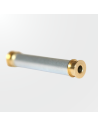
A carbon axle is essentially a rod made from carbon fibre —instead of the usual steel— on which the rear (or front) wheels of the car are mounted. Its function is to transmit the motor's rotation to the wheels in a solid manner, and its stiffness and weight have a direct impact on dynamic behaviour.
Carbon fibre offers a stiffness-to-weight ratio that is far superior to that of steel. This translates into several specific benefits on the track:
- Less rotating mass: reducing the weight of the rotating parts (axles, wheels, crown gear) has a multiplying effect on acceleration. The motor requires less effort to bring the axle up to speed, and this is noticeable in corner exits.
- Greater stiffness: an axle that does not flex under load transmits torque more directly and predictably. Less loss, more efficiency.
- Dimensional stability: carbon does not deform or bend as easily as a fine steel axle when impacted or dropped.
- Sharper response: experienced drivers describe carbon axles as "more alive"; the communication between the motor and the wheels is more direct.
That said, carbon is not magic: its real advantage appears when the rest of the setup —motor, tyres, chassis, braids— is also on point. In a stock car without tuning, the difference is less noticeable.
How to correctly choose a carbon axle
Before purchasing a carbon axle, there are several variables you need to be clear about. Choosing incorrectly can mean that the axle does not fit in the setup, that the diameter does not match your wheels, or that the length is not suitable for your chassis.
Diameter
This is the first filter. The most common diameters in 1/32 slot racing are 2.38 mm (3/32") and 3 mm, although other sizes exist depending on the manufacturer and scale. Always check the specifications of your chassis and setup before choosing. An axle with the wrong diameter will not fit in the bearings or will be loose, ruining any benefits of the carbon.
Length
This depends on the chassis and the wheelbase you want to achieve. Many manufacturers offer the same axle in various lengths. Measure your current axle or consult the technical sheet of the chassis to avoid mistakes.
Position in the car (front or rear)
Although the most common use is in the rear axle —where the transmission generates more torque and where rotating weight matters more— carbon axles can also be mounted on the front axle. In that case, the gain is primarily in weight, as the front axle does not transmit power.
Motor configuration
The type of motor mounting influences how the axle works. In sidewinder configuration (transverse motor, parallel to the rear axle), the crown gear goes directly on the axle and the load is lateral. In inline configuration (longitudinal motor, perpendicular to the axle), the axle receives torque differently. In anglewinder, the motor is tilted relative to the axle. Carbon adapts well to all three configurations, but the position and diameter of the axle may vary.
Compatibility with bearings and wheels
Carbon does not always have exactly the same surface finish as steel. Ensure that your bearings are compatible with the diameter of the carbon axle and that the wheels fit snugly. Some axles require a slight adjustment with very fine sandpaper.
Types and main differences
Not all carbon axles are the same. Within this category, you will find relevant differences:
Solid carbon vs. hollow carbon
Most carbon axles for slot racing are solid, which gives them all their structural stiffness. There are hollow versions for very specific applications where weight saving is prioritised over stiffness, but this is not common in slot racing. Solid axles are the standard and most reliable option.
Carbon vs. steel
Steel remains the most economical and sufficient option for street or beginner cars. Carbon comes into play when you seek performance, competition, or simply want the best possible setup. The price difference is justified when the rest of the car is at an equivalent technical level.
Axles with surface treatment
Some carbon axles incorporate a specific treatment or coating to improve fit with bearings or to increase surface hardness. They are an interesting option if you frequently mount and dismount wheels.
By scale and application
Carbon axles are primarily available for 1/32 and 1/24. In 1/24, where the cars are larger and heavier, the reduction of rotating weight is even more noticeable. In 1/32, the market has the most variety of options.
Technical aspects we need to know
Working with carbon axles involves having some technical knowledge that may not have been necessary with steel:
Cutting the axle
If you need to adjust the length, carbon is cut with specific tools or a fine cutting disc. Do not use pliers or tools that fracture the fibre: the cut must be clean and perpendicular for the axle to be perfectly straight. A precision cutting wheel or diamond disc is highly recommended.
Sanding and finishing
Carbon can be lightly sanded to adjust the diameter in specific areas if there is slight play. Use fine-grit sandpaper and do it patiently, measuring with a micrometer. The goal is for the axle to fit into the bearing with the correct fit, without play but without forcing.
Gluing wheels and crown gear
Carbon has less chemical adhesion than steel with some adhesives. Use specific adhesive for carbon or medium-viscosity cyanoacrylate. Before gluing, degrease the surface well with isopropyl alcohol. Poor adhesion on a carbon axle can cause the wheel to slip on the axle under load, ruining performance.
Bearings
With carbon axles, ball bearings are the natural pairing. Friction bushings generate more heat and can wear the surface of the carbon sooner. If you still use bushings, carbon is still better than steel, but you won't get its full potential.
Practical tips for use, maintenance, and preparation
Carbon is a durable material, but it requires different treatment than steel if you want it to last and perform at its best:
- Check straightness before mounting: roll the axle on a flat surface or use an eccentricity gauge. A carbon axle with curvature, even minimal, generates vibration and uneven wear on the tyres.
- Lubricate the bearings, not the axle: the lubricant should go in the bearings, not on the surface of the carbon where the wheels or crown gear are glued. Excess lubricant in those areas can weaken the bond.
- Store them properly: avoid leaving the axles loose in a box where they can bump against each other. Carbon does not bend easily, but a strong impact can create internal microfractures that are not visible to the naked eye and degrade stiffness.
- Inspect periodically: if you notice new vibrations or the car loses performance without apparent cause, inspect the axle. A microfracture may go unnoticed visually but affect behaviour.
- Do not force the disassembly of wheels: if you have glued a wheel with cyanoacrylate, do not use pliers to pull it off. Use the appropriate solvent and work patiently. Forcing can fracture the axle.
Common mistakes we should avoid
The experience of working with carbon leads to identifying the most common mistakes, especially among those making the switch from steel:
Buying by diameter without checking the actual tolerance
An axle nominally 2.38 mm may have slightly different tolerances depending on the manufacturer. Before buying in bulk, test with one unit and check the fit in your bearings and setup.
Using inappropriate adhesive
The most common mistake: applying the same adhesive you used with steel without checking its compatibility with carbon. Result: the crown gear or wheel spins on the axle under load. Always use adhesive tested on carbon.
Cutting the axle with the wrong tool
A poorly executed cut can leave the end splintered or slightly angled, causing the axle not to be perfectly centred in the bearing. Invest in a good cutting disc.
Mixing carbon axles with low-quality components
Putting a carbon axle in a car with worn bearings, damaged tyres, or an off-centre crown gear is wasting the potential of the material. Carbon amplifies the strengths of the setup, but also the weaknesses.
Not checking eccentricity
Mounting the axle without verifying that it is perfectly straight is a mistake that pays off on the track with vibrations and premature tyre wear. Spend two minutes on this step before each assembly.
Recommendations for beginners and advanced users
If you are starting with technical preparation
The carbon axle is an upgrade that makes sense when you have already resolved the basics: good tyre adhesion, braids in good condition, well-adjusted guide, and clean bearings. If you start with a stock car without tuning, the first step is usually to optimise those elements. Once the car responds well in the essentials, the carbon axle is one of the most noticeable and accessible upgrades to take the next leap.
Start with a rear axle in the diameter specified by your chassis, mount carefully, and compare lap times before and after. The difference, especially in acceleration and lap consistency, is usually clear.
If you already have experience in preparation
The carbon axle is likely already part of your regular kit. In that case, the nuances that make the difference are: the quality of the cut, the gluing method, the type of bearing, and the combination with the tyre profile. In high-level competition, some tuners work with axles of different diameters depending on the type of circuit, adjusting the torsional stiffness of the setup to adapt behaviour to tracks with more or less lateral load.
At Ministry of Hobby, you will find carbon axles from brands like NSR, Slot.it, and Scaleauto, proven references in competition with real stock so you don't waste time on preparations.
| Material |
Weight |
Stiffness |
Price |
Recommended use |
| Standard steel |
High |
Medium-high |
Low |
Stock cars, beginners |
| Stainless steel |
High |
High |
Medium |
Basic-medium preparation |
| Solid carbon |
Low |
Very high |
Medium-high |
Competition, advanced preparation |
Frequently asked questions about carbon axles
Are carbon axles compatible with any chassis?
They are compatible as long as the diameter and length match those of your chassis. There is no universal standard, so always check the measurements before buying.
Can I mount a carbon axle on the front axle?
Yes. On the front axle, there is no torque transmission, but the reduction of rotating weight still provides benefits in the overall response of the car, especially in direction changes.
How much lighter is a carbon axle compared to a steel one?
The difference varies depending on the diameter and length, but in typical 1/32 axles, it can mean a weight reduction of between 30% and 50%. In rotating mass, that percentage has a real effect on acceleration.
Does carbon bend or break easily?
It does not bend like steel, but it can fracture from lateral impact if the blow is strong enough. Under normal track use conditions, it is a very resilient material.
Do I need special bearings to use carbon axles?
You do not need special bearings, but it is advisable to use ball bearings instead of friction bushings. Ball bearings are the natural combination with carbon and ensure maximum performance.
Can I cut a carbon axle at home?
Yes, but you need the right tool: a fine cutting disc (diamond or similar) and to do it calmly so that the cut is clean and perpendicular. A poor cut ruins the axle.
What adhesive should I use to glue the crown gear on a carbon axle?
Medium-viscosity cyanoacrylate is the most common option. Degrease the surface of the axle well with isopropyl alcohol before applying the adhesive. Some tuners use specific adhesives for carbon, especially when frequent disassembly is anticipated.
Does the carbon axle directly improve lap times?
Not miraculously, but it does contribute by reducing rotational inertia and improving the response of the setup. The effect is more evident on circuits with many tight corners where exit acceleration is crucial.
For which scales are carbon axles available?
Mainly for 1/32 and 1/24. In 1/32, there is a greater variety of diameters and lengths. In 1/24, the offering is more specific but equally interesting due to the larger size and weight of the cars.
Is the carbon axle worth it in a club car (not high competition)?
It depends on your overall preparation level. If the rest of the car is already optimised —bearings, tyres, braids, guide—, the carbon axle is an upgrade that is noticeable. If the car is almost stock, there are other priorities first.
Do carbon axles require special maintenance?
No special maintenance, but basic care: store them protected from impacts, check their straightness before mounting, and do not force the disassembly of glued parts. They are durable if treated well.
What brands of carbon axles are trustworthy?
NSR, Slot.it, and Scaleauto are the most solid references in the market, with years of competition use backing their quality. At Ministry of Hobby, we regularly work with these brands.