When we start tuning a slot car, there are components that make a discreet but decisive difference. The axles are one of them. They may not catch the eye at first glance, but any experienced driver knows that a lower quality axle can ruin the most careful setup: vibration, unnecessary friction, premature bearing wear, and ultimately, loss of speed and consistency during a race. That’s why, when we talk about titanium axles or those treated with TiN (Titanium Nitride), we are discussing a tangible and measurable improvement, not a preparer's whim.
The world of competitive slot racing has evolved enormously in recent years. Brands like NSR, Slot.it, Avant Slot, and Scaleauto have pushed the limits of what can be achieved in 1/32 scale, and the level of demand for internal components has grown in parallel. In this context, choosing the right material for the rear axle — responsible for transmitting the motor's power to the wheels — is not a minor detail. It is a technical decision that directly affects the car's behaviour on the track.
At Ministry of Hobby, we have been working for years with preparers, championship drivers, and enthusiasts who simply want to get the best out of their cars. We know which axles perform better under continuous load, which withstand heat generated during long sessions, and which offer a surface hard enough to ensure minimal wear even with competition bearings. This category is designed for you to find exactly what you need, with the technical information necessary to make the right choice.
What titanium is in slot axles and why it matters
Titanium is a metal known for its extraordinary strength-to-weight ratio. In industrial and high-competition applications — from Formula 1 to aerospace — it is used precisely for this reason: it offers very high structural rigidity without adding unnecessary mass. In the context of slot racing, this translates into axles that do not bend or deform under the pressure of the bearings and crown gear, that maintain perfect concentricity, and that do not develop harmonic vibrations that are transmitted to the chassis and affect cornering behaviour.
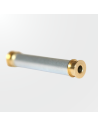
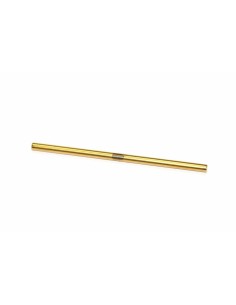
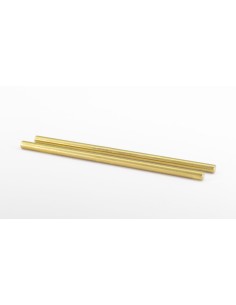
The TiN treatment, or Titanium Nitride, is different: it is not an axle made entirely of titanium, but a steel axle (usually of high quality) to which a surface layer of titanium nitride is applied through a deposition process. The result is an extremely hard surface — superior in surface hardness to untreated steel — with a very low coefficient of friction. Visually, these axles present that characteristic golden hue that distinguishes them at first glance.
Both options share a common goal: to reduce friction, increase durability, and maintain geometric precision over time. In a slot car, where tolerances are minimal and any play or irregularity is noticeable on the track, that level of precision is fundamental.
How to correctly choose a titanium or TiN axle
Before purchasing an axle, several parameters must be clear. The first and most important is the diameter: axles for 1/32 slot cars are usually 3 mm, although there are variations depending on the manufacturer and type of chassis. Installing an axle with the wrong diameter may seem to fit, but it will generate play or stresses that will quickly degrade performance.
The second parameter is the length. Each chassis and track configuration has a specific axle length. Measuring it correctly before buying avoids having to make adjustments or, worse, discovering on the track that the axle protrudes excessively or is too short.
The third factor is the compatibility with the crown gear and bearings. A TiN axle, due to its surface hardness, may be more demanding regarding the quality of the bearings used alongside it. Combining a high-performance axle with low-quality bearings is a common mistake that nullifies the investment.
Finally, consider whether the car is intended for universal track use (Scalextric, Ninco) or sport track (Scaleauto, Slot.it), as the track width and tuning demands may vary, influencing the choice of axle and its length.
Main types and differences
In our category, you will find basically two types of axles:
- Solid titanium axles: made entirely of titanium alloy. They are the lightest and stiffest. Their use is more widespread in competition setups where reducing mass in rotating components has a direct impact on acceleration and car response.
- TiN (Titanium Nitride) treated axles: steel base with titanium nitride coating. They offer very high surface hardness, excellent wear resistance, and reduced friction. They are a very popular option for their balance between performance and price.
Within each type, the differences arise from the manufacturer, manufacturing tolerances, surface finish, and thermal treatment of the core in the case of TiN. Not all axles with a golden coating are the same: the quality of the deposition process makes the difference between a coating that lasts the entire season and one that degrades after a few sessions.
Brands like NSR, Slot.it, and Scaleauto offer axles with their own specifications, designed to fit their chassis and bearings. In many cases, the most coherent choice is to use the axle from the same manufacturer as the chassis, unless there are specific technical reasons to replace it.
Technical aspects we need to know
An axle does not work alone: it is part of a system that includes bearings, crown gear, pinion, and wheels. The interaction between all these elements determines the final performance. When replacing a standard axle with a titanium or TiN one, it is advisable to check the condition of the bearings, as a worn bearing can damage the surface of the new axle or vice versa.
Concentricity is perhaps the most critical aspect. An axle that is not perfectly circular along its entire length generates vibrations that the driver perceives as a lack of traction or nervousness in corners. Quality titanium or TiN axles are manufactured with very tight tolerances, but they can be damaged if handled with inappropriate tools during assembly.
The torque of the crown gear on the axle is another point to watch. Excessive tightening can deform the axle or create internal stresses that reduce its lifespan. A torque wrench or, alternatively, the preparer's tactile experience, is essential here.
Regarding the type of motorisation, the position of the motor relative to the axle influences the load it bears. In a sidewinder configuration (motor parallel to the rear axle), the transmission is direct and the load on the axle is relatively uniform. In an inline configuration (motor perpendicular to the axle, in line with the car), the transmission varies and the forces acting on the axle have a different component. In an anglewinder setup, the angle of the motor introduces additional lateral forces. Knowing the motorisation of the chassis helps in choosing the right axle.
Practical tips for use, maintenance, and preparation
The first tip is basic but often overlooked: clean the axle before mounting it. Packaging residues, storage grease, or simply dust can create irregularities in the bearing seats. A clean cloth and, if necessary, a bit of specific degreaser do the job in seconds.
For assembly, use tools that do not scratch or deform the axle. Aluminium or nylon axle holders are a good option. Avoid unprotected steel jaws on TiN axles, as they can mark the coating and create points of accelerated wear.
Lubrication should be minimal and specific. For the bearings, use the lubricant recommended by the bearing manufacturer; at the contact point between the axle and the crown gear (if it is not a press fit), a microscopic amount of high-viscosity lubricant is sufficient. Over-lubricating attracts dirt and degrades the materials.
Periodically check the axle for marks or deformations, especially after collisions or strong off-track incidents. A slightly bent axle is difficult to detect by eye but easy to check by slowly spinning it on a flat surface or with a dial gauge.
Common mistakes to avoid
- Buying by price without checking dimensions: a cheaper axle with a 0.05 mm difference in diameter can create play or interference that ruins the setup.
- Ignoring the condition of the bearings: changing the axle without checking the bearings is like putting on new tyres without aligning. The investment will not yield the expected results.
- Mixing TiN axles with low-quality bearings: the surface hardness of the coating can, in some cases, accelerate the wear of soft bearings. Maintain the consistency of the set.
- Over-tightening the crown gear: the crown gear fixing screw should be firm, not forced. Excessive tightening can create a local deformation that becomes a source of vibration.
- Not checking concentricity after assembly: before hitting the track, spin the axle with the car in hand and observe if there is any irregular movement or abnormal noise in the bearings.
- Assuming universal compatibility: not all 3 mm axles are interchangeable between brands. Lengths, surface treatments, and tolerances vary. Always check the chassis specifications.
Recommendations for beginners and advanced users
If you are starting in the world of slot
It is not necessary to start with the most expensive axle in the catalogue. The most important thing is to learn how to correctly assemble the rear end, understand how the axle works with the bearings and crown gear, and develop the eye to detect vibrations or play. A mid-range TiN axle from a reputable brand like NSR or Slot.it is a solid choice to get started without excessive complications.
Before changing the axle, ensure that the rest of the rear end is in good condition. Often, problems attributed to the axle originate from worn bearings or a misaligned crown gear.
If you already have experience and are preparing for competition
Solid titanium makes sense when you are looking to reduce mass in rotating components to the maximum. Every gram you remove from the axle is mass that the motor does not have to move with each gear change. In combination with precision bearings and a well-concentric crown gear, the improvement in acceleration and response is noticeable.
In championships with free component regulations, it is worth investing in axles from manufacturers that publish their manufacturing tolerances. Repeatability — that all axles of the same reference are practically identical — is as important as the nominal performance of the material.
| Type of axle |
Material |
Surface hardness |
Weight |
Usage profile |
| Standard steel |
Carbon steel |
Medium |
High |
General use, beginners |
| TiN (Titanium Nitride) |
Steel + TiN coating |
Very high |
High |
Competition, good quality/price ratio |
| Solid titanium |
Titanium alloy |
High |
Low |
Advanced competition, maximum lightness |
Frequently asked questions
What is the difference between a titanium axle and one with TiN treatment?
The titanium axle is made entirely of titanium alloy, making it lighter than steel. The TiN axle is made of steel with a surface layer of titanium nitride, which gives it very high surface hardness and lower friction. TiN is more affordable; solid titanium is lighter.
Are they compatible with all chassis?
It depends on the diameter and length. The most common diameter in 1/32 is 3 mm, but the length varies depending on the chassis. Always check your chassis specifications before purchasing.
Do I need to change the bearings when installing a TiN axle?
It is not mandatory, but it is advisable to check their condition. A new axle combined with worn bearings will not perform as it should and may deteriorate sooner than expected.
Can the TiN coating be scratched or damaged?
Yes, if handled with unprotected metal tools. The coating is very hard against friction in bearings, but it can be marked with sharp impacts or steel jaws. Use nylon or aluminium tools for assembly.
When is it worth using solid titanium instead of TiN?
When you want to reduce mass in rotating components to the maximum, especially in competition setups where every tenth counts. For home track use or amateur championships, TiN offers a more balanced performance/price ratio.
What length of axle do I need?
It depends on your chassis and the track width you are using. Measure the original axle or consult the manufacturer's specifications. The most common axles in 1/32 range from 50 to 60 mm, but there are special lengths for specific configurations.
Is it compatible with universal and sport track?
The type of track (universal for Scalextric/Ninco, sport for Scaleauto/Slot.it) does not directly affect the axle itself, but it can influence the track width and, therefore, the necessary axle length. Always verify the measurements before mounting.
How often should I check or change the axle?
A well-maintained titanium or TiN axle can last entire seasons. Check it after strong collisions and periodically ensure there are no deformations or abnormal wear marks in the bearing support areas.
Can I combine a TiN axle with standard bearings?
Yes, but to make the most of the TiN axle's performance, it is advisable to use bearings of equivalent quality. Otherwise, the set will not perform to its potential, and the bearing may wear out sooner.
Do titanium axles improve top speed?
Not directly the top speed, but they do improve transmission efficiency: less friction means that more power from the motor reaches the wheels. The most noticeable effect is usually in acceleration and consistency of behaviour over a long session.