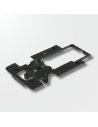
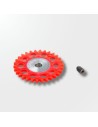
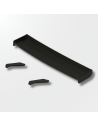
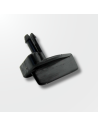
In the world of slot racing, there are parts that go unnoticed until they fail or are poorly chosen. The guide is one of them. It is the only point of contact between the car and the track, the piece that keeps it on the track, transmits electrical current to the braids, and largely defines how the car feels in hand. Replacing an inadequate guide with the correct one can completely transform a car's behaviour, whether during an afternoon of racing at home or in the decisive lap of a championship.
When one starts in slot racing, the guide seems like a minor detail. Over time —and with a few more derailed cars— one learns that choosing this small piece of plastic (or nylon, or aluminium) matters a lot. The depth at which it penetrates the track, the lateral play, the type of material, the length of the stem... each parameter affects stability, cornering response, and electrical continuity.
In this section, you will find slot guides for all systems, profiles, and levels: from direct replacements for box cars to competition parts for advanced setups. Whether you are looking to keep your car in optimal condition or are building a setup from scratch, here are the options that really work.
What is a slot guide and why is it so important
The guide —also called a comb in older slang, although the correct term is guide— is the piece that is inserted into the track and allows the car to follow the layout. Without it, the car has no steering or electrical connection.
It serves two critical functions at the same time:
- Mechanical guidance: keeps the car within the track, especially in corners, elevation changes, and chicanes. Its geometry —depth, length, width— determines how much lateral freedom the car has before derailing.
- Electrical connection: acts as a conductor between the electrified track and the car's braids, which in turn carry the current to the motor. A dirty, worn, or poorly contacting guide causes power losses, flickering, and erratic behaviour.
That is why a guide in poor condition —worn, broken, with excessive play, or simply inadequate for the track system— affects both performance and driving. It is a wear part that should be checked regularly and replaced when necessary.
How to correctly choose the guide for your car
Before buying a guide, there are three questions you must answer:
What track system do you use?
Not all guides are compatible with all tracks. The two most widespread systems in 1/32 scale are the universal track (used by Scalextric and Ninco) and the sport track (used by Scaleauto and Slot.it). The difference lies in the width and depth of the channel: a guide designed for sport track may fit too tightly in a universal track, or vice versa, causing friction or excessive play.
If you mix track brands —for example, combining Scalextric sections with Carrera or Ninco sections— it is especially important to check which guide performs best in that context. Do not assume that any universal guide will work for any track.
What car are you going to prepare?
Each car has a different housing geometry. Brands like NSR, Slot.it, Scaleauto, or Avant Slot use their own fastening systems (clip, screw, pivoting axle) and have specific stem measurements. Before ordering a replacement or upgrade guide, check the stem length and the type of fastening your chassis accepts.
What is the intended use of the car?
A guide for occasional home use is not the same as one for competition. In competition setups, the aim is to minimise lateral play, adjust the depth according to the category regulations, and use materials that offer greater durability and better conductivity.
Main types and differences
The market offers guides with significant differences in design, material, and application. Here are the most relevant types:
By material
- Standard plastic: the most common option in box cars and generic replacements. Economical, sufficient for recreational use. Wears out over time, especially on abrasive tracks.
- High-strength nylon: harder and more durable than conventional plastic. Less deformation under load. Used in mid-high range guides.
- Aluminium or metal: used in advanced competition or specific setups. Offers greater rigidity and dimensional precision, although it may generate more friction if the fit is not perfect.
By geometry and depth
- Standard guides: conventional depth, designed for general use. Compatible with most commercial tracks.
- Short or competition guides: reduced profile to minimise mechanical grip and favour response to direction changes. Widely used in competition categories where agility is prioritized over stability.
- Long or deeper penetration guides: provide more stability on worn tracks or those with many elevation changes.
By fastening system
- Clip fastening: the most widespread system in production cars. Allows for quick changes without tools.
- Screw fastening: more commonly used in competition chassis and custom setups. Allows for more precise adjustment of height and play.
- Pivoting guides: incorporate an axle that allows some lateral movement of the guide relative to the chassis, improving track following in sharp corners and reducing derailments.
Technical aspects we need to know
Beyond the model and material, there are technical parameters that make the difference between a guide that simply works and one that optimizes the car's performance.
Stem height
The length of the stem determines how high the body of the guide sits relative to the bottom of the chassis. If it is too short, the car may bottom out on the banking and the guide will be poorly positioned. If it is too long, the car will be elevated and lose stability. There are stems of various lengths (generally between 4 and 6 mm) to fit each chassis.
Lateral play
The guide should not be completely rigid: it needs some lateral play to follow the track naturally. Too much play gives a feeling of imprecision; too little play generates friction and can cause derailments in tight corners. Finding the right balance for each circuit is part of the tuning process.
Electrical conductivity
The guide conducts current from the track to the braids. If the material is poorly conductive, if there is dirt accumulated on the contact metal strips, or if the braids are poorly positioned, power losses and interruptions occur. Regularly cleaning the contact strips of the guide is a basic maintenance practice.
Compatibility with braids
Not all guides accept the same type or format of braids. Before changing the guide, check if the braids you have installed are compatible or if you will need to change them as well. Many brands sell the guide already mounted with their own braids to facilitate the process.
Practical tips for use, maintenance, and preparation
A good guide that is well maintained lasts much longer and performs better. Here are the habits that make a difference:
- Check the guide before each important session: ensure there are no cracks, that it rotates freely in its housing, and that the braids are in proper contact with the strips.
- Clean the contact strips: dirt and oxidation at the contact points are the most common cause of electrical losses. A cotton swab with isopropyl alcohol does the job in seconds.
- Replace the guide before it is completely worn out: a heavily worn guide generates play that makes the car unpredictable. Do not wait for it to fail completely.
- Adjust the height according to the circuit: on tracks with many elevation changes, it may be beneficial to play with the stem height to find the point where the guide always maintains contact with the track.
- In competition setups, try different guides: the same chassis can behave very differently with guides of different depths or lateral play. Testing on the track is irreplaceable.
Common mistakes we should avoid
Over the years, we have seen the same mistakes repeated. Avoiding them saves time, money, and frustration:
- Installing a guide incompatible with the track system: not all guides work well on all tracks. A sport guide on a universal track may work, but with excessive friction or poorly managed play. Always check compatibility before purchasing.
- Ignoring wear: the guide is a sacrificial part. If it starts to have excessive play or the tips are clearly worn, it needs to be replaced.
- Not verifying stem compatibility: changing the guide model without checking that the stem is suitable for that chassis may require unnecessary modifications.
- Installing braids incorrectly: if the braids do not press correctly against the guide strips, power cuts are inevitable even if the guide is new and of high quality.
- Tightening the guide too much on screw chassis: locking the guide without allowing lateral movement is a classic mistake. It needs to be able to pivot slightly to follow the track.
Recommendations for beginners and advanced users
If you are starting out
The most common scenario is that you need a replacement guide for your box car. In that case, look for the manufacturer's standard guide or a compatible equivalent. Brands like Scalextric, Ninco, or Carrera have their own replacement guides that fit directly without any modification. If your car is from NSR, Slot.it, Scaleauto, or Avant Slot, the spare parts catalog from those brands will provide the most suitable option.
Do not start by changing the depth or experimenting with different geometries: first, learn how your car behaves with the original guide, and then, when you know its reactions, you can start adjusting.
If you already have experience
With an intermediate-advanced level, working with guides becomes a natural part of tuning. Exploring guides with different depths for each type of circuit, adjusting lateral play, experimenting with pivoting guides on technical layouts, or using aluminium guides in competition setups are decisions that can make tenths of a difference.
In competition, many drivers carry several guides mounted on spare guides to change them between heats according to track conditions. Having a small stock of trusted guides —from brands you already know and understand how they perform— is part of the usual gear for any club driver.
| Type of guide |
Material |
Recommended use |
Compatible system |
| Factory standard |
Plastic |
Recreational use, direct replacement |
Universal / Sport depending on brand |
| High strength (nylon) |
Nylon |
Intensive use, clubs |
Universal / Sport |
| Short competition |
Nylon / aluminium |
Competition, greater agility |
Sport (Scaleauto, Slot.it) |
| Pivoting |
Plastic / nylon |
Technical layouts, better tracking |
Universal / Sport |
| CNC aluminium |
Aluminium |
Advanced setups |
Sport (Slot.it, NSR) |
Frequently asked questions about slot guides
Can I use any guide on any track?
No. Compatibility depends on the track system: universal (Scalextric, Ninco) or sport (Scaleauto, Slot.it). Using a guide designed for one system on the other can cause excessive friction or poorly controlled play. Always check compatibility before purchasing.
How often should the guide be changed?
It depends on use and track type. In moderate home use, it can last for months; in weekly competition, it may need changing every few sessions. The clearest sign is when excessive lateral play appears or the tips are visibly worn.
Does the guide affect the speed of the car?
Indirectly, yes. A dirty guide or one with poor contact causes electrical losses that reduce available power. Additionally, a guide with too much friction mechanically slows the car in corners.
What is the difference between a pivoting guide and a fixed one?
The pivoting guide has a pivot point that allows it to move laterally relative to the chassis, improving track following in sharp corners and reducing derailments. The fixed guide is stiffer and is usually preferred on fast layouts where precision is paramount.
Can I install a guide from another brand on my car?
In many cases, yes, as long as the stem is compatible with the chassis housing. There are universal guides that fit several chassis, but it is always advisable to verify the measurements before installation.
Are braids included with the guide?
It depends on the manufacturer and model. Some guides are sold already equipped with braids; others only include the guide body. Check the product contents before ordering to avoid missing an essential component.
What length of stem do I need?
The correct length depends on the chassis. Most 1/32 cars use stems between 4 and 6 mm. Check your chassis specifications or measure the original stem before ordering the replacement.
Does the guide influence tuning for competition?
Yes, quite a bit. The depth of the guide, lateral play, and type of pivoting are part of the tuning just like the hardness of the tyres or the motor settings. In competition, many drivers test several configurations before deciding.
Are there specific guides for 1/24 scale?
Yes. The 1/24 scale has different dimensions and track systems compared to 1/32. Guides are not interchangeable between scales. Make sure to filter correctly by scale when searching for your replacement.
What happens if the guide has too much lateral play?
The car becomes imprecise, tending to move within the track on straights and responding late in corners. In extreme cases, the guide may come out of the track at any irregularity.