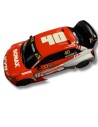
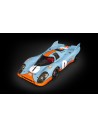
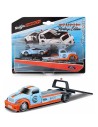
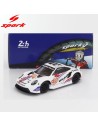
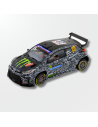
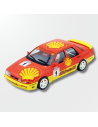
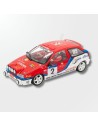
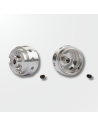
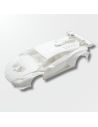
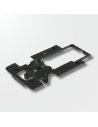
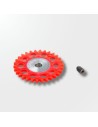
There are slot cars that turn quickly, glide elegantly, and go lap after lap without drawing too much attention. And then there are the trucks: bulky, noisy on the track, imposing in any display case, and capable of generating a completely different thrill when they take a corner with all that mass above the track. If you have ever seen a truck race at the Le Mans circuit or in any European championship of the category, you know exactly what we are talking about. That blend of power and precision is quite an achievement, and slot racing captures it better than it might seem at first glance.
Slot trucks are not just large cars. They have a completely different driving dynamic: the centre of gravity is higher, the mass distribution is different, the rear axle can carry double tyres that change grip and cornering behaviour, and the guide operates under different demands. Running a truck on the track requires adapting your style, understanding its limits, and when you get the hang of it, it becomes immensely satisfying.
In the world of collecting and modelling, slot trucks also occupy a very particular space. Their cabs reproduce real vehicles competing in endurance tests, rallies, or specific championships of the category with great detail. The usual scale is 1/32, although there are models in 1/24 with a level of detail that brings them closer to static models than to standard competition cars. For many enthusiasts, a well-built truck on a shelf is as valuable as any GT or prototype.
This section covers everything you need to know about trucks in the world of slot racing: what sets them apart from other vehicles, how to choose the right model according to your level and type of track, what technical aspects to keep in mind, and how to get the most out of them on the track.
What is a slot truck and why does it occupy a unique place in the hobby
A slot truck is a scale reproduction of a heavy vehicle designed for competition or to faithfully reproduce a real goods transport model with a sporting vocation. Unlike a conventional racing car, the truck combines a large-volume body with a chassis that must solve balance and grip challenges that do not exist in lower and lighter vehicles.
What makes these models interesting from a technical standpoint is precisely that complexity. The cab is usually a large piece that acts as suspended mass, the front axle works with narrower tyres than the rear, and the rear axle can mount tyres in a double configuration, which increases the contact footprint with the track and significantly modifies the model's behaviour in corners and braking.
From a collector's perspective, slot trucks represent real vehicles that have competed in iconic events such as the 24 Hours of Le Mans (in their specific category), the Dakar Rally, or various European and international truck racing championships. Brands like MAN, Mercedes-Benz, Volvo, DAF, or Renault Trucks have featured in these competitions, and some of them have slot replicas of notable fidelity.
For the enthusiast looking for something different within the hobby, the slot truck offers a driving and collecting experience that no other type of vehicle can match. They are the giants of the track, and rightly so.
How to correctly choose a slot truck
Before acquiring a slot truck, it is important to clarify several factors that will influence both the driving experience and compatibility with your setup.
The scale
Most slot trucks are manufactured in 1/32 scale, which is the most widespread standard in the market. This makes them compatible with Scalextric/Ninco (universal track) or Scaleauto/Slot.it (sport track) systems, although it is always advisable to check what type of guide the model uses and whether it is compatible with your track before purchasing. There are also models in 1/24 scale, usually aimed at more experienced enthusiasts or for static collection, as they require wider circuits and are less common on standard home tracks.
The type of use
Will you be running the truck on the track or will it live in a display case? If the answer is "on track," pay attention to the chassis, the condition of the braids, the guide, and the type of tyres it mounts. If it is for collection, the level of detail of the cab, the quality of the paint, and the fidelity to the real model are the factors that will weigh most in your decision.
The level of preparation
Basic or mid-range trucks usually come ready to run with minimal adjustment. More advanced models, designed for competition or demanding enthusiasts, may require more careful setup work: guide adjustment, braid inspection, checking the play in the rear axle, and verifying the torque. It is not a complicated task, but it is advisable to approach it calmly before putting the truck on the track for the first time.
The compatibility of systems
As with any slot vehicle, mixing track systems without proper information can cause problems. Before purchasing, check the type of guide the model uses and whether it is interchangeable, and confirm that the chassis width fits your circuit. Brands like Scalextric, Scaleauto, Ninco, or Carrera have different specifications that it is important to know before assuming everything is compatible.
Types and main differences between slot trucks
Within the category of slot trucks, there is more variety than it might seem at first glance. Here are the key differences you will find:
By tyre configuration
- Front tyres: narrower, just like in real trucks. They provide steering and, on track, influence the response to the guide.
- Single rear tyres: a single tyre per side on the rear axle. Smaller footprint, more agile behaviour.
- Double rear tyres: two tyres per side on the rear axle, just like in real road and competition trucks. Larger contact surface, better traction, but greater inertia in corners. They are the models most faithful to their real counterparts.
By model vocation
- Circuit trucks: replicas of vehicles competing in asphalt truck championships, with aerodynamic cabs and spoilers. They are the most common models in slot racing.
- Raid and off-road trucks: inspired by vehicles participating in events like the Dakar, with taller bodies and differently profiled tyres.
- Road trucks with competition livery: models that reproduce real commercial vehicles decorated with team or sponsor colours, more oriented towards collecting than on-track competition.
By scale
- 1/32: the most widespread. Compatible with most home and semi-professional circuits.
- 1/24: larger, more detailed, designed for collection or specific circuits.
Technical aspects we should know
Slot trucks present technical peculiarities that it is advisable to understand before running or preparing them.
The guide and its behaviour
Given the greater weight and volume of these models, the guide operates under more pressure than in a conventional car. It is essential that it is well seated, that the braids make good contact with the track, and that there is no excessive play that could cause electrical feed losses. Periodically check the condition of the braids and replace them if they show wear.
The motor and motorisation
Slot trucks usually mount motors with lower revolutions but higher torque than competition cars. This makes sense: they need to move more mass. The most common configuration is inline (motor in line with the rear axle, in a longitudinal position), although there are models with sidewinder configuration (transverse motor, parallel to the rear axle). Knowing the motor position is useful if you ever decide to replace it or work on the chassis.
The rear axle and double tyres
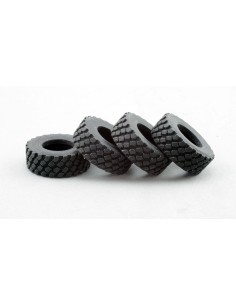
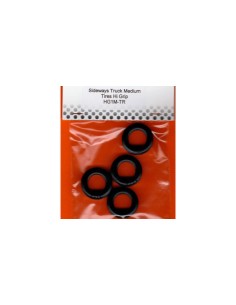
In models with double rear tyres, the rear axle mounts two pairs of wheels. This means there are more contact points with the track, but it also means that any difference in diameter between the tyres can generate vibrations or irregular behaviour. If you prepare or modify the rear axle, ensure that all tyres have the same effective diameter.
The centre of gravity
The elevated cab places the centre of gravity much higher than in any racing car. This makes trucks more prone to tipping in fast corners if the speed limit is exceeded. Learning to handle the controller smoothly during direction changes is an essential part of the experience.
Practical tips for use, maintenance, and preparation
A well-maintained slot truck runs better, lasts longer, and causes fewer problems on the track. Here are the most important points:
- Braid inspection: they are the first point of failure in any slot vehicle. In trucks, which are heavier, wear may be slightly greater. Inspect them regularly and replace them before contact becomes poor.
- Tire cleaning: dirty or greasy tyres significantly reduce traction. Clean the tread with a slightly damp cloth before each important session.
- Axle lubrication: a drop of specific slot lubricant on the rear axle bearings improves rolling smoothness. Do not exceed the amount: excess lubricant can reach the tyres and ruin grip.
- Guide verification: check that it does not have excessive lateral play and that it turns smoothly. A stuck or overly loose guide directly affects driving.
- Storage: store trucks horizontally, preferably with the tyres unloaded. If you leave them resting on the wheels for a long time, the tyres may slightly deform.
Common mistakes to avoid
Whether you are new to slot trucks or have been in the hobby for a while, these mistakes occur more frequently than it seems:
- Running too fast from the start: trucks have a much lower cornering speed limit than conventional cars. Increasing their speed without knowing the circuit almost always ends in a rollover. Start slowly and learn the critical points of the track.
- Ignoring system compatibility: not all slot trucks are compatible with all tracks. Before buying, check that the guide and chassis width fit your track.
- Mixing tyres of different wear on the double rear axle: if you change only one tyre on the double rear axle, the diameter difference can generate vibrations and erratic behaviour. Always change the complete pair.
- Neglecting the braids: in models that are rarely run, the braids can oxidise or lose tension. Check them even if the truck has been sitting in the display case for a while.
- Applying too much lubricant: excess lubricant is worse than lack. A single drop in the right place is sufficient; more can contaminate tyres or braids.
- Not checking the guide tension: a guide that is too loose makes the truck derail easily during direction changes; too tight, it limits response. Find the middle ground.
Recommendations for beginners and advanced users
If you are starting with slot trucks
The most important thing is to choose a mid-low range model that comes ready to run with minimal adjustments. This is not the time to experiment with alternative motors or modify the chassis. Familiarise yourself first with the vehicle's behaviour on track: learn its limits in corners, practice smooth handling of the controller, and observe how it behaves during braking. Trucks reward patience and precision much more than fast cars.
Regarding the circuit, if your track has very tight or very fast successive corners, trucks may struggle. Tracks with wide corners and progressive direction changes are the ideal environment for these models.
If you already have experience and want to go further
Advanced enthusiasts can work on chassis setup, replace tyres with higher grip rubber, change the motor for one with better torque at low and mid-revolutions, and fine-tune the guide. In models with double rear tyres, rectifying the diameter of the tyres for total uniformity is a detail that makes a real difference on track.
There is also the possibility of competing in specific slot truck championships, where regulations usually define the type of motor allowed, authorised modifications, and valid track systems. If you are considering this path, inform yourself about your club or championship's rules before investing in preparation.
| Feature |
Single rear tyres |
Double rear tyres |
| Contact footprint |
Smaller |
Larger |
| Traction |
Moderate |
Superior |
| Inertia in corners |
Less |
More |
| Fidelity to the real model |
Variable by model |
High (replica of real axles) |
| Axle maintenance |
Simple |
Requires more attention |
| User profile |
Beginners and collectors |
Experienced enthusiasts |
Frequently asked questions about slot trucks
Are slot trucks compatible with any track?
Not necessarily. Before buying, check the guide system of the model and the chassis width. Universal track systems (Scalextric, Ninco) and sport track systems (Scaleauto, Slot.it) have different dimensions. Additionally, the size of the body can be an issue on circuits with very tight corners.
Can slot trucks compete in championships?
Yes. There are specific championships for slot trucks both at club level and in more organised competitions. Each championship has its own regulations regarding permitted models and authorised modifications, so check the rules before preparing your vehicle.
What is the most common scale for slot trucks?
Scale 1/32 is the most widespread and the most compatible with standard home circuits. Models in 1/24 exist but are less common and require specific circuits.
Why do they tip over more easily than conventional cars?
The centre of gravity of a slot truck is much higher than that of a racing car. This means that in fast corners, if the speed limit is exceeded, the lateral inertia can be enough to tip the model over. It is an inherent characteristic of the type of vehicle, not a defect.
How often should the braids be checked?
It depends on usage, but as a general rule, checking them before each prolonged track session is a good habit. If the vehicle has been stored for a while, check them before running again.
Is it difficult to drive a slot truck for someone coming from cars?
It requires some adaptation. The cornering speed limit is much lower, the response to abrupt controller changes is different, and the overall behaviour is more inertial. With a bit of practice, most enthusiasts find the rhythm without difficulty.
Are double rear tyres difficult to maintain?
They are slightly more demanding than single ones because it is important that all tyres on the axle have the same effective diameter. If you change one, change the complete pair. Otherwise, maintenance is the same as with any other model.
Can I use a slot truck on a Carrera or Scalextric circuit?
It depends on the specific model. Some trucks come with interchangeable guides or adapters; others do not. Check the model specifications before assuming compatibility.
What type of motor is most common in slot trucks?
It is most common to find motors with good response at low and mid-revolutions, prioritising torque over maximum speed. The configuration varies by model: some have inline configuration and others sidewinder.
Are slot trucks a good option for collecting?
Absolutely. Their detailed bodies, real team liveries, and imposing size make them very attractive in display cases. For many enthusiasts, a well-preserved truck is a central piece of their collection.
Do I need to lubricate the double rear axle differently?
Not radically differently, but with more attention to the contact points. A drop of specific slot lubricant on each bearing is sufficient; excess can contaminate the tyres and reduce grip.
What circuit is most suitable for running trucks?
Circuits with wide and progressive corners, without very abrupt direction changes and without very tight chicanes. Layouts designed exclusively for fast cars can be frustrating with trucks due to the cornering speed limits imposed by their geometry.