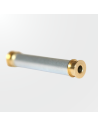
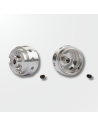
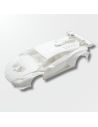
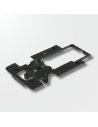
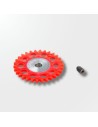
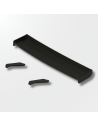
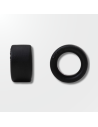
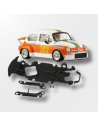
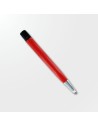
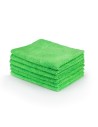
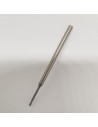
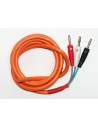
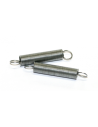
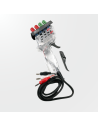
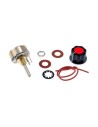
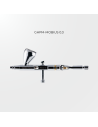
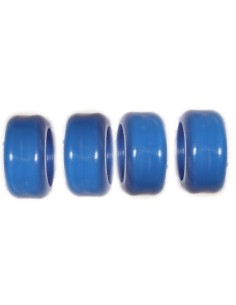
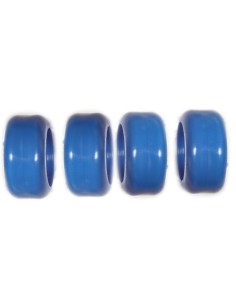
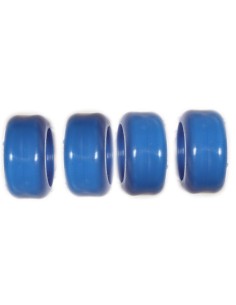
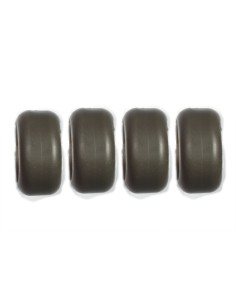
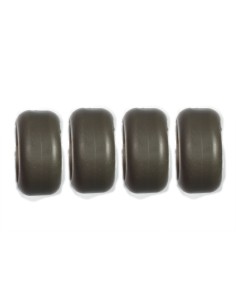
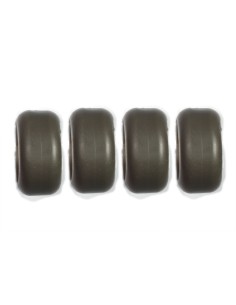
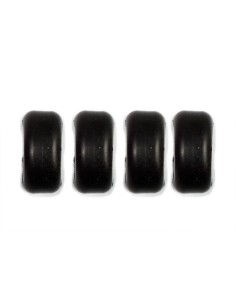
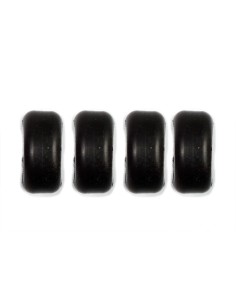
There are components and accessories that are difficult to classify into a single product family, but are equally necessary to fully enjoy the hobby. In this section, you will find items for specific use, such as drift tyres, and other complementary elements that complete the Ministry of Hobby catalogue without belonging to a broader category. If you are looking for something specific and cannot find it in another section, it is very likely that you will find it here.
The world of slot, modelling, and collecting is full of small details that make a difference: that unique accessory you need for a special build, that specific rubber for a particular discipline, that component that is neither a motor, nor a body, nor a track, but is essential for your project. This section exists precisely for that purpose.
Drift tyres: a discipline with its own character
Within slot, drift is a modality with a very defined identity. Unlike conventional circuit driving, where maximum grip and the cleanest line are sought, drift rewards control of the slide, spectacularity, and precision in the angle of the car when exiting corners. To achieve this, the type of tyre is crucial.
Drift tyres are made from hard compounds or low-friction materials that allow the rear wheels to lose grip in a controlled manner. Their profile and diameter are also designed to facilitate that lateral slip without the car completely losing control. They are not interchangeable with standard grip tyres: fitting a drift rubber on a car set up for regular grip will radically change its behaviour, and vice versa.
If you are starting in drift with slot, it is important that the entire setup is designed for this discipline: car, chassis, motor configuration, and of course, the tyres. Mixing grip components with drift ones often leads to frustrating results. With the right tyres, however, the car responds in a completely different way and the driving experience improves significantly.
How to choose the correct drift tyres
Before purchasing, it is advisable to clarify some basic parameters:
- Diameter and width: each car has specific rim measurements. Always check the specifications of your model before ordering, as a tyre that is too large or too small will not fit correctly or may rub against the body.
- Compatibility with the rim: drift tyres are designed to fit specific rims. Ensure that the inner diameter of the tyre matches the outer diameter of your rim.
- Material and hardness: the harder or slicker the compound, the easier it will be to initiate and maintain the slide. Some manufacturers offer different hardness levels to adapt to various driving styles or track surfaces.
- Track system: although the tyre itself is not tied to the rail system (universal or sport), the behaviour of the car does vary according to the track. Consider the type of surface you will be racing on.
If you have doubts about what size you need, check your car's manual or consult us directly: we have been advising enthusiasts on these types of decisions for years and are well acquainted with the catalogues of the most common brands.
Main types and differences between drift tyres
Not all drift tyres are the same. Although they share the philosophy of low grip, there are notable differences depending on the manufacturer and intended use:
- Hard plastic tyres: the most common in beginner models. They offer consistent sliding and are very durable. Ideal for those starting to explore this discipline.
- Hard rubber tyres: a middle ground between grip and drift. They allow for some control of the slide without losing all traction, making them more predictable for drivers with a bit more experience.
- Competition-specific drift tyres: designed for more advanced setups, with precise measurements and optimised compounds. They require more careful tuning of the overall setup.
The choice between one or the other depends on the driver's level, the type of car, and the track where it will be run. At Ministry of Hobby, you will find options for all profiles.
Technical aspects we should know
The drift tyre does not work alone: it is part of a broader system that includes the chassis, transmission, and overall car setup. Some technical points to keep in mind:
- Guide pressure: in drift, the guide must have enough pressure on the rail to maintain electrical contact, but without excessively limiting the lateral movement of the car. A fine adjustment here makes a difference.
- Braids: the braids must be in good condition and at the correct pressure. Poor electrical contact will cause erratic responses from the car, especially during entry and exit transitions of the slide.
- Weight and distribution: in drift, a slightly higher centre of gravity is often preferred compared to grip, to facilitate the initiation of the slide. Weight on the rear axle also influences this.
- Motor: the motor's response is key. A motor with high torque at low revs can make the car harder to control in drift. Many drivers prefer more linear motors for this discipline.
Practical usage and maintenance tips
Drift tyres, being made from harder materials, have greater durability than soft grip tyres. Nevertheless, it is advisable to follow some basic guidelines:
- Periodically check that the tyre has no deformations or irregular wear marks, which could indicate that the rim is not well balanced or that the car is misaligned.
- Regularly clean the track. Although less rubber is deposited in drift than in grip, accumulated dirt can alter the car's behaviour.
- Store the tyres away from direct light and heat. Plastic or hard rubber materials can deform if stored in unsuitable conditions.
- If you frequently mount and dismount tyres, do so carefully to avoid damaging the rim or deforming the tyre.
Common mistakes to avoid
Even experienced enthusiasts make some mistakes when working with drift tyres or other accessories of this type:
- Mixing grip and drift tyres: fitting a drift rubber only on the rear axle and keeping grip on the front, or vice versa, creates unpredictable and difficult-to-control behaviour.
- Not checking the measurements before buying: each model has its own specifications. A tyre with the wrong diameter may not fit or may rub against the body.
- Ignoring the condition of the braids: worn or poorly seated braids will cause power cuts that can easily be mistaken for tuning issues.
- Expecting the same behaviour on all tracks: the track surface greatly influences how a drift tyre responds. What works on plastic may not work the same on carpet or wood.
Recommendations for beginners and advanced users
If you are new to drift with slot, the most important thing is to start with a balanced setup: a car designed for this discipline, with the correct drift tyres from the beginning. Trying to convert a grip car to drift simply by changing the tyres may work partially, but rarely yields the best results.
For more experienced users, the key lies in fine-tuning: experimenting with different hardness levels, trying combinations of rims and tyres, and working on the guide pressure and braid condition to maximise the car's performance. Drift in slot has an exciting learning curve, and every small adjustment is noticeable on the track.
As for the other products in this section, if you have doubts about the compatibility of any accessory with your current setup, do not hesitate to consult us. We prefer that you take what you really need rather than having to return something that does not fit.
Frequently asked questions
Can I use drift tyres on any slot car?
In principle, yes, as long as the measurements are compatible with your rims. But keep in mind that the behaviour will change significantly: the car will lose grip noticeably. Ideally, these tyres should be used on cars prepared or designed for drift.
Do drift tyres wear out faster than grip tyres?
No. Being made from harder or plastic materials, they usually last longer than soft grip rubbers. However, they can suffer deformation if stored improperly or if the rim is not well balanced.
What is the difference between a drift tyre and a grip tyre?
The grip tyre is made to maximise adherence to the rail: soft materials, rounded profile, greater contact with the track. The drift tyre is designed to reduce friction and allow controlled lateral sliding of the car.
Do I need a special track to drift with slot?
It is not essential, but smooth plastic tracks facilitate sliding more than carpet or wood. The surface directly influences how the drift tyre responds.
Can I mix drift tyres on the rear axle and grip tyres on the front?
Technically it is possible, but the behaviour is usually unpredictable and difficult to control. To start, it is most advisable to use the same type of tyre on all four axles.
How do I know what tyre size I need?
Check your car's manual or the manufacturer's specifications. If you do not have them on hand, with the diameter and width of your current rim, you can find the correct size. You can also consult us, and we will help you.
Are drift tyres compatible with all rail systems?
The tyre itself is not tied to the rail system (universal or sport), but the behaviour of the car does vary according to the track. The important thing is that the measurements are compatible with your rim, regardless of the system.
What other products can I find in this section besides drift tyres?
This section gathers accessories and components that do not easily fit into other categories of the catalogue: specific use items, unusual complements, and other elements that are part of the hobby but do not have their own product family.
How often should I check my drift tyres?
It depends on usage, but a quick check before each session is sufficient: ensure there are no deformations, that they fit well on the rim, and that the diameter is uniform on both wheels of the same axle.
Does the type of motor influence how drift tyres behave?
Yes. A motor with high torque at low revs can make the car more abrupt and difficult to control in drift. Many drivers prefer more linear and progressive motors for this discipline.