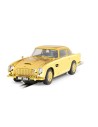
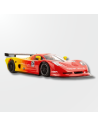
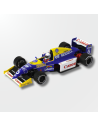
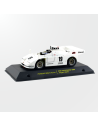
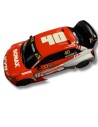
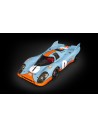
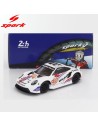
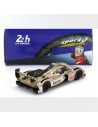
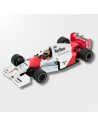
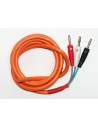
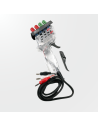
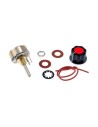
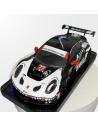
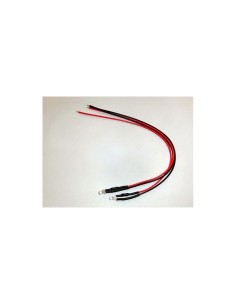
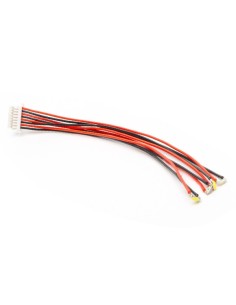
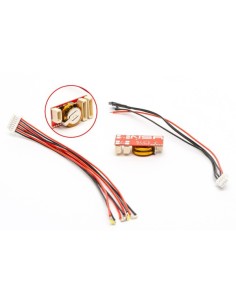
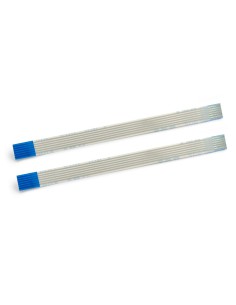
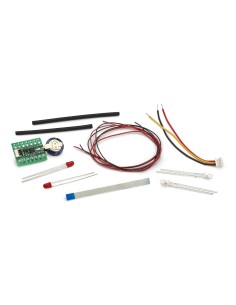
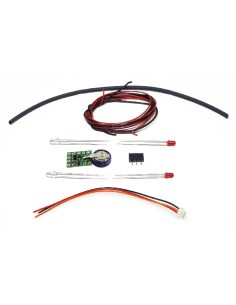
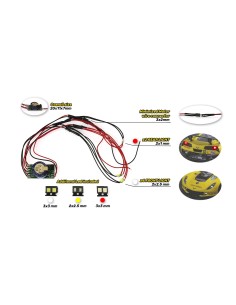
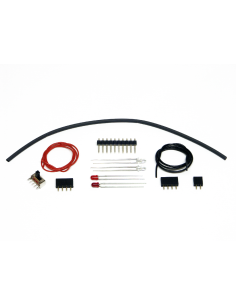
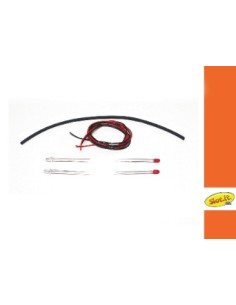
There are few things as satisfying in the world of slot racing as watching your car roll around the track with its lights on. The headlights illuminating the track, the taillights shining through the curves… that level of detail transforms a dynamic model into something that looks like it came straight from a real race. And the best part is that installing lighting in a slot car is more accessible than it seems, as long as we choose the right components and follow some basic steps.
In this category, you will find everything you need to light up your fleet: from complete kits with front and rear LEDs to loose components for those who prefer to design their own installation. Whether you are a beginner looking for something that works from the first moment, or you have experience in electronics and want a more elaborate setup, there are options for you here.
Lighting is not just aesthetic. A well-lit car looks more spectacular on any track, but it also adds a level of immersion when racing in low-light conditions or simply when you want to give your collection a more realistic finish. It’s one of those details that, once you try it, you can’t understand how you raced before without it.
Throughout this guide, we will explain what types of lights exist, how to choose them according to your car and your goals, how to install them, what mistakes to avoid, and which solutions are most recommended based on your level. This way, when you reach the catalogue, you will know exactly what you need.
What are lights and LEDs for slot cars and why do they make a difference
Lighting systems for slot cars are almost always based on LEDs (light-emitting diodes). LEDs are the ideal option for this use because they consume very little energy, generate little heat, are extremely small, and have a practically unlimited lifespan under normal usage conditions.
In the context of slot racing, lighting serves two main functions. The first is purely aesthetic: to replicate the appearance of a real car with its active position lights, headlights, and taillights. The second, more functional, is visibility during night sessions or on tracks with dim lighting, where distinguishing the position of each car on the track is easier with active lights.
Current solutions go far beyond simply sticking an LED and connecting it to the rails. Today, there are kits specifically designed for certain models from brands like NSR, Slot.it, Scalextric, or Scaleauto, with precise connectors and plates that fit the interior space of the chassis without the need for aggressive modifications. There are also universal solutions that, with a bit of skill, can be adapted to almost any car.
The result, when executed well, is a functional replica of the vehicle's real lighting: adapted light colour (cold or warm white for the headlights, red for the rear, orange for the indicators if the kit allows), without flickering, with balanced intensity, and without consuming more current than the circuit can supply.
How to correctly choose lighting for your slot car
Before purchasing any lighting component, it is advisable to ask yourself three basic questions:
- What car is it for? Not all kits are universal. Some are made for specific bodies and chassis, with specific connectors and dimensions. Checking compatibility before buying is essential.
- What type of installation do I want? There are plug-and-play kits that do not require soldering, and there are modular solutions designed for those who want to customize every detail. Choose according to your skills and the time you want to invest.
- What power supply will I use? Most slot systems operate between 12 and 14.8 volts. LEDs need an appropriate resistor or voltage regulator to avoid burning out. Some kits already include all this; others require you to calculate it yourself.
Another key aspect is the type of LED. SMD (surface mount) LEDs are the most common in slot kits due to their small size. They come in different sizes —0402, 0603, 0805— with the 0402 being the smallest and most delicate, and the 0805 being the easiest to handle for beginners.
You should also consider whether you want permanent lights (always on while the car is running) or a system with on/off functionality. Permanent lights are the easiest to install and the most common in the hobby. Systems with logic for turning on require additional components and a bit more electronic knowledge.
Finally, think about the visual finish. An excessively bright LED can appear unrealistic or even be distracting during driving. Ideally, the lighting should complement the car's aesthetics without looking artificial.
Main types and differences of lighting for slot cars
The market offers several categories of lighting products that are worth distinguishing:
Complete kits specific to model
These are the most convenient option. Manufacturers like NSR or Slot.it sell kits designed for their own cars, with PCBs (printed circuit boards) the exact size of the chassis, compatible connectors, and LEDs already positioned to fit into the body’s cavities. Installation is usually straightforward and the result is professional.
Universal kits with regulator board
Designed to adapt to different models, they include a small board with resistors or voltage regulator, several LEDs, and the necessary wiring. They require a bit more adaptation work, but they are very versatile and economical.
Loose LEDs and individual electronic components
For those who design their installations from scratch. They allow you to choose the exact colour, emission angle, LED size, and calculate the necessary resistance. This is the most flexible option, but it also requires the most knowledge.
Systems with dynamic lighting function
Some advanced kits simulate effects like braking (brighter rear lights when releasing the trigger), indicators, or differentiated position lights. They are more complex to install, but the level of realism they provide is exceptional.
Technical aspects we need to know
You don’t need to be an electrical engineer to install lights in a slot car, but it is advisable to understand some basic concepts to avoid problems.
Power supply voltage
Slot cars draw current directly from the track rails through the braids and guide. The usual voltage ranges from 12 V to 14.8 V, depending on the power supply and the type of circuit. An LED connected directly without a resistor at that voltage will burn out in seconds. Make sure that the kit you purchase includes protection or calculate the appropriate resistance.
Parallel connection
When installing multiple LEDs in the same car, the most common practice is to connect them in parallel (each with its own resistor). Connecting them in series increases the required voltage and can cause flickering or shutdowns if the track does not supply sufficient voltage at all times.
Polarity
LEDs are polarized components: they have an anode (positive) and a cathode (negative), and they only work correctly in one direction. If you connect them the wrong way, they simply won’t light up (in most cases they won’t be damaged, but it’s important to check this before gluing or closing the chassis).
Additional consumption
LEDs consume very little current, but in complex installations with multiple LEDs and additional components, the consumption can slightly affect the motor's performance. In competition cars, this can be relevant; in display or casual use cars, it is completely negligible.
Practical installation and maintenance tips
Installing lights in a slot car is not a reversible operation if you use permanent adhesives or solder, so it’s worth taking your time.
- Test before gluing: Always connect the system to the circuit and check that everything works correctly before securing anything. Discovering a fault after closing the chassis is frustrating.
- Use glue in small amounts: To secure the LEDs in the body’s headlights, a tiny drop of cyanoacrylate or specific plastic glue is sufficient. Excess can stain the lenses or hinder future repairs.
- Manage wiring carefully: The wires should be well organized inside the chassis, without rubbing against axles, tyres, or the motor. A loose wire can cause a short circuit or interfere with the movement of mechanical parts.
- Protect connections: If you do not use connectors, reinforce the solder joints with a dot of silicone or thermoplastic to prevent them from coming loose due to vibrations during driving.
- Periodic review: Although LEDs last a long time, wiring and connections can deteriorate with use. A quick visual check before each running session will save you surprises.
Common mistakes to avoid
Whether it’s your first installation or you already have experience, these are the most common mistakes we see in the hobby:
Not checking the kit's compatibility with the car model
A kit designed for a specific chassis may not fit another even if they are from the same manufacturer. Always check the compatibility reference before buying.
Connecting LEDs without a resistor
This is the most typical mistake among those starting in electronics. Without a resistor or regulator, the track voltage instantly destroys the LED. Never connect an LED directly to the rails without protection.
Using overly bright LEDs
A high-power LED in a 1/32 headlight looks completely unrealistic and can dazzle during driving. Look for medium-low intensity LEDs for a more believable result.
Ignoring wiring routing
Poorly managed wires are the main cause of mechanical failures related to lighting installations. A wire rubbing against the rear axle can jam it or break in a few sessions.
Gluing the body without checking final functionality
Some models require disassembling the body to access the lighting system. If you have that type of car, make sure everything works before closing it and that you can access the lights if you need to replace them.
Recommendations for beginners and advanced users
If you are starting
The best option is a complete kit specific to your car model. Brands like NSR and Slot.it offer well-designed kits that do not require soldering or calculating resistances: you simply connect, place, and you’re done. They are slightly more expensive than a generic kit, but the ease of installation and the final result more than justify it.
If your car does not have a specific kit available, look for a universal kit with a regulator board included and 0805 size LEDs, which are easier to handle. There are tutorials in forums and hobby channels that will guide you step by step.
If you already have experience
You can design your own installation with loose SMD LEDs, custom-calculated resistors, and ultra-thin silicone wiring. This gives you total control over the light colour, emission angle, and intensity. You can also explore systems with dynamic lighting, which simulate the real behaviour of a competition car's lights: a truly immersive experience when done well.
For display or collection cars, consider using small-format lithium batteries along with a magnetic switch for a completely autonomous result, without dependence on the rails.
| Type of solution |
Difficulty |
Customization |
Approximate price |
Recommended profile |
| Model-specific kit |
Low |
Limited |
Medium-high |
Beginner / intermediate |
| Universal kit with regulator |
Medium |
Medium |
Low-medium |
Intermediate |
| Loose LEDs + components |
High |
Total |
Low |
Advanced |
| System with dynamic lighting |
High |
High |
Medium-high |
Advanced |
Frequently asked questions
Do the lights affect the car's performance on the track?
The consumption of LEDs is minimal and in practice does not affect performance in casual use cars. In highly tuned competition cars, some drivers prefer not to install them to avoid altering electrical consumption, although the difference is practically imperceptible.
Can I install lights on any slot car?
In most cars, yes, although the interior space varies greatly depending on the model. Some chassis have very little room to accommodate wiring and boards. Closed-body cars with spacious interiors (GT, sedans, LMP) are generally the easiest to light up.
Do the lights work the same on all circuits?
They work on any standard analogue circuit. On digital circuits (like Scalextric Digital or Carrera Digital), behaviour may vary depending on the power supply system. Check compatibility before installing in cars you plan to use on digital tracks.
What LED colour is most realistic for headlights?
It depends on the car and the era you want to represent. Modern cars have xenon or LED headlights, which emit a cold white light (6000-6500 K). Classic cars had halogen headlights with a more yellowish tone (3000-4000 K). Choosing the right colour greatly enhances the overall realism.
Can I reuse the LEDs if I change cars?
Technically yes, although disassembling LEDs glued with cyanoacrylate can be delicate. Kits with connectors allow for easier reuse. LEDs soldered directly to a specific PCB are more difficult to recover.
What happens if I connect the polarity of an LED incorrectly?
In most cases, it simply won’t light up. When reversing the connections, the LED should function normally. Only in situations of overvoltage combined with reversed polarity is there a risk of damage.
Do I need to solder to install lights in a slot car?
Not always. Specific kits from some brands use connectors that do not require soldering. For custom installations with loose LEDs, knowing how to solder is an advantage, although there are alternatives with conductive paste or pressure connectors.
How long does an LED last in a slot car?
The theoretical lifespan of an LED exceeds 50,000 hours of operation. In the actual use of the hobby, it is very rare for an LED to fail due to wear; problems are usually mechanical (broken wiring, loose connection) or electrical (occasional overvoltage).
Is there a difference between permanent lights and lights with progressive on/off?
Permanent lights turn on whenever the car receives power and turn off when it stops moving. Lights with progressive or delayed on simulate real behaviour: they gradually turn on or respond to acceleration. The latter require additional components and greater electronic knowledge.
Can I install lights on a resin car?
Yes, although resin cars —like those from Avant Slot— usually have more detailed bodies with precise cavities for the headlights. In many cases, you may need to drill or mill slightly to accommodate the LED, which requires some practice to avoid damaging the body.
Do the lights work in 1/24 scale cars?
Perfectly. In fact, the larger size of 1/24 cars makes installation easier, as there is more space for wiring and components. There are specific kits for this scale with higher power LEDs adapted to the larger interior.
What tools do I need to install a lighting kit?
For a simple kit: precision screwdrivers, tweezers, cyanoacrylate or plastic glue, and if soldering is required, a fine-tipped soldering iron with thin solder (0.5-0.8 mm). For more elaborate installations, a multimeter to check voltages and continuity is very helpful.