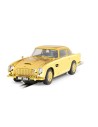
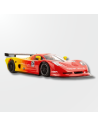
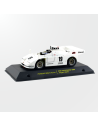
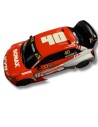
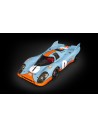
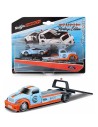
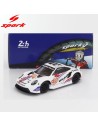
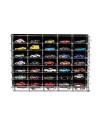
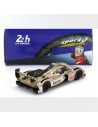
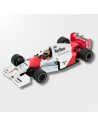
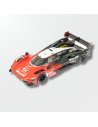
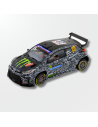
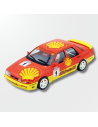
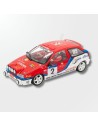
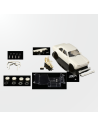
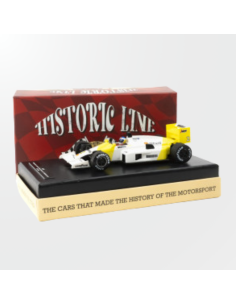
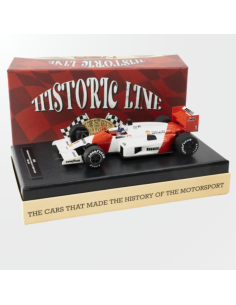
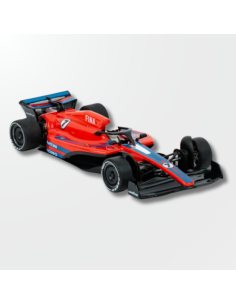
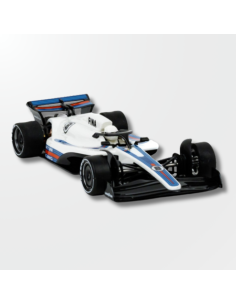
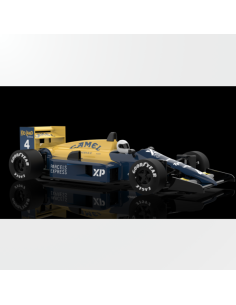
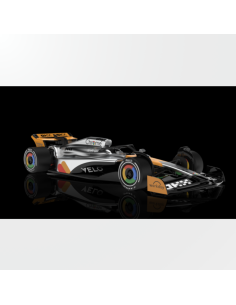
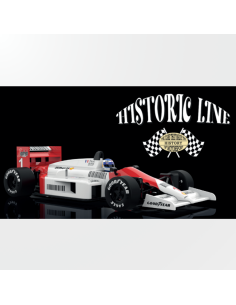
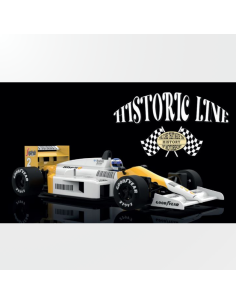
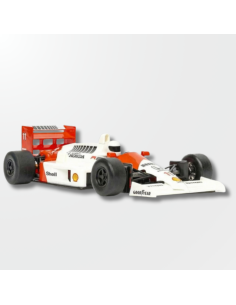
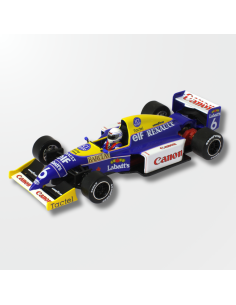
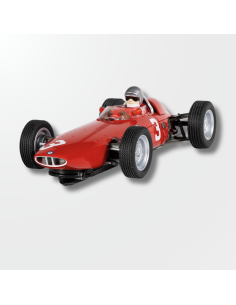
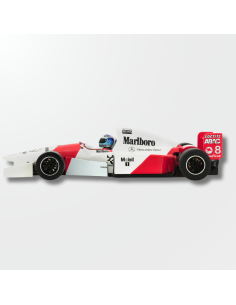
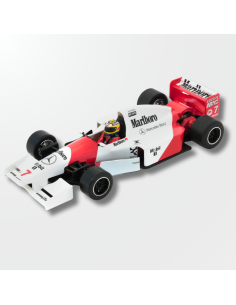
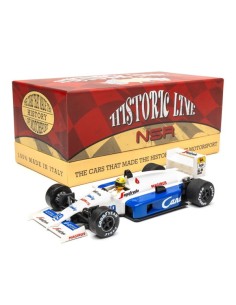
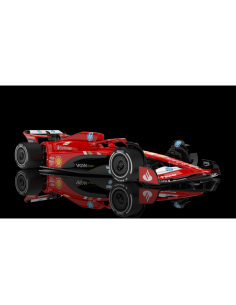
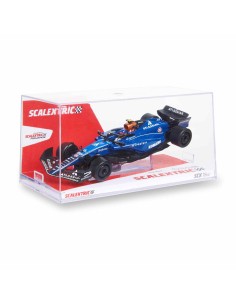
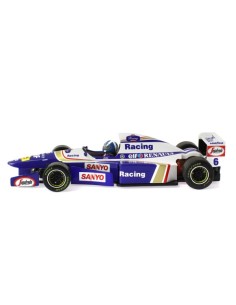
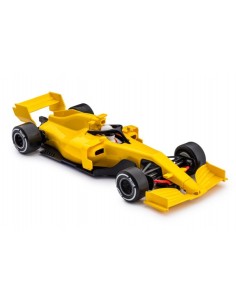
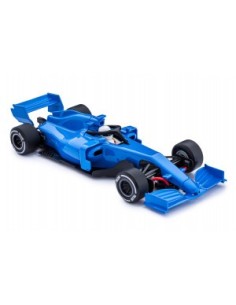
There are categories that have it all: history, technology, speed, and a breathtaking aesthetic. Miniature Formula 1 cars —whether for racing on a track or for display in a showcase— condense decades of aerospace engineering into a piece of just twenty centimetres. Here you will find replicas of the most iconic single-seaters from the Grand Circus: from the cars of the 70s with those huge wings and legendary sponsors, to the current hybrids with impossible cooling ducts and liveries that change every season.
Formula 1 has always exerted a special attraction in the world of collecting and slot. Perhaps because its shapes are unmistakable —the pointed nose, the exposed wheels, the halo, the flat floors— or because each driver carries with them a legion of fans who want to have at home the exact replica of the car with which they won their championship. Alonso in the Renault R25, Hamilton in the Mercedes W11, or Räikkönen in the Ferrari F2007 are objects of desire that transcend mere hobbyist modelling.
In this category, you will find both cars designed for racing —with prepared chassis, tuned motors, and good contact braids— and replicas aimed at collection and exhibition, where the level of detail and colour fidelity weigh more than the lap time on track. If you are looking for something in between, that also exists: production single-seaters that run well out of the box and that, with some adjustments, can be competitive in any club championship.
Whether you are a fan of a specific driver, a lover of a particular era of F1, or simply someone who wants to start with something visually striking, this section has options for you. Below we explain everything you need to know before choosing your next single-seater.
What are F1 slot cars and why are they a special category
A Formula 1 slot or collection car is, above all, a technical interpretation of a real machine. Replicating an F1 single-seater poses challenges that do not exist in other categories: the proportions are extreme, the aerodynamics are complex, the wings are delicate, and any error in the livery is evident to a trained eye.
Unlike a closed GT —which hides the engine and has a compact body— an F1 single-seater exposes almost everything: the engine, the suspension, the brakes, the tyres without fenders. This means that the brands that manufacture these replicas have to invest much more in moulding, painting, and decoration to ensure the result is convincing.
In the realm of competitive slot racing, F1 single-seaters are machines that tend to drive differently than a GT or a prototype. Their narrower track width, lower height, and shorter wheelbase make them more reactive in corners, but also more difficult to set up if the track demands traction. They are cars that are usually enjoyed more on fast layouts, with long curves and few chicanes.
From a collecting perspective, F1 is perhaps the discipline with the most critical mass of followers. This translates into a broader offering of official licenses, special liveries for anniversaries, or limited editions that commemorate historic victories.
How to choose your F1 single-seater
Before rushing to buy, it is advisable to ask yourself some basic questions:
- What do you want it for? A car for racing in a club championship, where tuning and consistency matter, is not the same as a piece for display in a showcase, where visual detail prevails.
- What track system do you have? Ensure that the car is compatible with your circuit. Most 1/32 models are designed for universal track (Scalextric, Ninco) or sport track (Scaleauto, Slot.it). Mixing systems without prior knowledge can cause guide or track width issues.
- What era of F1 fascinates you? The catalogue spans from the 60s to the most recent season. Each era has its aesthetics, its drivers, and its teams. There is no right answer.
- What level of detail do you need? Resin versions or high-end editions offer superior finishes, but come at a corresponding price. Injected plastic versions from brands like Scalextric or NSR offer good value for money for racing.
- Are you planning to tune the car? If you want to prepare it for competition, consider from the start what type of chassis it uses, what motor it has, and what spare parts are available on the market.
A good choice at the beginning avoids later frustrations. If you have doubts, at Ministry of Hobby we can guide you according to your circuit, your level, and your goals.
Main types and differences in F1 slot and collection cars
Within this category, there are very different product profiles:
Mid-high range injected plastic cars
They are the most common option for those who want to race with a recognizable single-seater without a high expenditure. Brands like Scalextric or NSR produce models with good fidelity to the livery, ready to run from the first moment. The level of detail is correct, although it does not reach that of resin versions.
Competition cars
Brands like NSR and Slot.it manufacture single-seaters aimed at performance: chassis with greater rigidity, motors with more torque, silicone tyres, and interchangeable components. They are the natural choice for those participating in regulated championships. The visual detail may be somewhat more austere, as the primary objective is the lap time.
High-end resin cars
Avant Slot is one of the few brands that produces resin cars at an industrial level, combining display finishes with the possibility of racing. Resins allow for moulding details that injected plastic cannot reproduce: very fine cooling ducts, aerodynamic surfaces with texture, carbon fins. They are pieces that sit at the intersection of slot and collecting.
Diecast and static F1 miniatures
For those who do not have a circuit or simply want a replica for display, diecast F1 offers a solid alternative. In 1/18 scale, the level of detail can be spectacular: detailed cockpit, functional steering, visible engine. In 1/43, you have a manageable and highly collectible piece.
Technical aspects you should know
If your goal is to race with the single-seater, it is advisable to understand some concepts before buying or preparing it:
Motorisation
F1 slot cars usually feature inline configurations (motor in line with the rear axle, perpendicular to it), which lowers the centre of gravity and favours stability in corners, or sidewinder (motor parallel to the rear axle, transverse), more common in prototypes and GTs but also present in some mid-range single-seaters. The inline configuration is especially valued in competition cars for the weight distribution it offers.
Guide and braids
The guide is the element that keeps the car on the track. In single-seaters, it is especially important because the low and narrow body leaves little margin for high guides. Check that the guide fitted to your car is compatible with your type of track. The braids —the conductive strips that transmit current from the track to the motor— must be well adjusted and clean to ensure smooth driving without micro-cuts.
Chassis
Plastic chassis are more flexible and better absorb track irregularities; metal (aluminium or zamak) chassis are stiffer and more precise but require a well-maintained track. Some models offer interchangeable chassis, allowing the car to be adapted to different driving styles or regulations.
Tyres
Urethane or silicone tyres offer more grip than standard rubber ones. In F1 single-seaters, the width of the rear tyre is a relevant factor as it affects traction in corners. Many enthusiasts replace the stock tyres with aftermarket versions to improve performance.
Scale
The most common scale in slot is 1/32. In diecast and collecting, 1/18 is the reference for maximum detail and 1/43 for extensive collections with limited space.
Practical tips for use, maintenance, and preparation
- Clean the track before racing: an F1 single-seater has a lower guide height than a GT, and any dirt on the track causes annoying micro-cuts. Wipe with a dry cloth or use a specific cleaner before each session.
- Check the braids frequently: in single-seaters, the space between the bottom of the chassis and the track is minimal. The braids wear out faster if the car rubs against the bottom. Replace them when you notice a loss of response.
- Lubricate sparingly: a drop of oil on the motor shaft and wheel axles is sufficient. Excess lubricant attracts dirt and can dirty the tyres, reducing grip.
- Adjust the guide height: if the car frequently derails in corners, check that the guide is not too high. A small adjustment can make a big difference in stability.
- Store collection cars in closed display cases: dust and direct sunlight are the greatest enemies of printed liveries and plastic parts. A display case with a lock and away from windows prolongs the life of the finish.
- For diecast: use a dry microfiber cloth to clean the body. Avoid aggressive chemicals that can damage decals or chrome.
Common mistakes to avoid
Buying the car before knowing your track system
This is the most repeated mistake among newcomers. Not all cars are compatible with all systems. Scalextric, Scaleauto, Ninco, and Carrera have differences in track width and guide type. Before buying, confirm what system you have and which car is compatible with it.
Confusing collection use with competition use
A high-end single-seater designed for display may not be the best option for a club championship: resin bodies are more fragile against impacts, and some collection models do not have chassis suitable for demanding driving. Choose according to the actual use you will give it.
Ignoring braid maintenance
Dirty or worn braids are the number one cause of driving problems in F1 single-seaters. Many enthusiasts look for the problem in the motor or chassis without checking this component first.
Over-lubricating
More lubricant does not mean more performance. Excess oil ends up on the tyres, reduces grip, and causes the car to slide in corners. Less is more.
Not checking the scale before buying for collection
A 1/18 and a 1/43 of the same single-seater are completely different objects in size, price, and space required. Always check the scale before adding to the cart if your goal is a coherent collection.
Recommendations for beginners and advanced users
If you are starting
Start with an injected plastic car from a reputable brand like Scalextric or NSR in 1/32 scale. They are robust, have easily found spare parts, and offer more than enough performance to enjoy from day one. If you are looking for collection, a 1/43 diecast of a driver or era you are passionate about is the most affordable and satisfying entry.
Do not invest in the most expensive model at first: until you have some experience (to use the metaphor), you will not know which features you value most.
If you already have experience
The leap to brands like Slot.it or NSR with inline configuration and silicone tyres opens up a world of possibilities in terms of tuning. You can work on the gear ratio by adjusting the crown-pinion combination, experiment with different types of chassis, or try different guides depending on the type of layout.
For advanced collecting, Avant Slot resins or limited editions from premium series are the most valued pieces. Combine them with a lit display case and a clear collecting criterion —by driver, by era, by team— and the result is spectacular.
| Profile |
Recommended Scale |
Main Use |
Reference Brands |
| Slot Beginner |
1/32 |
Running on home circuit |
Scalextric, NSR |
| Club Competition |
1/32 |
Regulated championships |
NSR, Slot.it |
| Entry Collector |
1/43 |
Display, low budget |
Various diecast brands |
| Advanced Collector |
1/18 |
Exhibition, maximum detail |
Premium diecast ranges |
| Slot + Collection |
1/32 |
Running and displaying |
Avant Slot (resin) |
Frequently asked questions about F1 slot and collection cars
Are F1 slot cars more difficult to drive than a GT?
In general, yes. Their narrower track width and shorter wheelbase make them more reactive. They respond better on fast layouts and derail more easily in tight chicanes. With practice and some tuning, they can be mastered perfectly.
Can I run an F1 single-seater on any circuit?
As long as the car is compatible with your type of track, yes. Check if your track uses universal track (Scalextric, Ninco) or sport track (Scaleauto, Slot.it) and acquire a model adapted to that system.
What scale is best for collecting F1?
It depends on space and budget. 1/43 is perfect for extensive collections in limited space. 1/18 offers maximum detail and is the star of any display, but takes up more space and is more expensive.
Do F1 replicas have official licenses?
It depends on the manufacturer and the model. Some series have licenses from FOM or the teams, which guarantees the fidelity of the livery. Others are unlicensed replicas with slight variations in logos or colours. Check the product sheet to find out.
Which F1 single-seaters are in highest demand in slot?
Cars associated with winning seasons or drivers with a large fan base always lead sales: McLarens from the 80s-90s, Ferraris from the Schumacher era, Mercedes from the hybrid era, and Alonso's single-seaters with Renault and Alpine concentrate the majority of interest.
Can I compete with a collection F1 single-seater?
It is not advisable. Cars designed for collection prioritise finish over performance. For competition, choose specific models from brands like NSR or Slot.it.
What motor is best for a competitive F1 slot?
There is no universal answer: it depends on the regulations of the championship you are participating in. Inline motors are common in high-end single-seaters due to the weight distribution they offer. Check the regulations before modifying anything.
How do I clean the body of a diecast F1 without damaging it?
Use a dry or slightly damp microfiber cloth. Avoid products with alcohol, solvents, or abrasives. For accumulated dust in hard-to-reach areas, a soft modelling brush is very useful.
Are resin F1 cars fragile?
More so than injected plastic ones against strong impacts. The wings and resin suspensions can break in a fall or a high-speed crash. They are ideal for well-maintained tracks and for use on circuits without aggressive barriers.
What is the difference between an NSR F1 and a Slot.it one?
Both brands offer high performance, but they have differences in chassis design, motor configuration, and available accessories. NSR is known for its variety of motors and modular chassis system; Slot.it stands out for mechanical precision and consistency in competition. The choice usually depends on personal taste and the regulations of the competition you participate in.
Is it worth investing in a limited edition F1?
For collectors, yes: limited editions tend to appreciate over time, especially those linked to historic victories or team anniversaries. For those who want to race, the buying criterion should be performance, not the rarity of the model.