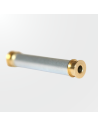
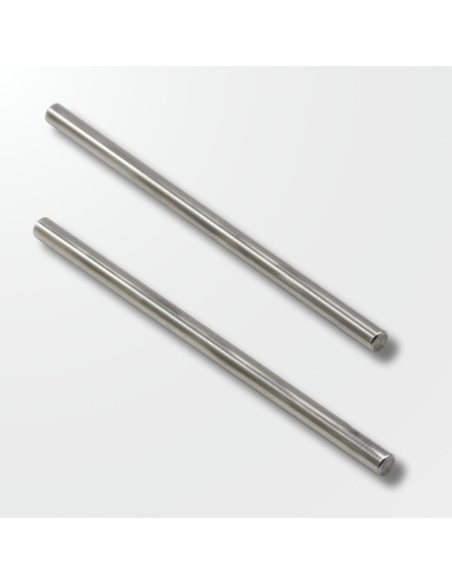
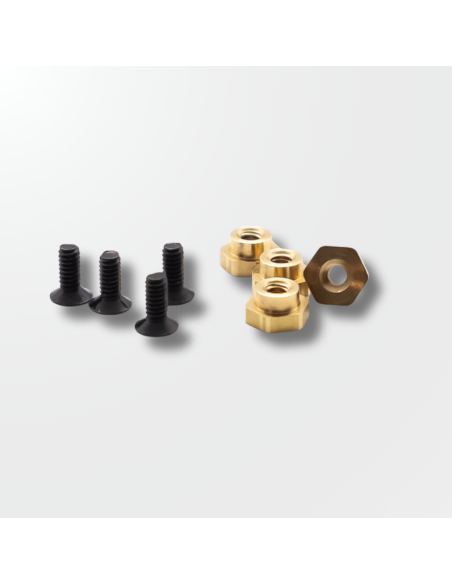
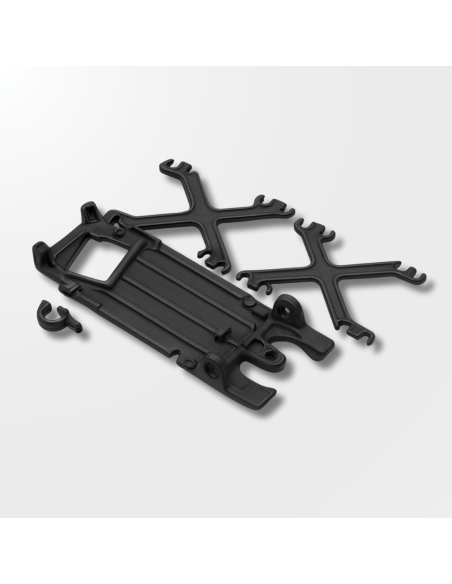
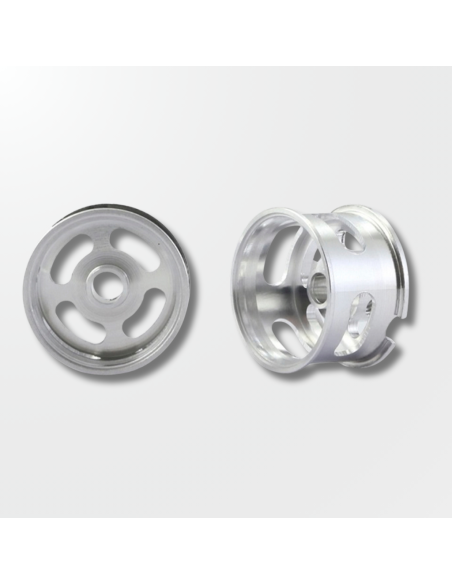
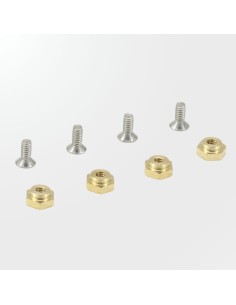
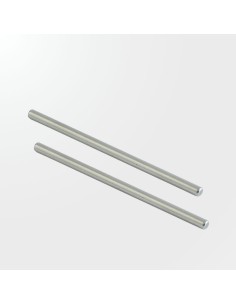
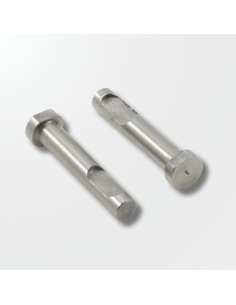
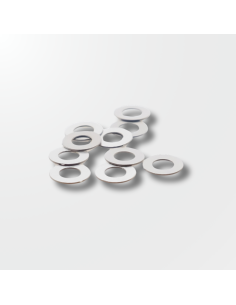
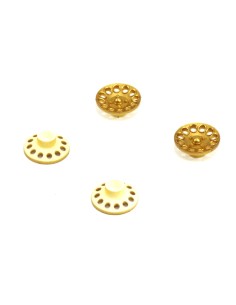
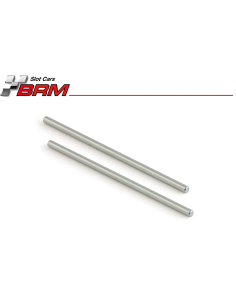
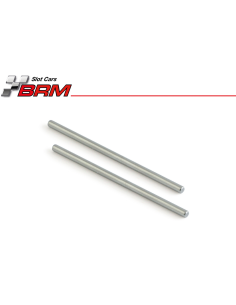
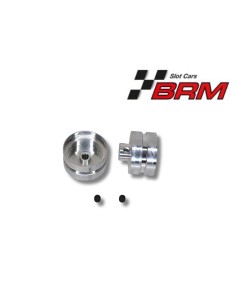
The 1/24 scale holds a very special place in the slot racing world. Its cars are larger, heavier, and more complex than the 1/32, making them an ideal platform for both high-level competition and for those seeking maximum detail and realism. However, this greater mechanical demand makes spare parts an essential part of the hobby: no 1/24 car lasts long on the track without careful maintenance and preparation.
When looking for spare parts for your 1/24 car, the needs are very specific. Not just any component will do: the adjustment of tolerances, the weight of the parts, and compatibility with the specific traction systems of this scale make the difference between a car that runs with precision and one that skids or transmits power unevenly. In this section, you will find everything you need to maintain, repair, and optimise your cars, with parts from leading brands such as BRM and Scaleauto.
Whether you are competing in organised championships —where the technical regulations define the permitted components— or enjoying at home on your own circuit, the logic is the same: know each part well, choose wisely, and assemble it correctly. Throughout this page, we explain everything you need to know to do it right from the very first moment.
What are 1/24 spare parts and why are they so important
Spare parts for slot cars in 1/24 scale are components specifically designed for cars of this scale, which in physical size are approximately double that of the usual 1/32. This greater volume also implies greater mass, larger contact surface with the track, and consequently, higher forces on all mechanical elements during driving.
A well-chosen spare part not only repairs a failure: it defines the behaviour of the car. The rigidity of the chassis affects grip in corners; the hardness of the tyre influences traction control; the profile of the crown gear and pinion determine acceleration and top speed. In 1/24, these variables have a more pronounced effect than in smaller scales because the speeds and masses involved are greater.
Moreover, 1/24 has a deeply rooted tradition in organised competition, especially in closed classes formats where the regulations limit components. Knowing which parts are homologated for your category is as important as knowing how to assemble them correctly.
How to correctly choose 1/24 spare parts
Before buying any part, it is advisable to answer three basic questions:
- Which car? Not all 1/24 spare parts are interchangeable. BRM and Scaleauto, for example, have their own geometries and fastening systems. Always check the exact reference from your car's manufacturer.
- For what use? A club racing car requires more technical parts that comply with regulations than a home-use car, where durability may take precedence over pure performance.
- What is the condition of the rest of the car? Changing just one tyre on a car with worn bearings or a damaged guide will not solve handling issues. The 1/24 is worked on integrally.
Another key aspect is the type of track. The rail system affects the guide and braids you need. Ensure that the part you buy is compatible with the system you race on: not all track systems are the same, and mixing components without proper research —as happens with Scalextric, Scaleauto, Ninco, or Carrera— can yield unexpected results.
Finally, consider the level of preparation that the part requires. Some are installed in seconds; others require partial disassembly of the rear end, adjustment of clearances, or even tyre truing. If you are starting with 1/24, prioritise drop-in components and leave more technical preparations for when you have more experience.
Main types and differences of 1/24 spare parts
The 1/24 spare parts catalogue encompasses several families of components. Here are the most relevant:
Motors and mounts
The motor is the heart of the car. In 1/24, inline motors (motor aligned with the rear axle, lowering the centre of gravity) and sidewinder motors (motor parallel to the rear axle, in a transverse position) are primarily used. Each configuration has direct implications on handling: the inline favours stability in fast corners; the sidewinder offers a different weight distribution and can be more lively. The mount is the support that fixes the motor to the chassis and defines the mounting angle and tension on the chain or gear.
Chassis
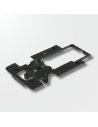
1/24 chassis are usually made of high-rigidity plastic or machined aluminium, depending on the range and use. The flexibility of the chassis is a setup parameter: a more flexible chassis better absorbs track irregularities, while a stiffer one offers more direct response but requires a better condition track. Some brands offer chassis with different hardness levels for the driver to choose according to the circuit.
Tyres and wheels
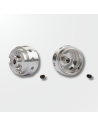
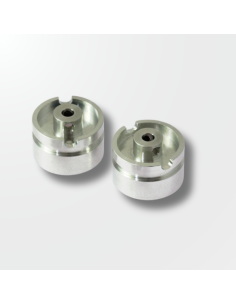
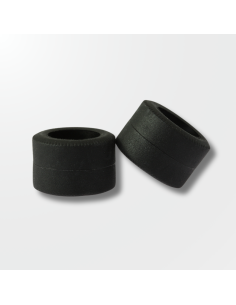
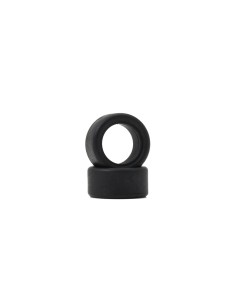
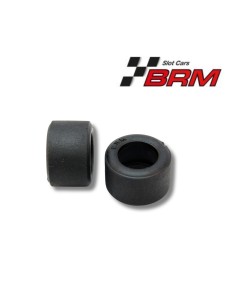
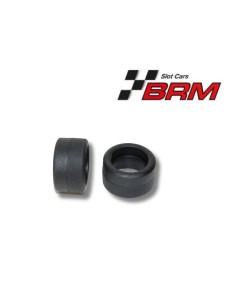
In 1/24, tyre choice is critical. The hardness (shore), diameter, and width affect behaviour in braking, acceleration, and cornering. Low-hardness silicone tyres offer more grip but wear out faster; urethane tyres are more durable and consistent over long sessions. The wheels must be concentric to avoid vibrations: a small error in eccentricity at this scale is clearly noticeable on the track.
Transmission: crowns and pinions
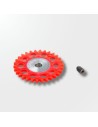
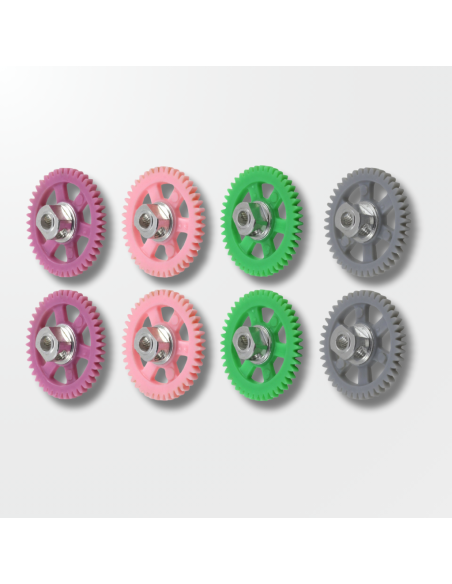
The crown-pinion ratio defines the car's gearing. A short ratio provides more acceleration but less top speed; a long ratio does the opposite. Adjusting this ratio according to the circuit layout —more corners vs. more straights— is one of the most common setup tasks in 1/24 competition. Materials also matter: delrin crowns are quieter and smoother; metal ones are more durable.
Guides and braids
The guide is the element that keeps the car on the rail. In 1/24, larger and deeper guides are used compared to 1/32, in line with the rail of this scale. A worn or poorly adjusted guide causes skids and loss of electrical contact. The braids are the copper conductors that transmit current from the rail to the motor: when they wear out, the throttle response becomes erratic and inconsistent.
Bearings
Bearings reduce friction on the axles and are essential for transmission efficiency. In 1/24, precision bearings allow the motor's power to reach the tyres intact. Their periodic cleaning and lubrication is one of the most cost-effective maintenance tasks you can perform.
Technical aspects we need to know
Working with 1/24 spare parts requires understanding some basic technical concepts that make a difference in the final result:
- Clearance in the transmission: A gear that is too tight generates heat and wear; too loose, play and power loss. The correct adjustment can be felt with the fingers: there should be a slight free play but without the pinion and crown rattling.
- Concentricity of the wheels: Wheels and tyres must rotate without eccentricity. To achieve this, many drivers true the tyres on the car itself with fine sandpaper or a specific tool.
- Height of the guide: The guide should just touch the bottom of the rail with firm contact but without creating excessive resistance. A guide that is too long slows the car down; too short, it easily derails.
- Braid tension: The braids should rest gently on the conductive rails. If they are bent upwards, the electrical contact fails during direction changes.
Practical tips for use, maintenance, and preparation
Regular maintenance of the 1/24 car extends the life of the spare parts and keeps performance stable session after session. Here are the habits that make a difference:
- Clean the tyres before each session. Resin or dust from the track accumulated on the rubber significantly reduces grip. A specific cleaner or even a bit of adhesive tape helps restore the original feel.
- Check the condition of the braids. A crushed braid or one with ends bent upwards causes micro electrical cuts that manifest as stutters or lack of response. Change them before the problem worsens.
- Lubricate bearings and gears moderately. Excess lubricant attracts dirt and can contaminate the tyres if it reaches the rear end. A drop is sufficient for each bearing; the gear needs just a thin film.
- Check the axial play of the axles. The axles should not have too much lateral play nor be pressed against the housings. A well-adjusted axle rolls freely with a gentle push from the fingers.
- Visually inspect the chassis after each session. In 1/24, impacts on the track can cause subtle deformations that affect handling. A small twist in the chassis changes the weight distribution between axles and makes the car unpredictable.
Common mistakes to avoid
Even experienced drivers make mistakes when working with 1/24 spare parts. Here are the most common:
- Buying without checking compatibility. Assuming that all 1/24 spare parts are universal leads to frustration. BRM and Scaleauto have different geometries; an axle from one may not fit the other.
- Over-tightening the motor or mount screws. The plastic of the mounts can deform with little effort. Tighten judiciously: firm but not excessive.
- Ignoring the condition of the guide. A worn guide that no longer makes clean contact with the rail ruins any other preparation work. It is the first part to check when the car loses consistency.
- Changing too many parts at once. If you change the motor, crown, pinion, and tyres in the same session, you won’t know what has improved or worsened the handling. Work methodically, one change at a time.
- Not cleaning the conductive rails before running. Braids in perfect condition on a dirty rail still provide poor electrical contact. Maintenance is required for both the track and the car.
Recommendations for beginners and advanced users
If you are starting with 1/24
The 1/24 scale has a steeper learning curve than the domestic 1/32. If you come from another scale, the first step is to familiarise yourself with the mechanical peculiarities of your car before starting to modify it. Begin by learning to disassemble and assemble the rear end with ease, identify the main consumables —tyres, braids, guide— and keep them on hand. Brands like BRM offer kits and cars with accessible and well-documented mechanics, making the first steps much easier.
Do not rush to change the motor before understanding how the car behaves in its original state. The stock motor of most entry-level 1/24 proposals is balanced to make the car manageable; a more powerful motor in inexperienced hands only multiplies derailments.
For advanced users and competition
In competition, the setup of a 1/24 is a discipline in itself. Level drivers work with transmission ratios adjusted to the layout, custom-trued tyres, mounts with different motor angles, and chassis tested in various flexibility configurations. Scaleauto is a solid reference in this context, with a very complete and updated spare parts catalogue for its competition platforms.
If you compete in championships with technical regulations, read the specifications before buying any spare parts: the homologation of components varies by category and organiser. A technically better spare part but not homologated can lead to exclusion during checks.
Comparative table: motorisation configurations in 1/24
| Configuration |
Motor Position |
Centre of Gravity |
Driving Profile |
Common Use |
| Inline |
Longitudinal (in line with the rear axle) |
Lower |
Stable, predictable in fast corners |
GT and saloon racing |
| Sidewinder |
Transverse (parallel to the rear axle) |
Medium |
Lively, reactive, more sensitive to setup |
Competition and mixed use |
| Anglewinder |
Angled relative to the rear axle |
Variable depending on angle |
Balanced between inline and sidewinder |
Technical competition |
Frequently asked questions about 1/24 spare parts
Are BRM and Scaleauto spare parts compatible with each other?
Generally, not directly. Each brand has its own chassis geometry, mounts, and fastening systems. Some generic components like standard bearings can be shared, but specific parts like mounts, axles, or guides require checking the exact reference.
What guide do I need for my 1/24 car?
It depends on the track system you will be racing on. The depth and width of the rail vary between systems, so the guide must be compatible with the type of track you use. Check the specifications from your car's manufacturer and those of the circuit where you compete or train.
How often should I change the braids?
There is no fixed interval: it depends on usage hours and the condition of the rail. Visually inspecting them before each session is sufficient. If you see they are very crushed, have broken strands, or the car responds irregularly to the throttle, it’s time to change them.
Is it worth truing the tyres?
In competition, yes. A trued tyre on the car itself eliminates eccentricity and maximises the contact surface with the track. In home use, it depends on the level of demand: if the car runs well, it is not essential, but you will notice the difference if you do.
What crown-pinion ratio should I use for a circuit with many curves?
For circuits with many curves and short straights, a shorter ratio (large crown / small pinion) improves acceleration out of corners. For faster layouts with long straights, a longer ratio provides greater top speed.
How do I know if my motor needs to be replaced?
Clear signs: the car has progressively lost speed without changes in the transmission, the motor heats up more than usual in short sessions, or an irregular or rough sound is heard. Sometimes cleaning the commutators and internal brushes is enough; other times the winding is damaged and the motor needs to be replaced.
Can I use generic bearings or should I use the brand's?
Standard precision bearings (for example, the 3x6x2.5 mm commonly found in many 1/24 cars) are perfectly valid as long as they are of good quality. The important thing is to respect the exact measurements so that the fit in the chassis is correct.
Is a plastic or aluminium chassis better?
It depends on the use. Aluminium offers greater rigidity and durability, but it is more expensive and does not always allow the degree of flexibility that some track configurations require. High-quality plastic can be a very competitive option and is easier to replace in case of impact damage.
Can I use 1/32 tyres on my 1/24 car?
No. The dimensions are completely different. 1/24 tyres have a larger diameter and width, in line with the wheels and axles of this scale. Trying to fit 1/32 tyres is not mechanically viable.
What is more important for improving performance: the motor or the tyres?
In most cases, the tyres. A car with good condition tyres, well-trued and correctly chosen for the track, will outperform one with a more powerful motor but worn or inappropriate tyres. Grip is the foundation of everything else.