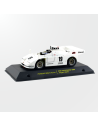
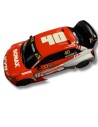
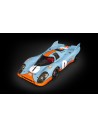
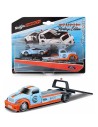
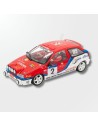
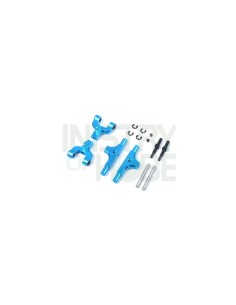
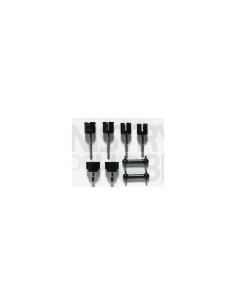
The TT01 is one of the most recognisable and long-lasting 1/10 scale radio-controlled chassis from Tamiya. Since its debut in the early 2000s, this all-wheel-drive (4WD) belt-driven chassis has become the favourite entry point for thousands of RC touring car enthusiasts, and it remains a reference within the community today. Its balance of price, reliability, and upgrade potential makes it hard to beat for those looking to get started without sacrificing technical growth.
If you are looking for parts to keep your TT01 running, upgrading components to fine-tune its performance, or simply want to understand what makes this chassis special before purchasing, you have come to the right place. On this page, you will find everything you need to know: from its mechanical fundamentals to the most common mistakes users make and how to avoid them.
The TT01 has generated a family of variants —TT01D, TT01E, TT01R, TT01 Type-E— that expand its possibilities without straying from the original base. Knowing the differences between them is key to making the right choice when purchasing the kit or selecting compatible spare parts. Throughout this guide, we break down each aspect with the precision that a chassis with over twenty years of active service deserves.
What is the TT01 and why is it still relevant
The TT01 is a 1/10 scale radio-controlled vehicle chassis developed by Tamiya, specifically designed for the touring car category. Its central belt drive mechanism to all four axles places it in a different category from classic rear-wheel-drive chassis: it offers greater stability and a more homogeneous weight distribution, resulting in more predictable handling, especially on asphalt surfaces or indoor tracks.
The reason the TT01 remains in Tamiya's active catalogue —and in the minds of the community— is simple: it works. Its double wishbone geometry in the suspension, reinforced plastic arms, and accessible differential housing allow any user with some skill to open it, adjust it, and improve it without the need for a professional workshop. Additionally, the availability of parts is exceptional: Tamiya has maintained catalogue compatibility for years, and the secondary market adds even more options.
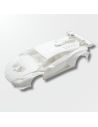
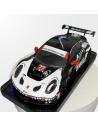
For the modeller transitioning from static models to RC, the TT01 is also appealing because most of its kits include detailed bodies —Mitsubishi Lancer, Honda Accord, Ford Focus, among others— that can be painted using common modelling techniques: airbrush, acrylic paints like those from Vallejo or Tamiya, masking tape, and transfer decals. The result can be as detailed as desired.
How to choose correctly between the TT01 variants
Before purchasing a kit or spare part for the TT01, it is advisable to accurately identify which version you have or are interested in, because although the variants share many components, there are relevant differences:
- Standard TT01: the original version, with basic suspension and belt drive. Ideal for beginners and learning RC mechanics.
- TT01D (Drift): factory-configured for drift, with hard plastic tyres and specific alignment adjustments. If you want to drift, this is your base; if you want grip, you will need to change tyres and check the geometry.
- TT01E (E-Tuned): incorporates improvements over the standard: adjustable front suspension, ball differential at the rear, CVA oil shocks. It is the most recommended entry point if you seek performance from day one without investing in immediate upgrades.
- TT01R (Racing): the competition-oriented version for clubs, with higher precision components. Less common in the market but highly valued by those competing in regulated categories.
- TT01 Type-E: an evolution that refines the chassis rigidity and suspension geometry. Compatible with most spare parts from the standard TT01, but with differences in some mounting points.
When choosing spare parts, the first step is always to confirm the exact version of the chassis using the kit number or the manual. A common mistake is to assume total compatibility between the TT01 and the TT01E when there are specific parts for each.
Main types and differences in the TT01 mechanics
The TT01 employs a central belt drive system that connects the front and rear differentials. This design has direct consequences on the vehicle's behaviour and maintenance:
Belt drive system
The central belt must be maintained at the correct tension: too loose causes loss of traction and slipping; too tight increases battery consumption and bearing wear. Tamiya recommends a specific slack that you can measure using the manual as a reference.
Differentials
The standard TT01 features gear differentials on both axles. They are reliable but allow some differential slip in corners. Advanced users often replace them with ball differentials or even opt for locked differentials for specific driving styles. The TT01E already incorporates a ball differential at the rear as standard.
Suspension
The double wishbone system allows for adjusting camber and toe angle through different mounting positions and the use of spacers. A well-adjusted geometry makes a notable difference in corner stability and tyre wear.
Motor and electronics
The TT01 accepts standard 540 can motors, the most common format in 1/10 RC. From 27T brushed motors for beginners to high KV brushless motors for users seeking speed, the chassis accommodates a wide variety. The choice of motor directly influences the requirements of the electronic speed controller (ESC) and the necessary battery.
Technical aspects we need to know
Working well with the TT01 involves familiarising yourself with some technical concepts that make the difference between a car that simply runs and one that is enjoyable to drive:
Toe and steering geometry
The TT01 allows for adjusting front toe by modifying the length of the steering rods. A slight toe-in stabilises the front end on straights; toe-out makes the steering more aggressive but less predictable. In competition, this adjustment is fine-tuned based on the circuit.
Shock absorber stiffness and ground clearance
The CVA shocks included in the TT01E allow for changing the oil viscosity to adapt the suspension response. A low ground clearance improves aerodynamics and lowers the centre of gravity, but increases the risk of getting stuck on track irregularities.
Tyres and wheels
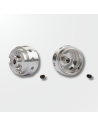
The choice of tyre compound is one of the most determining factors in grip. For indoor carpet tracks, soft foam compounds work very well; for outdoor asphalt, rubber slicks are more common. The width of the wheel also influences the footprint and should be consistent with the body used.
Weight and distribution
The TT01 has a fairly balanced weight distribution as standard. Adding ballast at specific points on the chassis can fine-tune performance, but it should be done in a controlled manner and recording changes to undo what does not work.
Practical tips for use, maintenance, and preparation
The TT01 is a grateful chassis if given regular minimum maintenance. These are the points that should not be neglected:
- Differential lubrication: using the appropriate grease on the differential gears reduces wear and smooths response. Tamiya offers specific lubricants for this task; avoid generic greases that may attack plastic.
- Check the drive belt: periodically inspect it for cracks, lateral wear, or loss of tension. A worn belt can break during a session and leave the car without traction.
- Motor cleaning: if you use a brushed motor, regularly check the condition of the brushes and the commutator. A dirty or worn commutator significantly reduces performance.
- Tightening screws: after the first sessions, review all screws on the chassis. Vibrations loosen parts more quickly than expected, especially on rough surfaces.
- Battery storage: if you use LiPo, always store them at the recommended storage voltage (generally around 50% charge). Do not leave them discharged or fully charged for long periods.
- Body and painting: a well-painted body with Tamiya paints or Vallejo acrylics and protected with a durable varnish withstands soft impacts and track rubbing much better.
Common mistakes we should avoid
The collective experience of the TT01 community has left a clear map of the most repeated failures. Knowing them in advance saves time, money, and frustration:
Installing incompatible parts between versions
As mentioned earlier, the TT01 and TT01E share many components but not all. Before ordering any spare part, confirm the exact version of your chassis. A common mistake is trying to install the steering knuckles from the TT01E on the standard TT01 without checking the mounting points.
Ignoring belt tension
A poorly tensioned belt is one of the most common and easiest problems to prevent. Spend five minutes after each disassembly of the chassis to check the tension before running.
Overusing the motor without managing temperature
High-turn brushed motors heat up quickly, especially with high-discharge batteries. If you do not monitor the temperature, you can damage the windings or melt the pinion. A heatsink or a small fan significantly prolongs the motor's lifespan.
Neglecting camber angle
Excessively negative camber can stabilise in corners but destroys the tyre on straights. Adjust camber progressively and measure tyre wear after each session as an indicator.
Buying upgrades without a priority order
The catalogue of upgrades for the TT01 is extensive and tempting. The usual recommendation is to start with bearings (if the kit does not include them), then move on to CVA shocks, and then tackle the electronics. Investing in a competition motor before having a well-adjusted suspension makes no sense.
Recommendations for beginners and advanced users
If you are starting
The TT01E is the most logical entry point: it includes the most important upgrades as standard (CVA shocks, rear ball differential) and saves the initial investment in basic upgrades. Choose a brushed motor in the 23T-27T range, an economical but reliable ESC, and dedicate the first sessions to understanding the car's behaviour before modifying anything. The factory geometry of the TT01E is already a solid base.
For painting the body, Tamiya spray paints for lexan are the most straightforward and offer very effective finishes with minimal equipment. If you already have experience with an airbrush, diluted acrylics from Vallejo or Tamiya also work perfectly on polycarbonate with the proper preparation.
If you already have experience with the TT01
Advanced users often approach the TT01 as an experimentation platform: switching to brushless motors, fine-tuning geometry with aluminium parts at critical points (steering knuckles, bulkheads), or building specific drift configurations with the TT01D as a base. The chassis can accommodate high-end electronics without structural issues, as long as the assembly is correct.
An interesting option for users with experience in static modelling is to combine the mechanical preparation of the TT01 with competition-level painted bodies: the result is a car that performs well and is a pleasure to showcase.
| Variant |
Suspension |
Rear Differential |
Shocks |
Recommended Profile |
| Standard TT01 |
Basic |
Gear |
Friction |
Entry-level / low budget |
| TT01D (Drift) |
Basic |
Gear |
Friction |
Drift / controlled sliding |
| TT01E (E-Tuned) |
Adjustable |
Balls |
CVA (oil) |
Entry-level + immediate performance |
| TT01R (Racing) |
Adjustable |
Balls |
CVA (oil) |
Club competition |
| TT01 Type-E |
Improved |
Balls |
CVA (oil) |
Intermediate / advanced user |
Frequently asked questions about the TT01
Do the TT01 and TT01E share all spare parts?
Most do, but not all. There are suspension and steering parts specific to each version. Always check the Tamiya part number before ordering to avoid incompatibilities.
Can I install a brushless motor on a standard TT01?
Yes, the 540 format is compatible. You will need a specific ESC for brushless motors and ensure that the pinion is correctly aligned with the drive belt. Beyond a certain KV, it is also advisable to check the rigidity of the motor mount.
What is the difference between the TT01D and drifting with a standard TT01?
The TT01D comes factory-configured for drift: hard plastic tyres and specific toe adjustments. A standard TT01 can be converted into a drift platform by changing the tyres, but the TT01D saves that initial step.
What is the lifespan of the drive belt?
It depends on use and maintenance, but with regular sessions, it usually lasts between 6 and 12 months. Inspect it periodically and replace it if you detect cracks or visible lateral wear.
What bearings does the TT01 need?
The standard TT01 comes with plastic bushings. The most recommended and economical upgrade is to replace them with ball bearings 850 (8x5x2.5 mm) and 1150 (11x5x4 mm) at the main points. The TT01E already includes bearings in some versions of the kit.
Is the TT01 suitable for official competition?
The TT01R is oriented towards club competition. In more serious categories, the chassis faces competition from more modern platforms, but in specific regulated classes for the TT01, it remains completely valid.
What paint should I use for the polycarbonate body?
Tamiya spray paints for lexan are the reference. If you prefer airbrush, diluted acrylics from Vallejo or Tamiya with their specific thinner work well on primed polycarbonate. Always apply the colour from the inside of the body to protect the finish.
Can I use LiPo batteries in the TT01?
Yes, as long as the ESC is compatible with LiPo (with low voltage cut-off protection). Check that the battery pack fits in the compartment without straining the wires. 2S LiPo (7.4 V) is the most common standard for this platform.
What oil should I use in the CVA shocks?
Tamiya offers shock oil in various viscosities (400, 600, 1000 cSt and higher). For general use on asphalt tracks, the 400-600 range in the front and 600-1000 in the rear is a solid starting point; then adjust according to the car's actual response.
Does the TT01 accept bodies from other brands?
Yes, any 1/10 touring car body with a wheelbase of 257 mm is compatible. There is a wide variety on the market, from replicas of racing touring cars to truck or drift bodies.
How long does it take to assemble a TT01 kit from scratch?
With some experience in modelling or RC, between 3 and 5 hours. For someone assembling it for the first time while following the manual calmly, it can take 6-8 hours. It is a very educational process that helps understand each component of the car.
Where can I find the complete parts breakdown of the TT01?
Tamiya publishes the manuals and parts breakdowns of all its kits on its official website. At Ministry of Hobby, we can also guide you on which part you need if you provide us with the kit number or the exact version of your chassis.