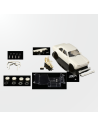
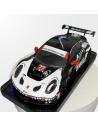
Drifting in 1/10 scale is one of the most technical and visually spectacular disciplines in radio control. Watching a car about 45 cm long slide in a controlled manner, with the rear end breaking traction and the body tilted at just the right angle, hooks you from the first time. It’s not pure speed; it’s precision, sensitivity on the controller, and a setup that makes the difference between sliding out of control and executing a clean line. In this category, you will find cars, kits, and everything you need to practice this discipline, whether you are new to radio control or looking to improve your current setup.
The 1/10 scale is the reference standard in RC drifting. It is large enough to appreciate every detail of the body and work comfortably on the chassis, yet manageable enough to run indoors, in parking lots, or on dedicated tracks. Most serious brands concentrate their development here, resulting in an extensive range of models, spare parts, and options. If there is a scale where the RC drift community is most alive, it is this one.
Whether you are attracted to the aesthetics of 90s Japanese touring cars, American muscle cars, or competition prototypes, the 1/10 scale has a body for you. And beneath that body, a chassis specifically designed for drifting: geometry, Ackermann angle, long-travel suspensions, and electronics that respond precisely to every command from the driver.
What is 1/10 scale RC drifting and why does scale matter
RC drifting involves driving a radio-controlled car in such a way that the rear axle loses traction in a controlled manner, replicating the technique of real drifting. Far from being a simple "slide," it requires mastering the entry into corners, the drift angle, and the transition from one side to the other. In competitions, judges evaluate angle, line, and proximity to the other car in tandem events.
The 1/10 scale means that the car measures approximately one-tenth of the real vehicle. In practice, we are talking about models between 42 and 48 cm long, with a weight ranging from 1,200 to 1,600 g depending on the setup. This size is the most widespread in the drift community for several reasons:
- Chassis with enough space for advanced electronics, high-speed steering servos, and high-performance batteries.
- Almost inexhaustible supply of OEM and aftermarket parts: from suspension arms to spindles of different offsets.
- Interchangeable bodies with a huge variety, both in clear polycarbonate for painting and in finished versions.
- Compatibility with standard electronics: 25T servos or similar, ESCs with dedicated drift modes, and brushless motors of the 540 or 550 type.
Other scales like 1/8 offer more physical presence but require more space and budget. The 1/12 or 1/18 scales are more economically accessible but lose options and community. The 1/10 scale is the perfect balance point for those who take drifting seriously.
How to correctly choose a 1/10 Drift car
Before buying, it is advisable to ask yourself some basic questions that will determine what type of car or kit fits best with your situation:
Kit, semi-kit, or RTR?
An RTR (Ready To Run) comes practically ready to roll: it includes electronics, body, and sometimes even the battery. Ideal for those who want to start running as soon as possible without the hassle of assembly. A kit requires the buyer to assemble the chassis from scratch and choose the electronics separately. It is the preferred option for those who enjoy the building process and want to control every component. Semi-kits or "builder's kits" are an intermediate version, with the chassis assembled but without electronics.
Rear-wheel drive (RWD) or all-wheel drive (AWD)?
The big decision in RC drifting. AWD (four-wheel drive) cars are easier to initiate sliding and forgive more mistakes, which is why they dominated the entry-level market for years. RWD (rear-wheel drive) requires more skill with the controller, but offers a feel closer to real drifting and is the most used in advanced competition. Nowadays, the advanced community has clearly leaned towards RWD.
Tubular chassis or platform?
Most 1/10 drift cars use a flat platform made of aluminium or reinforced plastic. Some more specific designs use tubular or mixed structures. The important factors are torsional rigidity and the ability to adjust the geometry: camber angle, toe, and especially the maximum steering angle (the greater it is, the easier it is to execute extreme angles).
Budget
The price range is wide. An entry-level RTR can be priced below €200, while a competition kit with high-end electronics can easily exceed €600-800. Define how much you want to invest in the car and leave room for tyres, battery, charger, and, if not included, the transmitter.
Main types and differences in 1/10 RC drifting
Within the 1/10 drift world, there are well-defined categories based on driving style, traction system, and the level of competition the car is aimed at:
AWD Drift
Chassis with four-wheel drive were the kings of RC drifting for a long time. They are more accessible for beginners because the car has a greater ease of initiating and maintaining the drift. Brands like Yokomo, MST, or Tamiya have developed AWD platforms with decades of evolution. Their weak point compared to RWD is that the driving feel is less organic and is increasingly less valued in competition.
RWD Drift
RWD (Rear Wheel Drive) is currently the competition standard in most RC drift categories and leagues. It requires more technique, especially in corner entry and transitions, but offers a much richer and more realistic driving experience. The best RWD chassis on the market allow for adjustments to the rear differential, steering angle, centre of gravity height, and mass distribution with notable precision.
Beginner drift vs. competition drift
Not all 1/10 drift cars are designed for the same purpose. Entry-level models prioritize durability and ease of use; competition models prioritize precision and adjustability. In competition, the electronics (especially the ESC and steering servo) matter as much or more than the chassis itself.
Technical aspects we need to know
1/10 scale RC drifting is a deeply technical hobby. Knowing the key components helps make better purchasing decisions and get the most out of the car:
Motor and ESC
Most current 1/10 drift cars use brushless motors of the 540 or 550 type, with KV typically ranging from 3,000 to 10,500 KV depending on use. A higher KV means more speed but less torque at low RPMs. For drifting, a moderate KV (between 4,000 and 7,000) usually provides better response. The ESC (electronic speed controller) must have a drift mode that allows for adjusting motor inertia and smoothing power cut-off, which is essential for maintaining angle without losing drift.
Steering servo
In RC drifting, the servo works constantly and at high frequency. A high-speed and high-torque servo is recommended, preferably with metal gears. The response speed (in seconds per 60°) is critical: below 0.08 s/60° is ideal for agile driving.
Tyres
Drift tyres are NOT designed for grip but for controlled sliding. They can be made of hard polycarbonate (the most common, called "drift tyres" or "slicks"), very hard rubber, or even 3D printed with specific patterns. The hardness and material directly affect the car's behaviour: more sliding or more control.
Battery
The most common format in 1/10 drift is the LiPo 2S (7.4 V) or 3S (11.1 V). The 2S offers more control and is recommended for beginners; the 3S provides more power but requires more skill. Pay attention to the dimensions of the battery pack to ensure it fits in the chassis compartment.
Geometry and setup
The setup of a 1/10 drift car includes adjustments for camber, toe, centre of gravity height, and maximum steering angle. These parameters determine how the drift initiates, how easily it is maintained, and how it responds to transitions. A good starting point is the factory setup; as experience is gained, adjustments can be made according to personal style and track surface.
Practical tips for use, maintenance, and preparation
- Warm up the car before intense sessions. A few minutes of gentle running allow the bearings and electronics to reach their operating temperature.
- Clean the tyres regularly. Drift tyres accumulate dirt that can alter their behaviour. A damp cloth after each session is sufficient.
- Check the steering. The servo and steering links suffer the most in drifting. Frequently check for play and wear in the ball joints.
- Lubricate the bearings. Dry bearings accelerate motor wear and generate unnecessary heat. A drop of fine oil every few sessions is sufficient.
- Adjust the rear differential according to the surface. On smooth surfaces (polished parking lots, wooden tracks), a tighter differential provides more stability. On surfaces with more grip, a looser differential facilitates the initiation of the drift.
- Manage your LiPo battery well. Do not discharge below the minimum voltage (generally 3.5 V per cell) and store at storage voltage (3.8 V per cell) if you will not use it for several days.
- Bring basic spares to the track. Steering links, ball joints, M3 screws, and a couple of spare tyres prevent a session from being cut short due to a small part.
Common mistakes to avoid
Buying a competition car as a beginner
A competition chassis with minimal entry-level electronics can be frustrating at first. The car does not forgive, and if the driver does not yet have the feel for RC drifting, the learning curve becomes unnecessarily steep. Start with a well-equipped entry-level model and level up when you master the basics.
Undervaluing the importance of the ESC
Many buyers focus their budget on the chassis and cut back on the ESC. This is a mistake: the speed controller determines how the motor responds during drifting, and a low-quality ESC without a drift mode can make the car almost impossible to control.
Using grip tyres on a drift car
It seems obvious, but it happens: mounting soft rubber tyres on a car set up for sliding means the car will not drift well or will do so unpredictably. Drift tyres are specifically designed for this use.
Not adjusting the steering angle
By default, many cars come from the factory with a standard steering angle designed for racing. For drifting, it is advisable to widen that angle to the maximum allowed by the chassis, as it greatly facilitates tight turns and transitions.
Ignoring battery balancing
Charging a LiPo without balancing the cells reduces its lifespan and can create risky situations. Always use a charger with a balance function.
Recommendations for beginners and advanced users
If you are starting
Opt for a well-rated RTR AWD or an entry-level RWD. Look for a model with good availability of spare parts, as crashes are inevitable in the first few months. Don’t obsess over high-end electronics from the start: learn to control the car and then invest in upgrades. A quality transmitter/receiver is worth the investment from day one, as you will reuse it in all your future cars.
If you already have experience
Explore competition RWD chassis and work on the setup: steering angle, type of differential, tyre hardness, and motor KV. The significant difference between an intermediate driver and an advanced one often lies in the ability to read the car's behaviour and adjust it, not in the components themselves. Also consider participating in local or national championships: the pressure of competition significantly improves technique.
| Feature |
AWD Drift (beginner) |
RWD Drift (advanced) |
| Ease of learning |
High |
Medium-Low |
| Driving feel |
Assisted |
Natural and technical |
| Use in competition |
Beginner categories |
Standard in competition |
| Maintenance |
Simple |
More demanding |
| Availability of options |
Good |
Very extensive |
| Entry price |
Accessible |
Medium-High |
Frequently asked questions about 1/10 RC Drift cars
What is the difference between a drift car and a racing car in 1/10 scale?
Mainly the geometry of the chassis, the tyres, and the electronic setup. Drift cars are prepared to slide in a controlled manner, with hard or polycarbonate tyres and setups with a greater steering angle. Racing cars seek maximum grip and clean lines, with soft rubber tyres.
Do I need a special track to do 1/10 RC drifting?
Not necessarily. A smooth, clean surface like a parking lot or wooden floor is sufficient for practice. Dedicated tracks offer a better experience and allow for tandem practice, but they are not essential to start.
What battery does a 1/10 drift car need?
Most use LiPo 2S (7.4 V) or 3S (11.1 V) packs in stick or saddle format. Check the specifications of the ESC manufacturer to know the maximum voltage allowed before using 3S.
Is it better to start with AWD or RWD?
It depends on your level and goals. AWD is easier to control at first. RWD has a steeper learning curve but is the way to go if you intend to compete or improve your technique in the long term. Nowadays, many drivers start directly with entry-level RWD.
Can I use the same transmitter for multiple cars?
Yes. A transmitter with multiple model memory allows you to use the same transmitter with different cars, saving the settings for each one separately. It is one of the smartest investments when you have more than one model.
What KV motor is recommended for 1/10 drifting?
For beginners, a motor between 4,000 and 6,000 KV offers a good balance between speed and control. Above 8,000 KV, the car becomes more difficult to handle in drifting; it is recommended only when the technique is already mastered.
Do drift tyres wear out quickly?
Hard polycarbonate tyres have a long lifespan, but they can lose profile with intensive use. Hard rubber tyres wear out a bit faster. In any case, they are economical consumables and easy to replace.
What servo do I need for RC drifting?
A high-speed servo (less than 0.10 s/60°) with sufficient torque (minimum 8-10 kg·cm) and metal gears. The servo is one of the components where it is not advisable to skimp in drifting.
Can I convert a 1/10 racing car into a drift car?
Technically yes, by changing the tyres to drift ones and adjusting the electronics. However, the geometry of racing chassis is not optimized for drifting, so the result will never match that of a chassis specifically designed for it.
Is a gyro (gyroscope) necessary for RC drifting?
It is not essential, but it helps a lot, especially at the beginning. The gyroscope automatically corrects small deviations of the rear, making the car more stable in the drift. Many advanced drivers use it with reduced sensitivity to maintain control without losing feel.
How often should I maintain a 1/10 drift car?
It depends on use. As a general rule: clean and visually inspect after each session, lubricate bearings every 5-10 sessions, and periodically check links and ball joints. Regular maintenance extends the life of all components and avoids surprises on the track.
Which brands have better spare parts support for 1/10 drift?
Yokomo, MST, Tamiya, and Overdose are leaders with a wide availability of spare parts and options. Before buying a chassis, check that spare parts are easily obtainable, especially suspension and steering parts that suffer the most.