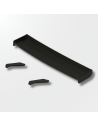
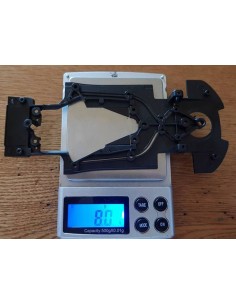
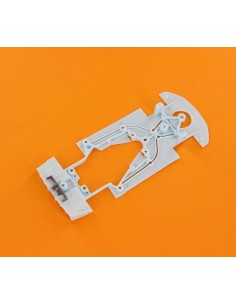
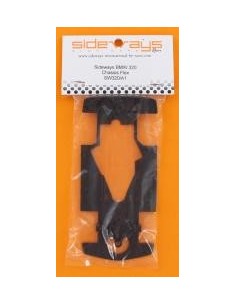
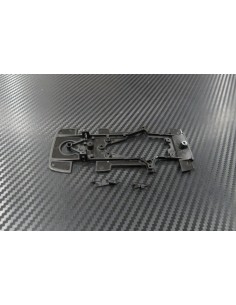
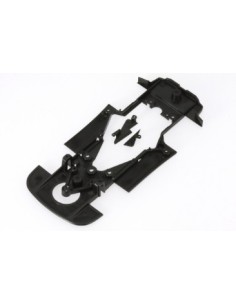
The chassis is the backbone of any slot car. It is the piece on which the motor, axle, guide, braids, and all the mechanics that determine how the car behaves on track are mounted. While there are resin, carbon fibre, or machined aluminium chassis, the plastic chassis is the starting point for almost everyone: it is the standard material for the vast majority of manufacturers and, if well chosen, delivers more than competitive results both on club circuits and at home on the table.
What many drivers discover over time is that "plastic" is not synonymous with inferior. The compound, geometry, wall thickness, and material hardness determine how the chassis performs under stress: whether it absorbs track irregularities, whether it transmits motor torque well, whether it flexes just enough, or whether it is too stiff for certain circuits. Understanding these nuances is what separates a driver who simply buys a spare part from one who truly prepares their car.
In this section, you will find plastic chassis for the most common brands and models on the market: NSR, Slot.it, Scaleauto, Avant Slot, and other leading manufacturers. Whether you are looking to replace the original chassis of your car because it has been damaged, or if you want to experiment with a different compound to fine-tune the setup, here are the most relevant options from the catalogue, with enough technical information for you to make a well-founded decision.
What is a plastic chassis and why is it so important
The chassis of a slot car is not just a support structure: it is the element that defines the complete geometry of the vehicle. The motor mounting points, rear axle support, guide support, braid channels, and, in many cases, the position of the ballast are integrated or mounted on it. Everything that affects the dynamic behaviour of the car references the chassis.
In the case of plastic chassis, the material is injection moulded, allowing for very precise and repeatable geometries. This is a real advantage: two chassis of the same model behave almost identically, something that is not always so easy to achieve with hand-machined parts. Additionally, plastic has a vibration absorption capacity that is beneficial in many track configurations.
The importance of the chassis is particularly noticeable in fast corners and elevation changes. A chassis that is too stiff can cause the car to lose contact with the rail on uneven surfaces; one that is too flexible can lead to oscillations that the driver perceives as instability. The balance between stiffness and flex is precisely what manufacturers pursue when formulating their plastic compounds.
How to correctly choose a plastic chassis
The first variable you should consider is compatibility with your car model. Not all chassis are interchangeable: each manufacturer designs theirs with specific measurements for wheelbase, width, motor position, and body mounts. Before purchasing, verify that the chassis corresponds exactly to your car reference.
Once compatibility is confirmed, the next factor is the compound. Manufacturers often offer the same chassis in different materials or hardness levels, and this is where the preparation work begins. A softer compound tends to provide more grip in cold conditions and greater adaptability to the track, while a harder one offers precision and consistency when the car is already at working temperature.
You should also consider the rail system for which the car is designed. Cars designed for universal rail (Scalextric, Ninco) have different geometries than those designed for sport rail (Scaleauto, Slot.it), and the chassis must be consistent with that configuration. Mixing components from different systems without fully understanding the implications is one of the most common mistakes among beginners.
Finally, consider what you will use the car for: if it is for club competition with homologated regulations, ensure that the chassis you choose is the original or permitted by the regulations. If it is for free use or preparation testing, you have more leeway to experiment.
Main types and differences
Within the world of plastic chassis, there are several categories worth distinguishing:
- Stock or standard chassis: This is the one that comes as standard with the car. It is designed to offer a balance between performance and cost, and is usually perfectly valid for recreational use and entry-level competition.
- Original spare chassis: Same material and geometry as the standard one, but sold as a separate part. Ideal when the original chassis has cracked or deformed due to a hit or heat.
- Alternative compound chassis: Some manufacturers, especially NSR and Slot.it, offer the same chassis model in different plastic compounds (designated by colours or their own technical names). They allow for adjusting the flex of the chassis without changing the geometry.
- Plastic chassis with reinforcements: Some versions incorporate inserts or thicker areas to increase rigidity in critical points, such as motor mounts or rear supports, while maintaining some flexibility in the rest of the structure.
The choice between one and the other depends on the level of preparation you want to achieve and the regulations under which you compete. To start, the stock chassis or its direct replica is always the most sensible option.
Technical aspects we need to know
The plastic chassis works differently depending on the type of motorisation of the car. In a sidewinder configuration (motor parallel to the rear axle), the chassis must manage the lateral forces generated by the transmission. In an inline configuration (motor in line with the rear axle, perpendicular to it), the centre of gravity is lower and the chassis works more symmetrically. In the anglewinder configuration (motor at an angle to the axle), a compromise between the two previous configurations is sought. Each configuration requires the chassis to be designed for that force scheme, so they are not interchangeable.
Another relevant technical aspect is the working temperature. Plastic behaves differently on cold tracks (outdoor circuits in winter) than on tracks that have been running for hours. Some experienced drivers change the chassis compound according to the time of year or the type of installation.
Dimensional tolerance also matters. A chassis that has accumulated impacts over time may have lost its original geometry. Before discarding a car for poor performance, it is worth checking if the chassis is straight using a flat reference surface. If there is deformation, replacement is the most straightforward solution.
Finally, consider the weight. The plastic chassis is usually lighter than its resin or metal counterparts, which can be an advantage or a disadvantage depending on the ballast that the regulations allow to be added.
Practical tips for use, maintenance, and preparation
Maintaining a plastic chassis is straightforward, but there are routines that make a difference:
- Regular cleaning: Track dust and lubricant residue accumulate in the inner areas of the chassis. Periodic cleaning with a cotton swab and an appropriate cleaner keeps axle supports and mounts in good condition.
- Checking flatness: Place the chassis on a flat surface (a glass or reference plate) and check for any twisting. A slight deformation can be corrected by applying controlled heat with a hairdryer on low temperature, although it requires practice.
- Inspection of mounts: The areas where the motor and rear mount are secured are points of greater stress. Check them periodically for cracks, especially if the car has suffered significant impacts.
- Lubrication of supports: The contact points between the chassis and the axles or mount must be properly lubricated. Always use slot-specific lubricants in minimal amounts: excess attracts dirt and degrades the plastic over time.
- Storage: Avoid leaving cars with the chassis under tension (for example, with clamps that are too tight during storage). Plastic can develop deformation memory over time.
Common mistakes to avoid
Knowing the most common mistakes saves time, money, and frustration:
- Buying without verifying exact compatibility: Two cars from the same manufacturer may have chassis with different geometries. Always check the specific model reference.
- Ignoring the hardness of the compound: Thinking that "a chassis is a chassis" and that they all behave the same is a common mistake. The compound has a real and measurable influence on the car's behaviour.
- Forcing assembly: If a component does not fit easily, do not force it. A plastic chassis can crack at mounting points if too much pressure is applied. Verify that the parts are correct before forcing assembly.
- Mixing systems without informing yourself: Combining components designed for different rail systems (for example, Scalextric and Scaleauto) without knowing the implications can result in a car that does not perform well in either.
- Using aggressive adhesives for repairs: Some cyanoacrylates and solvents can damage the plastic of the chassis. Always use compatible products and apply them carefully away from critical structural areas.
- Not checking flatness after a hard hit: A car that starts to behave oddly after an accident may have a deformed chassis. This is the first thing to check before looking for the problem in another component.
Recommendations for beginners and advanced users
If you are starting
The best decision is to replace the manufacturer's stock chassis when necessary. Don't complicate yourself yet with alternative compounds: first, learn to understand the base behaviour of your car and what variables affect it. The stock chassis is optimised for that model and will give you a solid reference to learn from.
Before purchasing, note the exact reference of the original chassis (usually engraved on the part or in the car's documentation) and search for it in our catalogue. If you have doubts, consult us: it is better to make the first purchase correctly than to repeat it.
If you already have experience
Alternative compounds are a real preparation tool. Brands like NSR or Slot.it have developed variants of their chassis in different materials that allow for adjusting flex without modifying geometry. This is especially useful in competition, where regulations may limit modifications but allow choosing between homologated versions of the same chassis.
Keeping a record of the chassis you have tested, in what motor configuration, and with what results on track will help you build a very valuable knowledge base. Slot racing is, to a large extent, a data and memory sport.
| Type of plastic chassis |
User profile |
Main advantages |
Considerations |
| Stock / standard |
Beginner, recreational use |
Performance-price balance, geometry optimised for the model |
Fixed compound, no adjustment options |
| Original spare |
All levels |
Identical to the standard, easy replacement |
Verify exact reference |
| Alternative compound |
Intermediate - advanced |
Flex adjustment, preparation possibilities |
Requires prior knowledge to make the most of it |
| With local reinforcements |
Advanced, competition |
Selective rigidity, greater durability at critical points |
Less common, verify compatibility with regulations |
Frequently asked questions about plastic chassis
Can I put a chassis from another brand on my car?
In principle, no. The chassis is designed for a specific body, mount, and anchor points for each model. Mixing manufacturers without custom preparation almost never works well.
What is the difference between a soft chassis and a hard one?
A softer chassis flexes more in response to track irregularities, which can improve grip on circuits with elevation changes. A harder one transmits torque better in fast corners and has a more predictable behaviour when the car is already running. The optimal choice depends on the type of track and driving style.
How do I know if my chassis is deformed?
Place it on a flat surface (a thick glass or reference plate) and check for any twisting or if any of the corners is elevated. You can also check if the wheels contact unevenly when the car is assembled.
Can a cracked plastic chassis be repaired?
It depends on the area and severity of the crack. Small cracks in non-structural areas can be consolidated with a specific adhesive compatible with plastic. Cracks in motor or mount anchor areas compromise the integrity of the assembly, and it is advisable to replace the chassis.
Is the plastic chassis valid for competition?
Yes, and in fact, it is the material required in many club competition regulations precisely to ensure equality among participants. Always verify the regulations of the championship you are participating in to confirm which versions are homologated.
When should I change the chassis?
When it shows cracks in structural areas, permanent deformation that cannot be corrected, or when the car starts to behave erratically without any apparent cause. A chassis in good condition is the foundation for all subsequent setup.
Are NSR and Slot.it chassis interchangeable?
No. Although both brands are leading in competition, their chassis have their own geometries and are incompatible with each other. Each is designed for the models and components of its own catalogue.
What lubricant should I use on the chassis?
Always use slot-specific lubricants at the contact points between the chassis and the axles or mount. Avoid generic mineral oils or spray lubricants that may damage the plastic or attract excessive track dust.
Can I use the same chassis for universal rail and sport rail?
Not directly. The chassis is designed for the guide geometry and rail width of a specific system. Mixing systems without adapting the components results in a car that does not perform well in either environment.
Does the chassis influence the car's top speed?
Indirectly, yes. A chassis in poor condition or with inadequate flex for the track can cause loss of contact with the rail and oscillations that reduce effective speed. A well-chosen and well-maintained chassis allows the motor to operate under optimal conditions.
What is the most common compound in stock chassis?
This varies by manufacturer, but it generally consists of engineering plastics (like ABS or PA) with different percentages of additives to adjust hardness and impact resistance. Manufacturers rarely publish the exact composition; what they usually specify is the relative hardness compared to other versions in their catalogue.
Does it make sense to change the chassis if the car is already performing well?
If the car is performing well and the chassis is in good condition, there is no reason to change it. Changing the compound is a fine-tuning tool for when you have mastered the base configuration and are looking for an additional performance margin in a demanding competition environment.