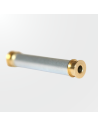
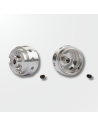
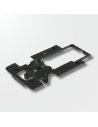
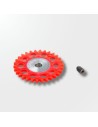
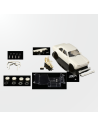
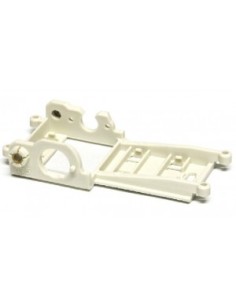
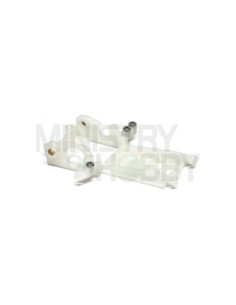
When we seek real performance on the track, mechanical details make the difference. One of those details —often underestimated— is the motor mount. In the sidewinder configuration, the motor is placed parallel to the rear axle, transversely to the chassis. This orientation has direct consequences on the centre of gravity, power transmission, cornering behaviour, and ease of adjustment. Without a well-chosen and correctly installed mount, the best motor on the market will not unleash its full potential.
In this category, you will find specific motor mounts and supports for sidewinder installation: parts made from different materials, with various fixing geometries and degrees of rigidity, designed for both prepared production cars and competition projects. If you are tuning an NSR, a Slot.it, a Scaleauto, or any other model that uses this motorisation system, here are the options you need to consider before making a decision.
It’s not just about "fitting the motor." The mount determines the alignment of the pinion with the crown gear, the transmission tension, the ability to absorb vibrations, and, in many cases, the possibility of modifying the inclination angle of the assembly to fine-tune the car's behaviour. A component that seems minor but, in the hands of someone who knows what they are looking for, transforms the way the car responds.
Whether you are starting out in slot car preparation or have been fine-tuning chassis for championships for years, understanding what a sidewinder mount is, what variables influence its choice, and what mistakes to avoid will save you time, money, and frustrations in the workshop.
What is a sidewinder mount and why is it so important
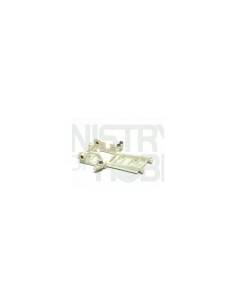
The mount —also called motor support— is the piece that fixes the motor to the chassis and establishes its relative position to the rear axle. In the sidewinder system, the motor is perpendicular to the car's longitudinal axis, that is, transverse. This means that the motor's pinion directly engages with the crown gear of the rear axle without the need for intermediate transmission systems, resulting in a clean, relatively simple mechanics that is widely used in the world of competitive slot racing.
The importance of the mount lies in several simultaneous factors:
- Alignment: A poorly aligned mount generates mechanical friction, premature wear of the pinion and crown gear, and loss of efficiency in transmission. The motor must be perfectly parallel to the rear axle for the gear to work without play or unnecessary tension.
- Rigidity vs. flexibility: Some mounts are completely rigid (providing precision and repeatability), while others allow for some degree of movement or impact absorption (useful on uneven tracks or to protect the pinion and crown gear).
- Motor height: The vertical position of the motor directly affects the car's centre of gravity. Lowering it favours stability in corners; raising it can improve traction in certain configurations.
- Ease of maintenance: A good mount allows access to the motor, disassembly of the pinion, and inspection of the transmission without dismantling the entire chassis. In competition, this is essential.
In summary: the mount is not a secondary accessory. It is the component that determines how the mechanical heart of the car works.
How to correctly choose a sidewinder mount
Before purchasing a mount, it is advisable to answer several key questions:
What chassis and motor is it compatible with?
Not all mounts fit all chassis. Each manufacturer designs its parts with specific measurements: distance between fixing holes, diameter of the motor housing, depth of fit. NSR, Slot.it, Scaleauto, or Avant Slot have their own geometries, and although some parts are interchangeable, it is advisable to verify compatibility before purchasing. Always check the motor measurements (the most common in 1/32 are the can 20×15 mm and similar variants) and those of the receiving chassis.
What material do you need?
Mounts are made from different materials, each with its advantages:
- Technical plastic (nylon, delrin): Lightweight, economical, with some vibration absorption capability. Very common in production cars and beginner preparations.
- Machined aluminium: Rigid, precise, heat-resistant. Preferred in competition where maximum repeatability is sought and the motor operates under high demands for extended periods.
- Carbon fibre or composite materials: High rigidity with low weight. Premium option for finely tuned preparations.
Do you need position adjustment?
Some mounts offer the possibility to adjust the motor's position: lateral displacement (to adjust the pinion-crown gear spacing) or inclination (to modify the transmission geometry). This versatility is highly valued in competition, although it adds complexity to the adjustment.
What type of chassis fixation does it have?
Through screws, retention clips, direct fit… The fixation system influences the speed of change and stability during the race. In competition, screw fixation is the most reliable.
Main types and differences
Within the world of sidewinder mounts, we find several differentiated categories:
Stock mounts
These are the ones that come mounted on cars directly from the factory. They are usually made of technical plastic, sufficient for recreational use and initial preparations. They work well with the motors for which they are designed, but may fall short if a more powerful motor is installed or if greater alignment precision is required.
Aftermarket competition mounts
Manufactured specifically to improve performance compared to the stock part. They are available in machined aluminium or composite materials, with tighter tolerances and, in many cases, with adjustment possibilities that the original part does not offer. They are the usual choice in club championships and competitions.
Universal vs. model-specific mounts
Some mounts are designed for a specific car model (for example, for a specific NSR body with a certain chassis), while others aim to be compatible with a broader range of chassis and motors. Universal mounts offer flexibility; specific mounts provide a perfect fit. In competition, the specific option usually prevails.
Mounts with adjustable tension system
Allow for regulating the engagement pressure between pinion and crown gear without disassembling the assembly. Very useful when working with different gear ratios or when wanting to adjust the car's behaviour based on the track.
Technical aspects we need to know
To get the most out of a sidewinder mount, it is essential to understand some technical concepts that directly affect the result on the track:
Play between pinion and crown gear
The play between both pieces should be minimal but present: too tight generates friction and heat; too loose causes loss of efficiency and noise. The mount largely determines this play. Many preparers use a thin sheet of paper as a reference to adjust the correct spacing during assembly.
Vertical position of the motor
In sidewinder configuration, lowering the motor brings the centre of gravity closer to the ground, improving stability. However, there are physical limits set by the body itself and by competition regulations. The chosen mount must allow the desired position without compromising the integrity of the assembly.
Vibration absorption
At high RPM, the motor generates vibrations that are transmitted to the chassis and affect driving. Rigid mounts transmit them directly (more control, but more sensitive to chassis imperfections); mounts with greater absorption capacity partially dampen these vibrations (smoother behaviour, slightly less precision in engagement).
Compatibility with the track system
The sidewinder mounting is present in both cars for universal track (Scalextric, Ninco) and sport track (Scaleauto, Slot.it). The configuration of the mount does not change according to the track system, but it may be conditioned by the specific regulations of each championship.
Practical tips for use, maintenance, and preparation
A well-chosen mount can last a long time if properly cared for. Some tips we apply in the workshop:
- Periodic cleaning: The accumulation of dirt, lubricant residues, and rubber dust in the gear area affects performance. Cleaning the pinion and crown gear frequently is essential.
- Check the adjustment after each intense session: Vibrations can loosen the fixing screws of the mount. Checking the tightness before each competition session is a habit that prevents surprises.
- Correct lubrication: The pinion-crown gear engagement point requires a minimal amount of specific lubricant. Too much makes it dirty and can attract dirt; too little causes premature wear. Always use lubricants designed for slot transmissions.
- Regularly verify alignment: If the car starts to vibrate more than usual or the motor consumption rises without apparent reason, the first thing to check is the alignment of the mount.
- Keep the original mounts: If you install an aftermarket mount, keep the stock one. In case of any problems or if the championship regulations change, having the original part on hand is a safety net.
Common mistakes to avoid
In the workshop, we see the same mistakes repeated more often than seems reasonable. These are the most common:
- Buying by price without verifying compatibility: An economical mount that does not fit well in the chassis is wasted money. Always check the measurements before purchasing.
- Over-tightening the fixing screws: Especially in technical plastic mounts, excessive tightening can deform the motor housing and generate incorrect alignment. Tighten just enough.
- Ignoring the engagement play: Mounting the pinion and crown gear tightly without leaving play is a very common mistake among novice preparers. Always leave a minimum functional play.
- Mixing mounts and motors from different manufacturers without verifying measurements: Not all motor cans have the same outer diameter. A small difference can mean that the motor is not securely held or that it has excessive play within the mount.
- Neglecting the lateral fixation of the motor: In some mounts, the motor can shift laterally if not secured properly. This alters the engagement play during the race with unpredictable consequences.
- Not checking the condition of the mount after an accident: A strong impact can slightly deform a plastic mount or bend a thin aluminium one. After a serious accident, always check the assembly before rolling again.
Recommendations for beginners and advanced users
If you are starting out
The most sensible approach is to start with the stock mount that comes with your car. Before investing in aftermarket parts, take time to understand how the sidewinder mounting works, how to adjust the engagement play, and how the condition of the mount influences the car's behaviour. Once you are clear on the limitations imposed by the stock part, you will be in a position to choose a competition mount well.
Brands like NSR or Slot.it offer very accessible and well-documented aftermarket mounts, ideal for taking the first step in preparation.
If you already have experience
You probably already know exactly what you are looking for: a specific material, a particular geometry, a specific adjustment system. In that case, the most important thing is to verify compatibility with your current chassis and decide whether to prioritise maximum rigidity (aluminium or carbon) or some degree of vibration absorption depending on the type of track you compete on. Brands like Scaleauto or Avant Slot offer interesting options for advanced preparations.
If you compete in a championship with strict technical regulations, always check if there are restrictions on the type of mount allowed before purchasing.
| Material |
Rigidity |
Weight |
Vibration absorption |
Recommended use |
| Technical plastic (nylon/delrin) |
Medium |
Low |
Good |
Stock, beginner, recreational use |
| Machined aluminium |
High |
Medium |
Low |
Competition, club championships |
| Carbon fibre / composites |
Very high |
Very low |
Very low |
Advanced competition, premium preparations |
Frequently asked questions about sidewinder mounts and supports
What is the difference between a sidewinder and an inline mounting?
In sidewinder, the motor is parallel to the rear axle (transverse to the chassis). In inline, the motor is perpendicular to the rear axle, aligned longitudinally with the car. The inline lowers the centre of gravity more but requires a different transmission. They are two distinct mounting philosophies with their own advantages and disadvantages.
Can I use an NSR sidewinder mount on a Slot.it chassis?
Generally, they are not directly interchangeable, as each manufacturer designs its parts with specific measurements. Some preparers adapt mounts from other brands, but this requires verifying measurements and, in some cases, modifying the chassis. The simplest and most reliable option is to use mounts specifically designed for your chassis.
Which mount is better for competition: aluminium or plastic?
For competition, machined aluminium is usually the most common choice because it offers greater alignment precision and withstands the high temperatures of a demanding motor better. Plastic has its place in beginner cars or in categories with very strict regulations.
How often should the mount be checked?
In recreational use, a check every 5-10 hours of running is sufficient. In competition, it is advisable to check the tightness of the fixation and the engagement play before each session.
Does the mount influence the motor's electrical consumption?
Yes. A poorly aligned mount that generates friction in the engagement makes the motor work harder, increasing its consumption and temperature. A correct mounting is essential for the motor to operate under optimal conditions and have a prolonged lifespan.
Can I mount any motor in any sidewinder mount?
No. The diameter of the motor housing in the mount must match the outer diameter of the motor can. The most common in 1/32 are 20×15 mm, but there are variants. Always check the measurements before purchasing.
What lubricant should I use on the pinion-crown gear engagement?
Use specific lubricants for slot transmissions, in a small amount applied directly to the teeth of the pinion or crown gear. Avoid generic lubricants that may attack the plastic materials of the assembly or attract excessive dirt.
Are aftermarket mounts compatible with competition regulations?
It depends on the regulations of each championship. Some allow free modification of the motor support; others require stock parts. Always consult the regulations before investing in preparation parts.
Which is better: fixed mount or mount with position adjustment?
Fixed mounts are simpler and more robust. Adjustable ones offer greater versatility for fine-tuning engagement or motor position, but require more care to ensure the adjustment does not shift during the race. For beginners, a fixed mount is safer; for advanced preparers, an adjustable one can make a difference.
How do I know if my mount is well aligned?
The clearest indicator is the sound of the engagement: a well-adjusted engagement is smooth and regular. If you hear a rough, irregular sound or notice excessive vibration in the chassis, check the alignment of the mount. You can visually verify that the pinion and crown gear are working in the same plane and that the play is uniform throughout the travel.
Is it worth changing the stock mount if I only run recreationally?
In purely recreational use, the stock mount is usually more than sufficient if the car is in good condition and the mounting is correct. Changing it makes sense if you seek to improve performance, if the original is damaged, or if you start to take an interest in preparation and competition.