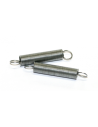
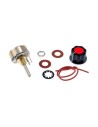
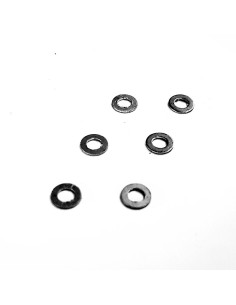
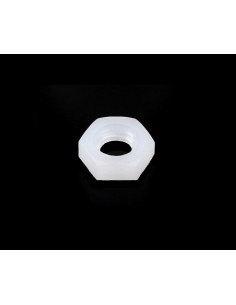
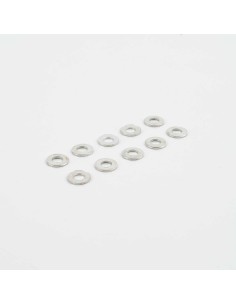
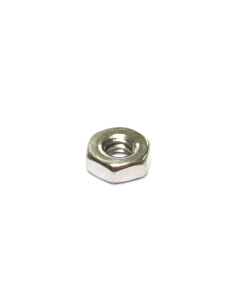
There are components that go unnoticed until they are missing or used incorrectly. Nuts and washers are exactly that: small parts with a huge role in any assembly, whether it be a competitive slot car, a static model, a diorama, or a restored diecast model. A poorly secured axle, a screw without the appropriate washer, or a nut that vibrates and loosens can ruin hours of work or, worse, render a perfectly functioning assembly useless. At Ministry of Hobby, we know that those seeking these parts do not do so on a whim: they need them to finish a job well done, and they need them correct the first time.
Whether you are preparing a slot chassis for competition, adjusting a motor mount, mounting a figure on a base, or assembling a resin body, nuts and washers are the elements that ensure everything is secure, aligned, and free of unwanted play. In small scales like 1/32 or 1/43, the difference between an M2 metric and an M2.5 can be the difference between a perfect fit and having to disassemble again. That is why the catalogue you will find here is designed for those who work with precision.
In this section, we gather nuts and washers aimed at technical modelling: from standard steel or brass parts to specific options for competitive slot applications, where every gram counts and where the quality of the material directly influences the model's behaviour. If you have doubts about which reference you need, the following sections will help you choose wisely.
What are nuts and washers and why do they matter in modelling
A nut is a threaded fastening element that works in conjunction with a screw or a threaded axle to join or hold pieces together. A washer is the intermediate element — flat or spring — that is placed between the nut (or the head of the screw) and the surface, serving functions that go beyond simply filling space.
In modelling and slot, these parts serve several critical functions:
- Load distribution: the washer increases the contact surface and prevents the pressure from damaging soft materials like resins, plastics, or ABS.
- Prevention of loosening: lock washers (Grower) or self-locking nuts prevent vibration — very present in running slot cars — from undoing the tightening over time.
- Adjustment of play and height: by stacking washers of different thicknesses, the position of a component on an axle or chassis can be precisely regulated.
- Surface protection: in diecast miniatures or painted models, a washer prevents the screw's metal from scratching or staining the finish.
- Weight control: in slot competition, replacing a steel nut with one made of aluminium or titanium can result in a marginal but real weight reduction, relevant in models where every tenth of a gram in the correct position improves dynamics.
In summary: they are not auxiliary parts. They are part of the assembly, and choosing them incorrectly has direct consequences on the final result.
How to correctly choose nuts and washers
Before ordering any reference, it is advisable to answer three basic questions:
1. What metric do I need?
The metric indicates the diameter of the thread pitch. In modelling and slot, the most common are M1.4, M1.6, M2, M2.5, and M3. Using an incorrect metric not only prevents proper assembly but can also damage the thread of the screw or component. If in doubt, measure the diameter of the screw with a caliper or consult the technical data sheet of the component's manufacturer.
2. What material do I need?
The material affects weight, strength, and behaviour against corrosion or heat:
- Steel: strong and economical. Suitable for most applications where weight is not critical.
- Brass: softer than steel, easy to work with, and non-magnetic. Common in fine adjustments of static modelling.
- Aluminium: very light. Used in slot competition preparations where every tenth of a gram matters.
- Stainless steel: resistant to corrosion, ideal for parts exposed to moisture or aggressive cleaners.
- Nylon: electrically insulating and very light. Useful in assemblies where short circuits need to be avoided or in areas of contact with electronic components.
3. What type of washer do I need?
Not all washers serve the same purpose. The flat washer distributes load; the lock washer (Grower) prevents loosening due to vibration; the toothed washer locks more aggressively. In competitive slot, where the car vibrates constantly, lock washers are almost essential at critical points like the motor mount or rear axle supports.
Main types and differences
Standard hex nuts
The most common shape. Six sides that allow tightening with a wrench or pliers. Available in all relevant metrics for modelling. They are the default option when there are no space or weight restrictions.
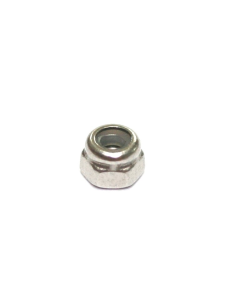
Self-locking nuts (Nylstop)
They incorporate a nylon insert on the top that prevents rotation once tightened. Very useful in points subjected to continuous vibration, such as motor mounts in a slot car. They should not be reused too many times, as the insert loses effectiveness.
Wing nuts
Allow for manual tightening and loosening without tools. Rarely used in slot or precision modelling, but practical in diorama structures or removable bases.
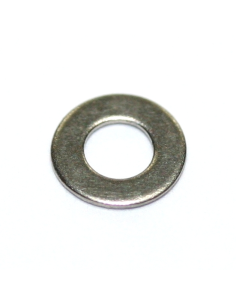
Flat washers
The most versatile type. Distribute the tightening load and protect surfaces. In modelling, they are essential whenever the screw works on resin, plastic, or ABS.
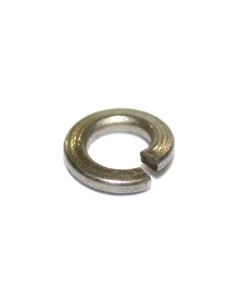
Lock washers (Grower)
In split spiral, they act like a spring that maintains constant tension on the tightening. Fundamental in any mechanical assembly with vibration.
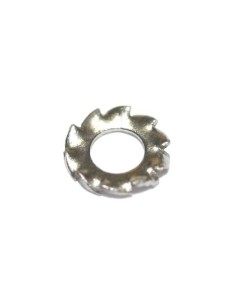
Toothed washers
With exterior or interior teeth that bite into the surface and block rotation. More aggressive than Growers. Used when the material allows it and the security of the tightening is a priority.
Technical aspects we need to know
Working with nuts and washers in small scales has its peculiarities. Here are the key concepts to handle before starting assembly:
Thread pitch
Together with the metric, the pitch defines how much the nut advances with each turn. In modelling, fine pitch is almost always used, allowing for more precise adjustment and reducing the risk of the nut loosening. Before buying, confirm that the screw and nut have the same pitch.
Nut height
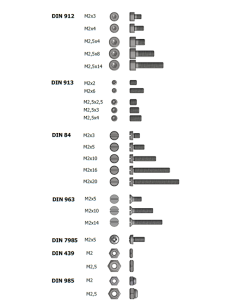
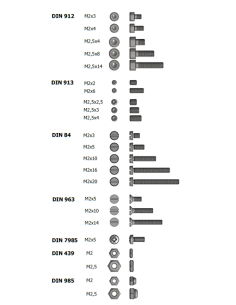
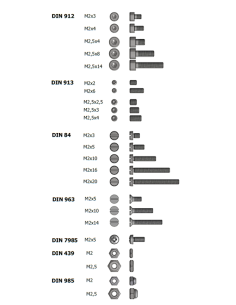
Low nuts (type DIN 439) take up less axial space and are very useful when there are height restrictions in the chassis or inside a body. Standard nuts (DIN 934) offer more thread surface and greater strength.
Tightening torque
In such small parts, over-tightening is as harmful as not tightening enough. Excess torque can strip the screw thread, damage the plastic of the chassis, or deform a resin part. Use appropriate tools — precision screwdrivers, miniature wrenches — and apply force judiciously.
Use of thread lockers
Products like Loctite 243 (medium strength) or 222 (low strength) are applied to the thread before assembly and polymerise once tightened, adding an extra layer of security against loosening. They are especially useful in slot competition when a lock washer is not wanted due to weight or space considerations.
Practical tips for use, maintenance, and preparation
- Organise by metric: store nuts and washers in separate sorting boxes by size. Mixing them is the quickest way to waste time searching at the worst moment.
- Use fine-tipped or magnetic tweezers: in M1.6 and M2 metrics, trying to place a nut with your fingers is frustrating. A fine-tipped tweezer or a magnetic tool makes the job much more manageable.
- Check the tightening after the first sessions: in a newly assembled slot car, the vibration of the first laps can settle the components and slightly loosen some points. A check-up prevents surprises.
- Do not reuse self-locking nuts indefinitely: the nylon insert loses locking capacity with each tightening and loosening cycle. If you have disassembled and reassembled more than three or four times, replace the nut.
- Clean the threads before assembly: in parts from machining, there may be burrs or residues of cutting fluid that hinder proper tightening. A little isopropyl alcohol and a fine brush solve the problem.
- Protect finishes on diecast and models: if you need to secure something onto a painted or varnished piece, always place a flat nylon or brass washer in between. Metal on metal or on paint can scratch or transfer oxidation.
Common mistakes we should avoid
Mixing metrics
Forcing an M2.5 nut onto an M2 thread seems to fit, but it damages both parts and the resulting tightening is not reliable. Always use the correct metric, always.
Omitting washers "to save space"
In modelling and slot, many durability problems — screws that loosen on their own, plastics cracking around a fastening — stem from having omitted the washer thinking it was unnecessary. It is almost always necessary.
Tightening by eye on resin or plastic parts
Resin is more fragile than ABS plastic and can crack with excessive tightening. If you are inexperienced with the material, gradually add tension and stop as soon as you feel firm resistance.
Using steel where insulation is needed
In electronic assemblies — LED installation, braid connections in slot cars — a metal washer or nut in the wrong place can cause a short circuit. In these cases, use nylon.
Not checking compatibility of pitch
Metric and pitch go together. Two M3 nuts can be incompatible with each other if one is standard pitch and the other is fine pitch. Always check both details before ordering.
Recommendations for beginners and advanced users
If you are starting
The most practical thing is to get a selection of common metrics (M2, M2.5, and M3) in steel, along with a corresponding collection of flat washers. This covers 90% of the situations you will encounter in a beginner slot car, in a model kit, or in any basic diorama assembly. There is no need to go beyond that until the type of projects you undertake requires it.
Also invest in fine-tipped tweezers and a precision screwdriver with interchangeable heads. With these two tools, handling small parts becomes much less of a struggle.
If you already have experience
In slot competition preparations, the choice of materials becomes strategic. Replacing steel nuts with aluminium in specific points of the chassis reduces weight in positions where that savings improves dynamics. Combining Grower washers with thread lockers at the most critical points virtually eliminates the risk of loosening without adding significant weight.
In advanced static modelling and dioramas, brass washers allow for very fine height adjustments in articulated bases or display structures, and their neutral finish does not clash with the overall look. For those working with diecast miniatures in scales like 1/18 or 1/43 and needing to frequently disassemble and reassemble components, wing nuts or knurled head nuts offer convenience without sacrificing grip.
| Type |
Common Material |
Main Application |
Key Advantage |
| Standard hex nut |
Steel / brass |
General use in slot and models |
Versatility and availability |
| Self-locking nut (Nylstop) |
Steel with nylon insert |
Mounts, motor supports |
Vibration resistance |
| Low nut (DIN 439) |
Steel / aluminium |
Areas with limited space |
Lower axial height |
| Flat washer |
Steel / brass / nylon |
Surface protection |
Load distribution |
| Lock washer (Grower) |
Steel |
Points with vibration |
Prevents loosening |
| Toothed washer |
Steel |
Critical tightening on metal |
Maximum locking |
| Nylon washer |
Nylon |
Electronic assemblies, painted finishes |
Insulation and protection |
Frequently asked questions
What is the most common metric in 1/32 slot cars?
It depends on the manufacturer, but M2 and M2.5 are the most frequent in chassis and mount screws. NSR, Slot.it, or Scaleauto usually specify in their instructions or technical sheets which metric they use for each of their components.
Can I use any M2 nut with any M2 screw?
In principle, yes, as long as the thread pitch matches. The standard M2 metric has a pitch of 0.4 mm. If the screw has a different fine pitch, the nut will not screw on correctly even if the diameter is the same.
What exactly is the purpose of the washer in a slot assembly?
Mainly to protect the material where the nut or screw head rests, to better distribute the tightening pressure, and in the case of Growers, to prevent vibration from loosening the assembly during racing sessions.
What is the difference between a flat washer and a Grower?
The flat washer distributes load and protects surfaces; the Grower (pressure, spiral) acts like a small spring that maintains constant tension in the tightening, preventing vibration from undoing it. In dynamic applications like slot, both are often combined.
Does the material of the nut affect the car's behaviour?
In competition, it can have a marginal influence. Changing steel nuts for aluminium in elevated positions of the chassis reduces weight in height, slightly lowering the centre of gravity. It is not a dramatic difference, but in very tight setups, it can be relevant.
How often should I check the screws on my slot car?
It depends on the intensity of use. In competition sessions, a quick check at the end of each day is good practice. In recreational use, checking before each session and after any accident or strong impact is sufficient.
Can I use Loctite thread locker on all nuts?
Not on all. Thread locker complicates future disassembly. Use it only at critical points where loosening is a real problem and where you foresee that you will not need to disassemble frequently. For the rest, a Grower washer is sufficient and more practical.
What washer should I use if the screw goes onto a painted piece of a model?
A flat nylon or soft brass washer. Nylon does not scratch or transfer oxidation, and brass is soft enough not to damage the paint if the tightening is moderate.
Can self-locking nuts be reused?
A couple of times, yes, but they lose effectiveness with each cycle. After three or four disassemblies, it is safest to replace them. They are inexpensive parts, and it is not worth risking the grip of a critical component.
Is there a difference between washers for slot and conventional hardware?
The difference lies in the available metrics and dimensional precision. Conventional hardware parts rarely go below M3, while in modelling, M2 or M1.6 are commonly used. Specific references for modelling are manufactured with tighter tolerances, which matters when the available space is minimal.
Are the same nuts used for static models, figures, and dioramas as for slot?
In general, yes, as long as the metric and material are suitable for each application. The difference lies in the use: in slot, there is vibration and dynamics; in models and dioramas, the assembly is static and the mechanical demands are lower. For static models, the choice criterion usually focuses more on protecting the finish than on withstanding vibration.