In the world of slot racing and scale modelling, the materials that make up each part make the difference between a mediocre result and a truly good one. Steel is one of those materials that appears in the most critical corners of any setup: rear axles, guides, fasteners, braid springs, chassis and countless components where the strength, dimensional accuracy and hardness of the metal determine the final behaviour of the assembly. It is not a flashy material, but it is absolutely essential.
When preparing a car for competition or undertaking a model restoration, the choice of the right steel is not a minor detail. A poorly tempered axle bends with the first impact; a guide with too much flex loses contact with the track; a soft screw breaks before tightening. The experienced hobbyist knows this and therefore seeks specific references, not generic hardware materials. Here you will find steel in formats and applications designed for the real hobby: precision parts, calibrated rods, springs and machined components that meet the tolerances required by competition regulations and the specifications of leading manufacturers.
Whether you are building a chassis from scratch for a 1/32 competition car, need to replace a worn axle, adjust the stiffness of a chassis or simply have workshop material for small interventions, steel in its various forms is a category you visit more often than you imagine. And having the correct stock on hand, with the right measurements and finishes, saves time and avoids last-minute compromises before a race.
What is steel and why is it so relevant in slot racing and modelling
Steel is an alloy of iron and carbon —with possible additions of other elements such as chromium, nickel or manganese— whose properties vary depending on its composition and heat treatment. In the context of scale hobbies, we are mainly interested in it for three reasons: its hardness, its dimensional accuracy once machined and its fatigue resistance under repeated load cycles.
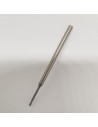
In slot racing, rear axles are perhaps the most critical steel component. Typically made from stainless steel or hardened steel with a polished finish, they must maintain absolute straightness to ensure that the wheels rotate without eccentricity. Any deviation, no matter how small, results in vibration, loss of traction and uneven tyre wear. Brands like NSR, Slot.it or Scaleauto pay meticulous attention to the quality of the steel in their axles, and it is no coincidence that they are references in competition.
In static modelling, the applications of steel range from structural rods in dioramas to assembly pins for resin figures, through springs for articulated mechanisms in high-end diecast pieces. The material provides a solidity that plastic or brass simply cannot offer in certain contexts.
Stainless steel, in particular, is used where corrosion could be a problem: in parts exposed to aggressive lubricants, track cleaners or environmental humidity. Carbon steel, on the other hand, is more common when ease of machining is a priority and the part will be protected or encapsulated within the assembly.
How to correctly choose steel for your project
The first question we must ask ourselves is what exact function we need the material for. A drive axle is not the same as a fastening screw or a reinforcement rod. Each application has its requirements, and choosing poorly can mean having to redo the work.
- Diameter and tolerances: In slot racing, the most common axles are 3 mm in diameter with very tight tolerances. An axle with excessive play in the bearings causes power losses and erratic behaviour. Always check the manufacturer's specifications before purchasing.
- Length: Rear axles vary according to the chassis and the distance between wheels. In competition, sometimes a long rod is used and cut to size; in other cases, pre-machined axles of the exact length are used.
- Surface finish: A polished or ground finish facilitates mounting in bearings and reduces friction. A rough finish can retain more lubricant, which is desirable in some configurations but counterproductive in others.
- Tempering and hardness: Parts subjected to repeated impacts need steel with good tempering. Parts that need to bend slightly without breaking (like some springs) require more elastic steel.
- Compatibility with the system: If your car is prepared for sport track (Scaleauto, Slot.it) or universal track (Scalextric, Ninco), the geometries and tolerances of certain steel components may vary. Do not assume that everything is interchangeable without checking.
In general, for a hobbyist starting to prepare their own cars, the most practical approach is to acquire pre-machined steel components certified by trusted spare parts manufacturers. As experience is gained, it is common to resort to raw rods to work on them in the workshop with personal tools.
Main types and differences
Within the catalogue of steel materials found in the hobby, we can distinguish several formats and alloys with very different uses:
Stainless steel
This is the most common in competition slot car axles. It combines good hardness with resistance to oxidation, making it ideal for parts that will be in contact with lubricants and must maintain their dimensions over time. NSR and Slot.it, for example, use high-quality stainless steel in their axles, resulting in a shiny finish and excellent straightness.
Carbon steel
More economical and easier to machine than stainless steel, it is used in fasteners, small pins and components where corrosion is not a real threat. In model parts that will be painted or protected, it is a very valid option.
Hardened steel
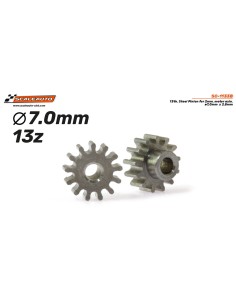
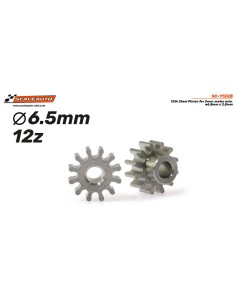
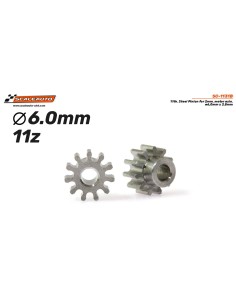
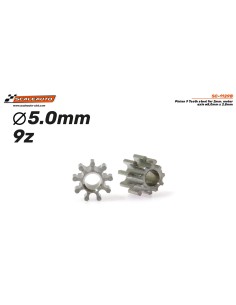
Subjected to heat treatments to increase its surface hardness, it is used where wear resistance is needed: pinions, crowns in certain configurations, reinforced guides. The tempering can make it somewhat more brittle under sudden impacts, so its use must be consistent with the application.
Calibrated rods and springs
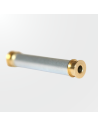
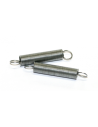
Steel rods in long bar format are common raw material in preparation workshops. From them, custom axles, supports and structural elements for dioramas are made. Springs, with a rectangular section and millimetric thickness, are used in braids, springs and electrical contact systems.
Technical aspects we need to know
Working with steel in the hobby requires some basic knowledge to avoid mistakes that compromise the result:
- Cold machining: Stainless steel rods can be cut with specific metal cutting discs. Do not use tools for plastic or aluminium: the result will be imprecise and you may damage the part and the tool.
- Centering and straightness: When cutting an axle, the cutting plane must be perfectly perpendicular to the axis of the rod. Any angle introduces eccentricity when mounting the wheels. A precision lathe or a cutting guide is essential for serious work.
- Lubrication: Steel axles in bronze or ball bearings require proper lubrication. The type and amount of lubricant varies according to the bearing and the rotational speed. Excess lubricant can attract dust and contaminate the track; a deficiency causes premature wear.
- Thermal expansion: In long race sessions, steel components heat up. Tolerances must take this reality into account; an overly tight fit when cold can seize when hot.
- Magnetism: Some steels are magnetic, which can be relevant in cars with a track adhesion magnet. Ensure that the steel components you mount do not interfere with the magnetic field of the magnet if your regulations or setup require it.
Practical tips for use, maintenance and preparation
Steel, when well treated, lasts practically indefinitely in hobby applications. Here are some tips to get the most out of it:
- Clean the axles with a lint-free cloth before mounting. Any particle trapped between the axle and the bearing acts as an abrasive.
- Periodically inspect the straightness of the rear axles. Simply rolling them on a flat glass surface will reveal any oscillation indicating deformation.
- If an axle has bent due to an impact, do not attempt to straighten it cold with pliers. The result is rarely satisfactory. Replace it directly: the cost is minimal compared to the time you will lose trying to recover it.
- For raw working rods, store them in tubes or supports that keep them straight. Storing them in drawers where they can bend renders them useless for precision applications.
- In static modelling, if you are going to weld steel, ensure you use the appropriate flux. Stainless steel, in particular, requires specific flux for the weld to adhere properly.
- Apply a thin layer of protective oil to carbon steel parts that will not be used immediately. This will prevent superficial oxidation that, although it does not always compromise function, makes assembly difficult and gives a poor appearance.
Common mistakes to avoid
The experience of workshop and competition makes it clear that certain mistakes are repeated more often than they should:
- Using generic axles without verifying the diameter: A 2.9 mm axle in a bearing designed for 3 mm introduces play that is imperceptible to the touch but catastrophic at 20,000 rpm.
- Mixing materials indiscriminately: Mounting a soft steel axle in an assembly designed for hardened steel can result in rapid deformations under load.
- Ignoring compatibility between systems: Brands like Scalextric, Scaleauto, Ninco or Carrera have their own geometries. An axle or guide that fits perfectly in one chassis may be incompatible with another without being obvious at first glance.
- Over-tightening steel fasteners in plastic chassis: Steel is much harder than plastic. Excessive tightening destroys the threading of the chassis and leads to complicated repairs.
- Not checking straightness after an impact: A car that "does not run the same as before" after a track accident often has a slightly bent axle. This is the first place to look.
Recommendations for beginners and advanced users
If you are starting out
The most sensible approach is to work with pre-machined steel axles and components from brands with specific catalogues for slot racing like NSR, Slot.it or Scaleauto. These parts come with the correct tolerances and are the safest starting point. Do not complicate yourself with raw rods until you have the tools and knowledge to handle them accurately. And when in doubt about compatibilities, ask: a bad component can cost you a race or damage other more expensive parts.
If you already have experience
Working with calibrated rods, adjusting tolerances according to the type of bearing, choosing the correct tempering for each application and machining custom axles are the next level. Many advanced preparers maintain a small stock of rods of different diameters and alloys to avoid relying on delivery times when a race is approaching. It is also common to combine components from different manufacturers to optimise an assembly, which requires knowing the specifications of each part precisely. The comparative table below can help you navigate the main references.
| Type of steel |
Main application in hobby |
Advantages |
Considerations |
| Stainless |
Slot rear axles, precision pins |
Resistance to oxidation, hardness, polished finish |
More difficult to machine without the right tools |
| Carbon |
Fasteners, small pins, diorama rods |
Economical, easy to work with |
Requires protection against oxidation |
| Hardened |
Pinions, crowns, reinforced guides |
High wear resistance |
Greater brittleness under sudden impacts |
| Calibrated springs |
Braids, springs, electrical contacts |
Controlled flexibility, conductivity |
Critical thickness depending on the application |
Frequently asked questions
What axle diameter is most common in 1/32 slot cars?
The most widespread standard diameter in 1/32 slot cars is 3 mm. However, some specific models and chassis may use other measurements; always check the manufacturer's specifications before purchasing.
Can I use any steel rod from the market to make axles?
No. General hardware rods rarely meet the straightness and diameter tolerances required for a competition slot axle. It is preferable to use calibrated rods or pre-machined axles from specialised brands.
Is stainless steel always better than carbon steel for axles?
In most slot applications, yes: the resistance to oxidation and the surface finish of stainless steel make it more suitable. For modelling applications where the part will be covered or painted, carbon steel can be perfectly valid and more economical.
How do I know if an axle is bent without a lathe?
Roll it on a flat, smooth surface, such as glass or a marble table. If it wobbles or bounces, it is deformed. You can also hold it between your fingers and spin it, observing if the end describes an arc.
Does the magnetism of steel affect the car's behaviour on the track?
It can if the car uses a track adhesion magnet and the steel component is close. In non-magnet competition, this aspect is less critical, but it is advisable to know the magnetic properties of the material you are mounting.
What lubricant should I use for steel axles mounted in bronze bearings?
Low viscosity specific slot oils are the most recommended. A drop at each end of the axle, at the point of contact with the bearing, is sufficient. Avoid thick lubricants or household oils, which attract dirt and can stick.
Can I weld stainless steel at home for modelling work?
Yes, but it requires specific flux for stainless steel and suitable solder. Without the correct flux, the weld will not properly wet the surface and the result will be fragile. For delicate structural joints, two-component epoxy glue is often more practical.
What is the difference between a polished steel axle and a ground one?
The ground axle has been machined with abrasive to achieve very precise tolerances and an extremely smooth surface, ideal for high-speed ball bearings. The polished axle has a good visual finish but may have somewhat wider tolerances. For serious competition, grinding makes the difference.
Are all steel springs for braids the same?
No. The thickness, hardness and electrical conductivity vary between references. A braid that is too rigid may bounce on the track and lose contact; one that is too soft bends permanently and loses contact pressure. The correct choice depends on the system and the type of race.
When should I replace an axle instead of trying to reuse it?
Whenever it shows visible deformation, wear marks at the bearing contact points, or if the car has suffered a strong impact. In competition, the cost of a new axle is negligible compared to the performance lost running with a compromised one.
Does the steel I use in static modelling need any prior treatment before painting?
Yes. The steel should be lightly sanded to create microporosity and apply a specific primer for metal before painting. Without priming, the paint —even acrylics from brands like Vallejo or Tamiya— does not adhere well and peels off easily.
Are there differences in steel between slot spare parts brands?
Yes, although they are not always documented in detail by manufacturers. User experience and competition tests indicate that brands like NSR and Slot.it pay special attention to the metallurgical quality of their axles, with straightness and finishes that are noticeable on the track. Not all axles on the market are equivalent even if they have the same nominal diameter.