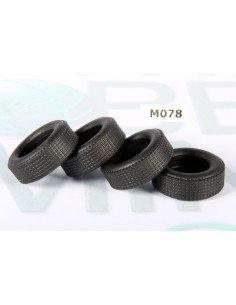
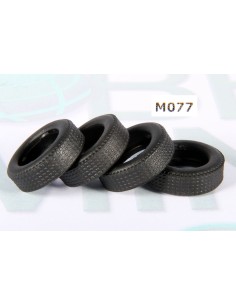
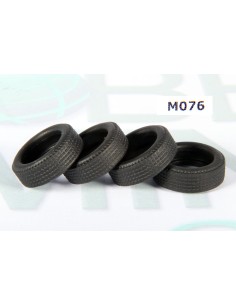
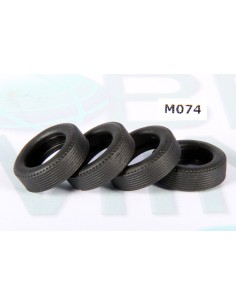
Formula 1 and GP cars from the 60s, 70s, and 80s are a special category within slot racing. Their scale, wheel dimensions, and the characteristic shape of their tyres —wide at the rear axle, narrow at the front— radically differentiate them from a modern GT or touring car. Finding the right tyre for a classic is not always straightforward: profiles are different, diameters vary depending on the era and model, and the hardness of the compound directly influences the behaviour on the track's asphalt.
In this section, you will find tyres specifically designed for classic GP cars in 1/32 and 1/24 scale, with profiles and diameters corresponding to racing single-seaters from another era. Whether you are looking to improve the grip of your racing car or need to replace worn tyres on a collector's piece, here you have tested options with technical backing.
Both enthusiasts competing on slot circuits with classic car regulations and collectors wanting to keep their models in perfect condition have different needs. A competition tyre requires a compound that grips when hot, withstands several minutes of racing without degrading, and transmits guide corrections faithfully. A collector's tyre, on the other hand, may prioritise the preservation of the original shape and visual appearance. Knowing this difference is the first step to making the right choice.
What are GP classic tyres and why do they matter
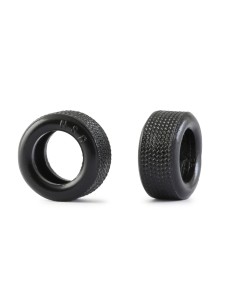
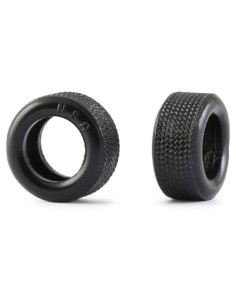
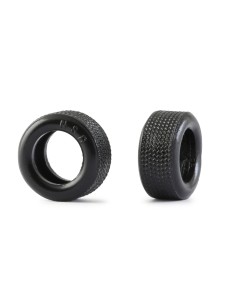
GP classic tyres are rubber components designed to replicate —in scale— the profiles that racing single-seaters used between the 60s and early 80s. In real life, those cars mounted slick tyres or very defined wet profiles; in slot, that geometry translates into low-profile and wide tyres at the rear axle, with a rounded or flat contact surface depending on the model.
The importance of choosing the correct tyre goes beyond aesthetics. A tyre that is too large will rub against the wheel arch or prevent full turning. One that is too small will leave the car raised on the rim, with no real contact with the track. And one with the wrong compound —too hard for your circuit's surface, for example— will cause the car to skid without the possibility of correction.
For cars used in federated competition or club championships, regulations often specify particular brands and references of tyres. Before purchasing, it is advisable to review the rules of the category in which you compete, as not all tyres are homologated for all classes.
How to correctly choose the tyre for your GP classic
The first parameter is the outer diameter. In classic GP cars, the rear axle usually requires tyres with a larger diameter than the front. Check the technical specifications of your car or measure the diameter of the original tyre (if it still has it) with a caliper. Even differences of a tenth of a millimetre affect performance.
The second is the width. The rear tyres of a classic single-seater are significantly wider than the front ones. Make sure to buy both sets (front and rear) if the manufacturer differentiates them, or use specific references for each axle.
The third factor is the compound. In general terms:
- Soft compound: more grip, but greater wear. Ideal for wooden tracks or very smooth surfaces.
- Medium compound: balance between grip and durability. A more versatile option for mixed circuits.
- Hard compound: less immediate grip, but lasts longer. Useful on plastic tracks or in long sessions.
Finally, consider whether the tyre is glued or mounted on a rim. Some are sold already mounted and trued on their corresponding rim; others are sold loose and require you to mount, glue, and true them. For serious competition, self-truing is common as it allows for precise diameter adjustments.
Main types and differences
Within GP classic tyres, several families coexist according to their function and origin:
Homologated competition tyres
These are the ones listed in the regulations of specific classic slot categories. They are usually made of soft or medium compound, with a very controlled diameter to ensure equality among participants. Brands like NSR, Slot.it, or Scaleauto offer specific references for these regulations.
Original replacement tyres
These are the ones that the car manufacturer (Scalextric, Ninco, Avant Slot…) included as standard or marketed as replacements. Their quality varies greatly: some are perfectly valid for racing, while others are more suitable for maintaining the original appearance of the model.
Aftermarket tyres
These are tyres manufactured by third parties, designed to improve performance compared to the standard ones. They usually offer better compounds, greater dimensional precision, and more options for diameter and width. They are the preferred choice for tuners and competition drivers.
Wet and profiled tyres
Some classic GP slot cars incorporate wet-pattern tyres to faithfully reproduce historical configurations. They are not common in competition, but they hold significant value in collections and exhibitions.
Technical aspects we should know
The behaviour of a classic slot car on track largely depends on the tyres. There are several technical concepts that are worth understanding before making any changes:
Effective diameter and truing
The diameter that comes from the factory is rarely exactly what is specified. Therefore, competition drivers true (turn) the tyres once mounted on the rim, to achieve a precise and uniform diameter at all four contact points. A car with tyres of different diameters between left and right will pull to one side consistently.
Shore hardness
The hardness of the compound is measured in Shore units. The lower the value, the softer the tyre and the better it grips when cold, but it degrades faster. The correct choice depends on the surface of the track and the duration of the heats.
Gluing
To prevent the tyre from spinning on the rim under acceleration or braking, it is glued with specific adhesive (fine cyanoacrylate, for example). Poor gluing is a frequent source of performance issues that goes unnoticed until the wheel is closely inspected.
Compatibility with the rim
The inner diameter of the tyre must match the outer diameter of the rim. Mounting a tyre that is too tight deforms the compound; one that is too loose will not adhere properly. Always check that the tyre reference is compatible with the rim of your specific model.
Practical tips for mounting and maintenance
Changing the tyres on a GP classic is a straightforward operation if done in an orderly manner. Here are the steps and tips we apply in the workshop:
- Carefully remove the old tyre: if it is glued, a mild solvent (small amount of acetone) helps to separate it without damaging the rim. Be cautious with plastics: acetone can attack some ABS rims.
- Clean the rim: remove any residue of glue before mounting the new tyre. A clean surface ensures better adhesion.
- Mount and glue: place the tyre centred on the rim and apply a minimal drop of fine cyanoacrylate. Allow it to cure before mounting the wheel on the car.
- True if you have a lathe: for competition, truing is almost essential. For home use or collection, it may not be necessary.
- Storage: rubber tyres harden over time, especially if stored in dry environments or exposed to light. Store spare tyres in airtight bags and in a dark, cool place.
On track, it is common to clean the tyres with a bit of isopropyl alcohol between sessions to remove dust and dirt that reduces grip. Do not use aggressive products that may alter the compound.
Common mistakes to avoid
After years of observing preparations and assisting drivers of all levels, there are mistakes that are repeated too often:
- Buying by price without checking the diameter: a cheap tyre that does not have the correct diameter is useless, no matter how economical it is.
- Mixing tyres of different hardness on the same axle: while it may seem like a good idea to balance behaviour, in practice it creates unpredictable handling.
- Not truing and not checking concentricity: a slightly eccentric tyre causes the car to vibrate at high speeds and significantly reduces track time.
- Ignoring the category regulations: some championships specify not only the tyre reference but also the condition (new, used, number of sessions). Competing with non-homologated tyres can lead to exclusion.
- Storing mounted tyres on the car for months: the weight of the car on the tyre during storage can deform it. If you are not going to use the car for a while, store it without the wheels or at least without resting on them.
Recommendations for beginners and advanced users
If you are starting with GP classics
The most practical approach is to start with the tyres recommended by the regulations of the championship or club you are joining, or with the original replacement tyres from the car manufacturer. This ensures that everything fits without needing additional adjustments. As you become more familiar with the car's behaviour, you can experiment with softer compounds or specific aftermarket options.
Do not invest in a truing lathe until you are sure that classic competition is your category. Many mid to high-level drivers have been competing for years with well-mounted and glued tyres, without truing, with very solid results.
If you already have experience
The qualitative leap in a well-prepared classic GP car usually comes from the tyres. Experimenting with different compounds depending on the track (softer on wood, harder on plastic), adjusting the diameter to the millimetre through truing, and paying attention to gluing are the three most direct vectors for improvement.
Brands like NSR and Slot.it offer aftermarket tyres with very specific specifications and consistency between batches, which facilitates reproducibility of adjustments from race to race. For models that use less common diameter rims, Scaleauto also has references of interest.
| Type of compound |
Relative hardness |
Grip |
Durability |
Recommended surface |
| Soft |
Low Shore |
High |
Short |
Wood, smooth plastic |
| Medium |
Medium Shore |
Medium-high |
Medium |
Mixed tracks |
| Hard |
High Shore |
Medium |
Long |
Plastic, long sessions |
Frequently asked questions
Can I use modern tyres on a classic GP car?
It depends on the diameter and width. Classic GP cars usually have specific measurements that do not match those of a modern GT or touring car. Always check the dimensions before buying.
When should I change the tyres on my classic?
When you notice a clear loss of grip, uneven wear, hardened surface, or visible deformations. In competition, many drivers change tyres every season or at the start of a championship, regardless of visual condition.
Do I need to true the tyres to race in a classic championship?
It is not always mandatory, but it is highly recommended for serious competition. For home use or hobby, it is not necessary.
Do wet tyres work on a dry slot track?
Wet-pattern tyres have less contact surface than a slick, so their grip on dry surfaces is inferior. They are mainly used for aesthetic fidelity to the historical configuration of the car.
What adhesive is recommended for gluing tyres?
Fine cyanoacrylate, applied in minimal quantity. Too much adhesive can overflow and contaminate the tread surface, reducing grip.
Can I mix tyre brands between front and rear axles?
Technically yes, as long as the dimensions are correct. In competition, it is advisable to use the same reference on the rear axle to ensure uniformity. The front influences grip less but does affect overall balance.
Do slot tyres deteriorate over time even if not used?
Yes. Rubber ages and hardens, especially with exposure to light, heat, or dry environments. Store them in airtight bags and away from heat sources or direct light.
How do I know if the tyre is compatible with my car's rim?
Check the technical specifications of the tyre (inner diameter) and compare it with the outer diameter of your rim. You can also review which references the car manufacturer recommends for your specific model.
Do aftermarket tyres always improve performance compared to standard ones?
Generally yes, in terms of compound and dimensional precision. But "better" also depends on the track, surface, and driving style. There is no universal answer: sometimes a well-mounted and trued standard tyre outperforms a poorly installed aftermarket one.
Is there any tyre regulation for classic categories in Spain?
Yes, several clubs and federations have specific regulations for classic GP categories that include homologated tyre references. Always check the current regulations of your category before purchasing.