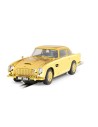
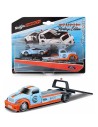
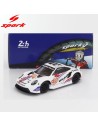
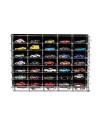
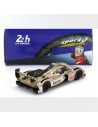
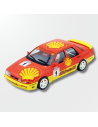
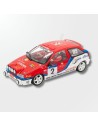
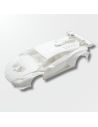
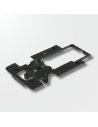
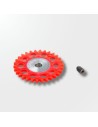
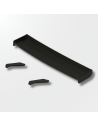
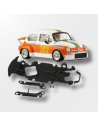
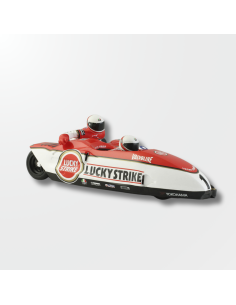
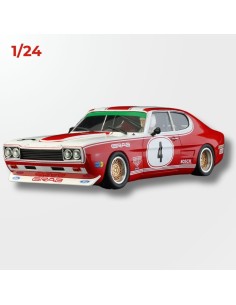
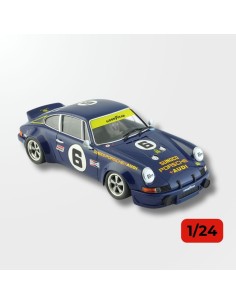
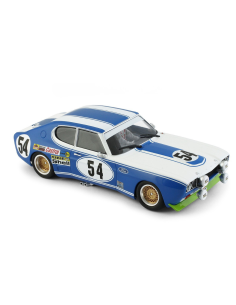
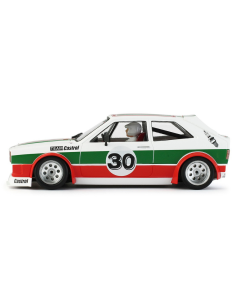
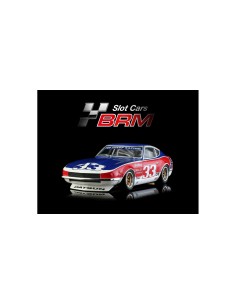
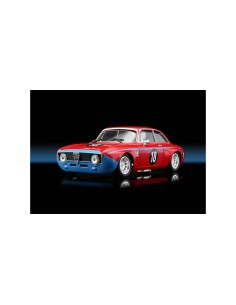
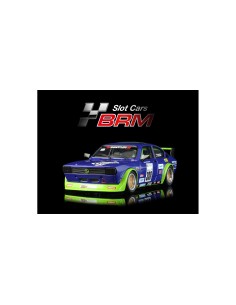
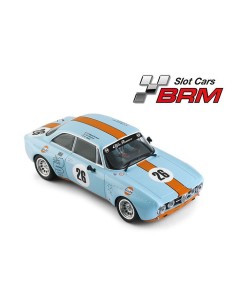
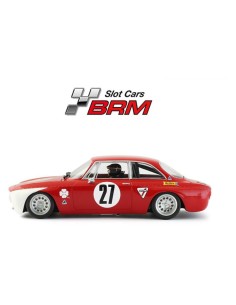
There are scales that simply impress as soon as you see them on the table or on the track. The 1/24 scale is one of them. With a considerably larger size than the usual 1/32, these cars combine an extraordinary level of visual detail with a physical presence that captivates both the most demanding collector and the slot driver looking for a different experience. If you are here, you probably already know what it means to open a box and find a model that looks like it was taken straight from the paddock or the museum.
The 1/24 scale occupies its own space in the world of modelling and slot. It is not the most common scale in federated competition, but it has a loyal and passionate community that values precisely what makes it special: the generous size, the richness of detail in the body and interior, and the versatility to use them both on the track and on display. In this section, you will find models oriented towards slot —with chassis prepared for running— and parts more focused on static collecting or exhibition.
If you are coming from 1/32 and considering the jump, or if you have been working in this scale for years and want to expand your collection, here is what you need to know to make the right choice, understand the technical differences, and get the most out of each model.
What the 1/24 scale represents and why it is so appealing
The 1/24 scale means that the model is exactly 24 times smaller than the real car. Stated like this, it may seem like a simple number, but in practice, it represents a huge difference compared to other popular scales. A real car of about 4.5 meters in length becomes a model of approximately 18-19 cm. That is much more car in the palm of your hand.
That additional size has direct and very positive consequences:
- More space for detail: manufacturers can include complete interiors, detailed dashboards, stitching on the seats, seatbelts, and even driver figures with realistic helmets and overalls.
- More faithful bodies: the lines of the real car are reproduced more faithfully because there is more surface to work with. The curves, air intakes, and diffusers look much more defined.
- Visual impact on the track or in display: a 1/24 on a circuit immediately catches the eye. On a shelf, two or three well-exposed models create a composition that is hard to achieve with a smaller scale.
Historically, 1/24 was for decades the reference scale of slot in many countries, especially in the United States, where Strombecker or Aurora sets marked entire generations of enthusiasts. In Europe, it always coexisted with 1/32, although the latter eventually imposed itself as the competition standard. Today, 1/24 is experiencing a moment of reclamation thanks to its value as a collectible object and the growing demand for more physical and spectacular driving experiences.
How to choose a 1/24 car: keys before buying
Choosing well in this scale requires being clear about what you want it for. It is not the same to look for a model to run on a circuit as it is to display in a showcase, and the decision affects both the budget and the type of piece you should select.
Define your main use
- Slot and competition: you need a model with a homologated or adaptable chassis, the correct guide for the track system you use, good condition braids, and a motor suitable for the desired setup.
- Static collection: here the priority is the level of detail, the fidelity of the finish, and the quality of the materials. 1/24 diecast collection models are a very valid option for this profile.
- Mixed use: some models can be enjoyed both on the track and in display. They usually have a careful finish and at the same time a functional chassis.
Pay attention to the track system if it is for slot
In 1/24, compatibility with the track system is a critical aspect that you cannot ignore. Not all cars are compatible with all tracks. Before buying, confirm whether the model is designed for universal track (like that of Scalextric or Ninco) or for sport track (like that of Scaleauto). Mixing systems without prior information can result in a model that does not guide well, loses electrical contact, or does not fit the track at all.
Evaluate the level of finish and the manufacturer
In this scale, the difference between manufacturers is very noticeable. Brands like Scaleauto have bet on 1/24 with high-performance models and very well-finished products. For diecast collection, the offer is also wide, with manufacturers specializing in very faithful reproductions of historical and modern cars.
Types and main differences in the 1/24 scale
Within the 1/24 universe, there are quite distinct product profiles. Knowing them helps you avoid surprises and invest where it really adds value.
1/24 slot cars
These are models prepared to run on electric tracks. They come with chassis, motor, guide, braids, and tyres mounted from the factory or ready to assemble. In this scale, the chassis are usually more robust and the motors have more torque than in 1/32, which translates into a more physical driving experience and higher top speed when the setup is done well. The motorization can be sidewinder (transverse motor, parallel to the rear axle), inline (longitudinal motor, in line with the axle, which lowers the centre of gravity), or anglewinder (motor at an angle to the rear axle), each configuration with its implications for dynamic behaviour.
1/24 diecast collection cars
These are static miniatures made primarily from die-cast metal (zinc or aluminium), with painted finishes and detail elements such as turning wheels, opening doors, functional hoods, or fully decorated interiors. They are not prepared to run on electric tracks, but they are pieces of great collector value and visual presence.
1/24 resin models
Less common in this scale than in 1/32, but there are manufacturers that produce resin bodies for assembly and customization. Resin allows for the reproduction of complex geometries and very limited series with a fidelity to the original that is difficult to achieve with injected plastic.
Technical aspects we need to know
If your interest is slot, there are a series of technical concepts that mark the difference between a car that simply runs and one that truly competes.
Motorization and chassis configuration
As mentioned, the three main configurations are sidewinder, inline, and anglewinder. In 1/24, the sidewinder configuration is common due to the ease of adjustment and the good mass distribution it offers. The inline lowers the centre of gravity by placing the motor closer to the ground and in line with the axle, which improves stability in corners. The anglewinder is an intermediate solution that allows for a reduction in motor height compared to the sidewinder while maintaining some design flexibility.
Guide and braids
The guide is the element that follows the track rail and keeps the car on course. In 1/24, guides are generally larger than in 1/32, and it is important that they are in good condition and well adjusted. The braids —the conductive strips that collect current from the rail— must have good contact and not be deformed or dirty. Regular maintenance of both parts is essential for clean driving and without interruptions.
Tyres and wheels
In this scale, tyres play a crucial role in grip and car response. The diameter, hardness, and profile directly influence cornering behaviour and top speed. It is advisable to keep them clean and check their condition periodically, especially if the car has been stored for a long time.
Comparison table: 1/24 scale versus other scales
| Feature |
1/24 |
1/32 |
1/43 |
1/64 |
| Approximate model length |
17-20 cm |
12-15 cm |
9-11 cm |
6-7 cm |
| Level of detail |
Very high |
High |
Medium |
Basic |
| Visual presence |
Very high |
High |
Medium |
Low |
| Space required |
Considerable |
Moderate |
Reduced |
Minimal |
| Use in slot competition |
Yes (specific circuits) |
Federated standard |
Limited |
No |
| Collecting |
Very popular |
Popular |
Very popular |
Popular |
Practical tips for use, maintenance, and preservation
Whether you have a slot car or a diecast collection, there are simple habits that make a difference in their long-term condition.
For 1/24 slot cars
- Clean the braids and the track regularly. Accumulated dirt is the most common cause of power loss and irregular contact.
- Check the condition of the tyres before each session. A hard tyre or one with accumulated dirt significantly reduces grip.
- Lubricate the axles and motor moderately: too much lubricant attracts dust and can contaminate the tyres, ruining grip.
- Store the car in its box or on a specific stand to prevent the body from accumulating dust or suffering scratches.
- If the car is going to be stationary for a long time, remove the braids or at least ensure they are not under constant tension to avoid deformation.
For diecast and collection cars
- Display the models away from direct sunlight: painted finishes and plastic parts degrade with prolonged exposure to UV rays.
- Use closed display cases to reduce dust accumulation. If not possible, a dry soft microfiber cloth is your best ally for cleaning without scratching.
- Avoid handling the models with bare hands: the grease and moisture from your skin deteriorate metallic finishes over time.
- Keep the original boxes: they preserve the model's value and facilitate any eventual sale or exchange.
Common mistakes we should avoid
Years in this hobby teach you to spot the mistakes made by those who are starting —and also some made by those who are no longer beginners.
- Buying without verifying track compatibility: in 1/24, the range of track systems is more limited than in 1/32. Always confirm that the car is compatible with your circuit before purchasing it.
- Mixing track systems without informing yourself: the tracks of Scalextric, Scaleauto, Ninco, or Carrera have different dimensions and characteristics. Running with the wrong system can damage the guide or cause erratic behaviour.
- Ignoring the type of motorization: buying a car without knowing whether it has a sidewinder, inline, or anglewinder motor can lead you to acquire incompatible spare parts or not understand why the car does not behave as you expected.
- Overloading with lubricant: more is not better. Excess lubricant contaminates tyres and braids, creating more problems than it solves.
- Neglecting the exposure of diecasts: a model displayed on an open shelf under a window can lose finish and value in a few years.
- Confusing diecast with slot cars: although both exist in 1/24 scale, they are very different products. A diecast collection is not prepared to run on electric tracks.
Recommendations for beginners and advanced users
If you are starting in the 1/24 scale
The first thing is to define whether your main interest is slot or collecting. If it is slot, research what track system you have or plan to set up, because in 1/24 the range of circuits is more specific and limited than in 1/32. Start with a complete factory model that does not require major adjustments: this way you can learn the behaviour of the scale before getting into setups.
If your goal is collecting, do not be swayed solely by the price. A well-preserved mid-range model is worth much more than a cheap piece that loses finish in the second year. Look for manufacturers with a good reputation and, whenever possible, check real photographs of the model before buying it.
If you already have experience with 1/24
In competition, chassis preparation and the correct choice of tyres and motor are the factors that make the difference. Delve into motorization configurations —especially the implications of inline on the centre of gravity and corner response— and work on the guide setup to adjust the behaviour to your driving style and the track layout.
If you combine slot with collecting, consider protecting the bodies with a layer of matte or satin varnish compatible with the model's finishes. This prolongs the life of the finish without altering the original appearance.
Frequently asked questions about 1/24 cars
Are 1/24 slot cars compatible with 1/32 circuits?
In general, no. The 1/24 scale requires tracks with wider and more separated rails. Trying to run a 1/24 on a 1/32 circuit usually results in guide and contact problems. Always check the model's compatibility with your track system.
Can I display a 1/24 slot car in a showcase?
Yes, perfectly. Many enthusiasts alternate between running it on the track and displaying it in a showcase. For this, it is advisable to clean the model well before storing it and protect the body from dust and direct light.
What is the difference between a 1/24 diecast and a 1/24 slot car?
The diecast is a static miniature made from die-cast metal, intended for collection and display. The slot car has an electromechanical chassis, motor, guide, and braids, and is designed to run on electric tracks.
How much space do I need to display several 1/24 cars?
Each model occupies between 17 and 20 cm in length and about 8-10 cm in width. For a standard display case of 90 cm wide, comfortably between four and five models can fit in a row, depending on the body style.
Is it harder to drive a 1/24 slot car than a 1/32?
It depends on the circuit and the car. 1/24 models have more mass and generally more power, making them more physical to drive. On wide layouts with good grip, they can be very satisfying even for enthusiasts with medium experience.
What motorization configuration is best for starting in 1/24 slot?
The sidewinder is the most common configuration and the easiest to understand and adjust. For starting in the scale, it is a good choice because it offers balanced behaviour and the adjustments are intuitive.
Do 1/24 diecast cars lose value over time?
It depends on the manufacturer, the edition, and the state of preservation. Limited editions from recognized manufacturers, in perfect condition and with original box, tend to maintain or increase their value. Mass-produced models without boxes lose value more quickly.
Can I mix parts from different brands in a 1/24 slot car?
In many cases, yes, but it requires knowing the compatibilities well. There are components like guides, braids, or tyres that can be interchanged between brands, but others like the chassis or axles are specific. Always consult the technical sheet before mixing components.
Are there official slot competitions in 1/24 scale?
Yes. Although 1/32 is the most widespread scale in federated competition, 1/24 has its own competitive ecosystem, especially in clubs with a tradition in this scale. Check your club's specific regulations to know the homologation requirements.
What brands offer quality 1/24 slot cars?
Scaleauto is one of the most prominent references in 1/24 slot, with high-performance models and very good finishes. In diecast collecting, the offer is wide with manufacturers specializing in faithful reproductions of large-scale cars.
How do I clean the body of a 1/24 car without damaging it?
Use a dry microfiber cloth or one slightly dampened with water. Avoid abrasive products or strong solvents. For the interior of the chassis and the braids, specific slot cleaners are the safest option.
Is it worth switching to 1/24 if I already have a 1/32 circuit set up?
It depends on your goals. If you are looking for a more physical and spectacular driving experience, or if you are attracted to large-scale collecting, 1/24 has a lot to offer. However, it requires an investment in specific track, so consider whether you have the space and budget to maintain both scales.