Shopping Cart
-
-
 James Bond Aston Martin 'Goldfinger'€62.00 €69.00
 Mosler MT900R Salvatore Noviello 11th Anniversary EVO3€63.57 €73.57
 Formula 90-97 Blanco/Azul/Amarillo 1990 Nº6 morro bajo€76.30 €79.90
 Porsche 908/3 Turbo White Edition Jürgen Barth€29.50 €36.00
 Advance Audi S1 WRC Sonax€30.00
 -
 Rodador con transformador€40.00
 Punta Hex. 0.9 mm€3.40
 -
 Circuito Open Rally Set€188.43
 Muelle para mandos€2.00











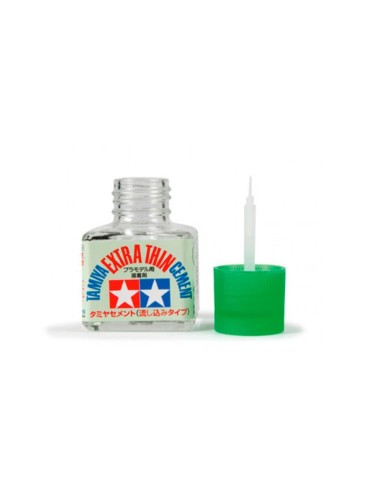
Extra Liquid Glue

Out-of-Stock
€6.32
Tax included
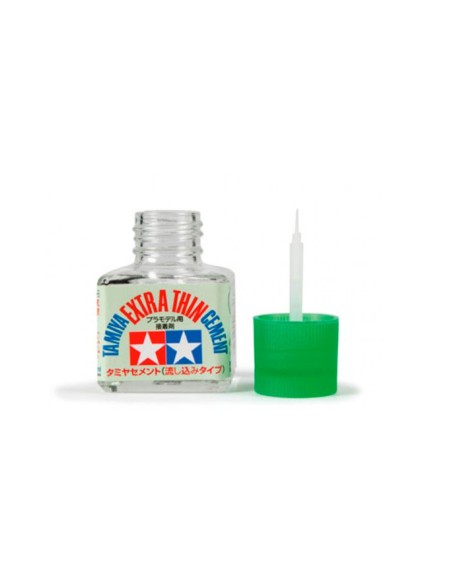
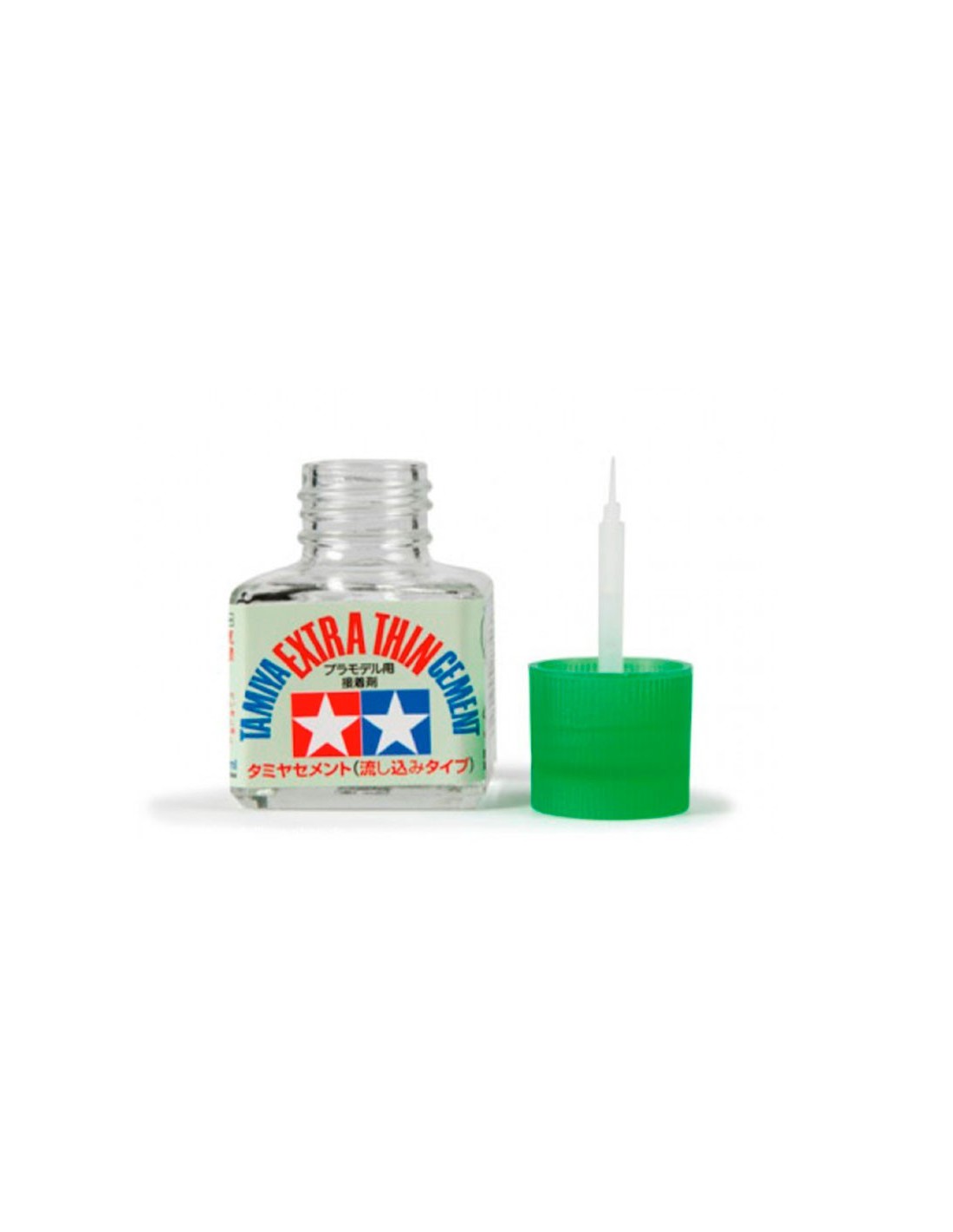
Tamiya extra thin cement (ref. 87038) in a 40 ml format, with an integrated applicator brush in the cap for precise application on polystyrene models. Strong bond in 5 minutes and fully cured in 24 hours.
The reference glue for plastic models that require precision in every joint
The Tamiya Extra Thin Cement (ref. 87038) is one of the most popular glues among static modelling enthusiasts. Its extra liquid formula penetrates by capillarity into the joint between polystyrene parts, creating a clean, solid, and practically invisible bond when applied correctly. The 40 ml bottle makes it a convenient option for both one-off projects and regular workshop use.
Main features
- Extra liquid viscosity: flows easily into joints thanks to capillary action, without the need to apply large amounts.
- Integrated applicator brush: the cap includes a brush that allows for precise dosing and access to hard-to-reach areas.
- Working time: initial strength from approx. 5 minutes; full final strength after 24 hours.
- Format: 40 ml bottle.
Compatible materials and limitations
This glue is primarily formulated for polystyrene, the plastic used to manufacture the vast majority of static models on the market. It can also be used in combination with other materials such as wood, cardboard, or paper. However, it is not suitable for Styropor®, polyethylene (PE), or polypropylene (PP), so it is advisable to identify the material before use.
Application tips
- Clean and dry the surfaces well before gluing: dust and grease hinder adhesion.
- Apply a thin layer on one side; it is not necessary to cover both surfaces.
- Join the parts and maintain light pressure for a few seconds to set the joint.
- If there are any visible wet glue residues, do not wipe with a cloth: wait for it to harden and carefully cut it away. Rubbing while wet can stain or dissolve the plastic surface.
- For very thin plastic parts, minimise the amount applied to avoid damaging the piece with the solvent.
Ideal for…
This glue is perfect for static models of aircraft, armoured vehicles, ships, and polystyrene figures. It is also very useful in preparing slot cars when repairing or reinforcing plastic body parts. Its precision application makes it especially recommended for delicate joints, small photo-etched details on plastic bases, or assemblies in visible areas where excess adhesive would ruin the finish.
Frequently asked questions
What is the difference between Tamiya Extra Thin Cement and standard Tamiya Cement?
The main difference is viscosity. Extra Thin is much more fluid and acts by capillarity, making it ideal for already positioned joints. Standard Cement has a thicker consistency and allows for glue application before joining the parts. Each has its moment: Extra Thin is preferred for precision work and clean finishes.
Can I use it on painted surfaces?
It is not recommended. As it is a solvent-type glue, it can attack the paint and leave marks on the finish. The ideal approach is to glue first and paint afterwards.
How long should I wait before sanding or painting the joint?
It is considered resistant after 5 minutes, but to handle the piece safely and apply paint or primer, it is advisable to wait the 24 hours indicated by the manufacturer for full final strength.
Is it suitable for repairing plastic slot car bodies?
Yes, as long as the body is made of polystyrene. Apply a minimal amount with the brush to the area of the crack or break, join the parts, and let it cure. The result is discreet and durable.
Is there a risk of the glue damaging delicate or thin-walled parts?
Yes, there is a risk if applied excessively. On very thin parts, the solvent can deform or dissolve the plastic. Use the smallest amount possible and, if in doubt, test on a non-visible area before working on critical zones.
Tamiya Extra Thin Cement (ref. 87038, 40 ml) — precision plastic cement for polystyrene scale models, slot car bodywork repair, dioramas and static figures. Fast-setting formula with integrated brush applicator for clean, hairline joints. Compatible with wood, cardboard and paper; not suitable for Styropor®, PE or PP. A go-to adhesive for modellers seeking professional results.
TA87038
No reviews
Comments (0)
No customer reviews for the moment.
Tap to zoom