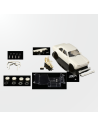
The Sakura D3 is one of the most recognised RC competition car chassis within the world of scale radio control, especially in the drift discipline. Developed by CRC (Carisma Racing Concept) and marketed under the Sakura brand, the D3 has earned a solid reputation among enthusiasts due to its balance between accessibility and real track performance. If you are looking for parts, options, or information to get the most out of your D3, you are in the right place.
Within the RC universe, drift is a discipline that demands precision in tuning, sensitivity in driving, and a chassis that responds faithfully to adjustments. The Sakura D3 was born to meet exactly that need: to offer a versatile platform suitable for both those starting in RC drift and experienced drivers looking for a chassis with room for development. Its architecture allows for deep modifications without the need to start from scratch, making it a highly valued option within amateur and semi-professional competition categories.
Over the years, the D3 has generated an active community of users who share setups, configurations, and technical solutions. This translates into a broad knowledge base and a availability of aftermarket options that few chassis in its range can match. From suspension geometry to the choice of electronics, every preparation decision has a direct impact on how the car behaves on track.
In this section, you will find everything related to the Sakura D3: from original spare parts to optional upgrades, as well as setup and maintenance tips. Whether you want to keep your D3 in perfect condition or are preparing a competition version, here you have the catalogue and the criteria to make the best decisions.
What is the Sakura D3 and why is it important
The Sakura D3 is an electric RC car chassis specifically designed for the practice of scale drift. Unlike touring or conventional circuit chassis, the D3 is designed to offer controlled oversteer behaviour, with a weight distribution and suspension geometry aimed at facilitating the long and fluid slides that characterise this discipline.
What makes the D3 relevant in the market is that it marked a generation of RC drift enthusiasts. When it appeared, it combined a reasonable entry price with a build quality above the average of its segment. The result was a chassis that was massively adopted in drift circuits, clubs, and competitions at both local and international levels.
Technically, the D3 is a 4WD chassis with a layout that allows for adjustments to weight distribution, camber geometry, steering angle, and other key parameters for drift. This level of adjustment is what differentiates it from more basic options and brings it closer to competition-use platforms.
For the collector or enthusiast discovering it years after its launch, the D3 remains a reference due to its active community and the availability of parts, both original and third-party options. It is not an obsolete chassis: it is a consolidated chassis with a support ecosystem that remains alive.
How to correctly choose parts and options for the Sakura D3
The range of spare parts and options for the D3 can be overwhelming if you are not clear on what you want to improve. The first step is to distinguish between maintenance spare parts and performance upgrade parts. They are not the same, and confusing them can lead to spending money on options that do not contribute anything if the chassis is not properly maintained from the start.
For maintenance, it is essential to have the most common consumables available: ball joints, screws, suspension parts, belts, or drive shafts depending on the version of the D3. These parts wear out with normal use, and it is advisable to have them on hand to avoid losing track time due to a minor breakage.
Regarding performance options, the choice depends on the pilot's level and the type of competition or practice. A pilot starting in drift does not need to invest in advanced options before mastering the basic driving of the chassis. In contrast, an experienced pilot who already knows the behaviour of the D3 can fine-tune the setup with specific parts for suspension geometry, chassis stiffness, or transmission improvements.
Another important criterion is compatibility. The D3 has several versions and revisions, and not all options are compatible with all of them. Before purchasing any part, it is advisable to check which version of the chassis it is designed for. At Ministry of Hobby, we indicate compatibility on each product sheet to avoid such errors.
Finally, electronics is a section that deserves independent attention. The ESC, motor, and steering servo have a direct influence on the car's behaviour. In RC drift, the steering servo is particularly critical: it needs speed and precision to respond to angle corrections in real-time.
Main types and differences
Within the Sakura D3 ecosystem, there are differences between versions and between the types of available parts. Understanding these differences helps make better purchasing decisions.
Chassis versions
The D3 has gone through different revisions throughout its commercial life. The differences between versions can affect the position of anchor points, compatibility with certain options, or small changes in factory geometry. If you have a D3 from a specific version, make sure to identify it before buying spare parts.
Original spare parts vs. aftermarket options
Original spare parts guarantee exact compatibility and maintain factory specifications. They are the recommended option for standard maintenance. Aftermarket options, manufactured by third parties, are usually aimed at improving a specific aspect of performance: greater stiffness, lower weight, better suspension response. Both have their place, and combining them intelligently is what makes experienced tuners successful.
Materials
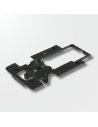
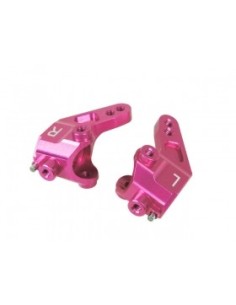
The parts of the D3 are made from different materials depending on their function. Carbon fibre appears in chassis plates and reinforcements where rigidity and low weight are priorities. Machined aluminium is used in suspension parts, hub carriers, and shock towers where dimensional precision is sought. High-strength technical plastics cover the rest of the structural components. Each material has its advantages and specific wear points.
Technical aspects we should know
To make the most of the Sakura D3, it is advisable to understand some technical concepts that directly affect its behaviour on track.
Steering geometry and drift angle
The maximum steering angle is one of the most important parameters in a drift chassis. The D3 allows for adjustment of this angle within certain limits using specific options. A greater drift angle facilitates transitions and sharp turns, but it can affect straight-line stability. The correct balance depends on driving style and track type.
Weight distribution
The position of the battery, motor, and electronics influences the weight distribution between axles. In drift, a slightly rearward distribution favours oversteer tendency, which is what is sought. However, too much weight at the back can make the car unpredictable. The D3 allows for some flexibility in component placement to adjust this balance.
Transmission and differential
The D3's transmission system includes differentials that can be configured with different oil viscosities or partially locked according to needs. A more locked rear differential favours sliding; a more open one provides more traction. Finding the correct point is part of the tuning process.
Damping
The D3's shock absorbers are adjustable in preload and, depending on the version or installed options, also in hardness. In drift, damping is usually set softer than in conventional circuit racing to allow for greater weight transfer during transitions.
Practical tips for use, maintenance, or preparation
Regular maintenance is what keeps a chassis in optimal condition over time. Here are the key points for the Sakura D3:
- Cleaning after each session: dust and dirt accumulated in the transmission and suspension accelerate wear. Basic cleaning after each use significantly prolongs the life of the parts.
- Checking screws: vibrations and impacts from drifting can loosen screws over time. Periodically checking critical points prevents loss of parts on track.
- Lubrication of the transmission: gears and drive shafts need proper lubrication. Using the correct type of lubricant (grease for gears, fine oil for bearings) makes a real difference in smooth operation and wear.
- Condition of bearings: bearings are wear parts. When they start to show signs of deterioration (noise, resistance to turning), the smartest move is to replace them before they affect other parts.
- Steering alignment: after impacts or adjusting geometry, it is important to verify that the steering is correctly aligned. Misaligned steering consumes unnecessary energy and causes uneven wear on tyres.
- Battery and electronics: periodically check electrical connections and ensure that the ESC is correctly programmed for the driving style and motor installed.
Common mistakes we should avoid
Experience with the D3 and with enthusiasts working with it allows us to identify some recurring mistakes that are worth knowing to avoid:
- Buying options before mastering the standard chassis: modifying the chassis before understanding its base behaviour makes it difficult to know what is working and what is not. It is advisable to run first with the stock configuration and then introduce changes one at a time.
- Ignoring version compatibility: as mentioned, not all parts fit all versions of the D3. Checking compatibility before purchasing saves time and money.
- Overloading the chassis with options: more options do not necessarily mean better performance. Each modification should have a clear and measurable objective.
- Neglecting basic maintenance: a dirty chassis or one with loose screws can ruin a track session or cause unnecessary breakages. Regular maintenance is more effective than any option.
- Configuring electronics without criteria: a poorly programmed ESC can make even the best chassis unmanageable. Taking the time to set it up correctly is an investment that pays off immediately.
- Not adjusting the steering after modifications: any change in suspension geometry or steering points requires subsequent verification and adjustment. Skipping this step negates part of the benefit of the modification.
Recommendations for beginners and advanced users
If you are starting with the Sakura D3
The most important thing when starting is to familiarise yourself with the behaviour of the chassis before modifying it. The D3 in standard configuration already offers more than adequate performance to learn the fundamentals of RC drift. Focus your first euros on having consumable spare parts on hand: ball joints, screws, perhaps a set of spare shock absorbers. What breaks in the first impacts is usually always the same.
Also, take time to understand the electronics: learn to program the ESC, adjust the throttle response to your level, and work with the steering servo until you find the speed and travel that suit you best. These software adjustments cost no money and have a huge impact on the drivability of the car.
If you already have experience with the D3
An advanced user knows the limits of the standard chassis and knows what they want to improve. At this point, suspension geometry options, transmission improvements, and selecting the correct differential are the areas where the most fine-tuning can be done. It is also the time to explore carbon fibre or aluminium options if looking to reduce weight or increase stiffness in specific points.
The key at this level is to document changes: note what is modified, how behaviour changes, and whether the result is as expected. This work discipline is what differentiates a progressing tuner from one who spends money without direction.
| Aspect |
Beginner |
Advanced User |
| Spending priority |
Consumable spare parts and basic electronics |
Geometry, transmission, and materials options |
| Modifications |
Minimal; get to know the stock chassis first |
Progressive, documented, and with a clear objective |
| Electronics |
Basic ESC programming and servo adjustment |
Advanced configuration based on motor and driving style |
| Maintenance |
Cleaning and checking screws |
In-depth maintenance of transmission, bearings, and shock absorbers |
Frequently asked questions about the Sakura D3
Is the Sakura D3 suitable for beginners in RC drift?
Yes. Although it is a chassis with advanced development potential, in standard configuration it is perfectly manageable for someone starting out. Its active community and the availability of information make learning easier.
How many versions of the D3 exist?
The D3 has had several revisions throughout its production. The differences between versions can affect part compatibility, so it is important to identify the exact version of your chassis before buying spare parts or options.
Do aftermarket options really improve performance?
It depends on the option and the pilot's level. In the hands of someone who already knows the chassis, they can indeed make a measurable difference. For a beginner, the impact is usually less than improving driving technique or electronic setup.
What steering servo does the D3 need for drift?
The steering servo for drift needs to be fast and have enough torque to maintain the angle under the forces generated during sliding. Reaction speed is more critical in drift than in conventional circuit racing. Check your chassis specifications for compatible torque and servo format.
Can I use the D3 in official competitions?
It depends on the competition regulations. The D3 is a widely used chassis in local and regional RC drift competitions. For competitions with specific regulations, check that the chassis and installed modifications meet the requirements before registering.
How often should I check the bearings?
There is no universal fixed interval, as it depends on usage intensity and track conditions. A reliable indicator is to check the bearings when noise or resistance to turning the wheels by hand is perceived. Prevention is always more economical than a breakdown during a session.
What is the difference between lubricating with grease or oil in the D3?
Grease is used on gears where long-lasting lubrication that stays in contact with the parts is needed. Fine oil is more suitable for bearings, where low viscosity reduces friction without accumulating dirt. Using the wrong lubricant can accelerate wear instead of reducing it.
Where can I find technical information about configuring the D3?
The D3 user community has generated a considerable amount of guides, videos, and forums with technical information. Additionally, at Ministry of Hobby, we have first-hand knowledge and can guide you on parts and configurations based on your level and objectives.
Are RC drift tyres the same as touring tyres?
No. Drift tyres are designed to slide under control, generally made from hard plastic or low-grip materials. Conventional rubber touring tyres offer traction and are designed to roll without sliding. They are not interchangeable in function or behaviour.
Is it worth investing in a carbon fibre chassis for the D3?
Chassis plates made from carbon fibre reduce weight and increase torsional stiffness, which can improve the car's response to direction changes. However, the benefit is more noticeable for advanced drivers who have already exhausted the improvement margin of other adjustments. For a developing driver, there are more cost-effective investments.
Can I convert the D3 into a conventional circuit car?
Technically, it is possible to make adjustments that bring the D3's behaviour closer to a circuit chassis, but it is not designed for that. If you are looking for a touring or circuit competition chassis, there are more suitable specific options. The D3 excels in drift; forcing it outside of that discipline does not bring out its best.
What should I do if a part of the D3 is no longer available?
The active D3 community has generated alternative solutions for many discontinued parts, including adaptations from other platforms or 3D printing in some cases. At Ministry of Hobby, we help you identify if there is a compatible alternative when an original part is not available.