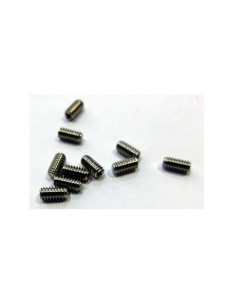
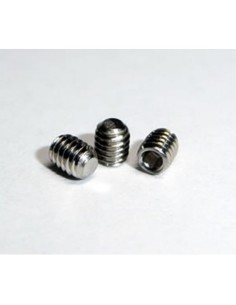
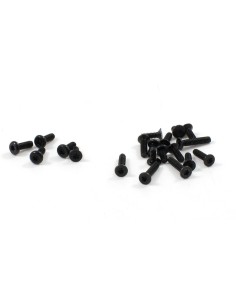
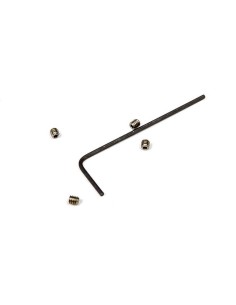
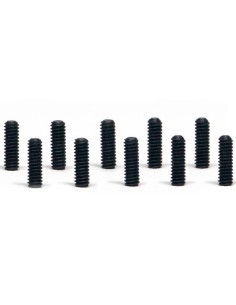
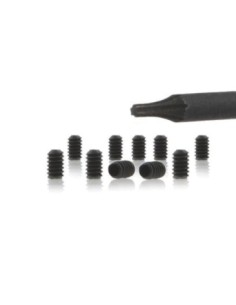
There are parts that no one mentions until they urgently need them. The Allen or Torx screw that holds the motor mount, the one that secures the guide, the one that adjusts the tension of an axle or keeps the body attached to the chassis: they are small, almost invisible, but when they are missing or rounded, the session ends. At Ministry of Hobby, we know well how frustrating it is to have everything ready and to stop because of a screw. That’s why we maintain a specific catalogue of screws with Allen (internal hexagon) and Torx (six-point star) heads, designed for both those preparing slot racing cars and those assembling static models or performing workshop tasks on miniatures and dioramas.
When we talk about screws in this context, we refer to small metric screws —usually from M1.4 to M3— with a recessed head that are tightened with an Allen key (also called hex key or imbus key) or with a Torx bit. They are the reference screws in the world of competitive slot racing, in precision electronics, and in chassis preparation, precisely because they allow for controlled torque application without damaging the head, occupy little space in areas with limited access, and offer very reliable retention against the vibrations inherent to the circuit.
If you are preparing a car for racing, optimizing a resin chassis, or simply repairing a part that has failed in the workshop, finding the correct screw —with the right metric, thread pitch, length, and material— makes the difference between a clean assembly and one that will cause problems after a few laps.
What is an Allen or Torx screw and why is it important
A screw, in precision screw terminology, is a low-profile recessed screw (countersunk or cylindrical) that is operated from the inside of the head using a specific tool. In the case of Allen, the head has a hexagonal recess that fits with the key of the same profile. In Torx, the recess is star-shaped with six points, which increases the contact surface with the tool and reduces the risk of slipping or rounding.
In the world of slot and precision modelling, these screws are almost ubiquitous because:
- They allow work in very tight spaces without the need for flat or Phillips head screwdrivers that may slip and damage adjacent parts.
- The torque is distributed evenly, which is crucial when working with technical plastic, resin, or machined aluminium parts.
- Their low profile makes it possible to fit them in areas where a conventional screw would not fit, such as inside a competition chassis or the mount of an inline or sidewinder motor.
- They are much more resistant to loosening due to vibration than their Phillips head equivalents, which is particularly important in a slot car subjected to constant acceleration and braking.
In brands like NSR, Slot.it, Avant Slot, or Scaleauto, Allen and Torx head screws are standard in most of their competition components. Knowing what metric each manufacturer uses —and having replacements available— is part of the knowledge that distinguishes an experienced preparer from one who learns through trial and error.
How to correctly choose the Allen or Torx screw
The correct choice depends on several factors that should be reviewed before ordering:
Metric and thread pitch
The metric (M1.4, M1.6, M2, M2.5, M3…) indicates the outer diameter of the thread. The thread pitch (distance between threads) is equally important: an M2 screw with a pitch of 0.4 is not interchangeable with another M2 of a different pitch. In precision screws for slot, the most common pitches are the so-called "fine pitch" or "standard ISO metric pitch." If in doubt, it is safest to measure the original screw with a caliper before replacing it.
Length
The length of the screw is measured from the base of the head to the end of the thread (in cylindrical heads) or from the tip to the end (in countersunk heads). A screw that is too long can interfere with other internal parts; one that is too short does not guarantee sufficient grip. In competition chassis, tolerances are very tight.
Material
Stainless steel is the most common option for slot screws: resistant, lightweight for its size, and with good corrosion resistance. Treated carbon steel offers greater hardness but can rust if there is moisture. In some advanced competition applications, titanium screws (maximum strength-to-weight ratio) or anodized aluminium (when weight savings are a priority) are used. For general workshop use, stainless steel is the most practical choice.
Head type: Allen vs. Torx
The choice between Allen and Torx is usually determined by the manufacturer of the component you are maintaining. It is not a matter of personal preference: if the part has Torx, you need Torx. That said, if you have the option to choose in your own project, Torx offers greater resistance to tool slippage, especially in very small sizes (M1.4-M1.6) where Allen screws may fatigue sooner.
Main types and differences
Within the Allen and Torx screws aimed at slot and modelling, we find several variants depending on the geometry of the head and the intended function:
Cylindrical head (socket head cap screw)
This is the most common type in precision mechanical applications. The head slightly protrudes from the mounting surface, making tightening and disassembly easier. It is commonly used to secure motor mounts, axle supports, guides, and structural elements of the chassis.
Countersunk head (countersunk)
Designed to be flush with the surface. It is ideal for securing bodies, covers, and elements where the screw head should not protrude. It requires the material to have the corresponding countersunk accommodation.
Button head (button head)
Intermediate profile: lower than the cylindrical but without the need for countersinking. It offers a wider support surface, useful in soft materials like plastic or resin where excessive tightening could embed into the material.
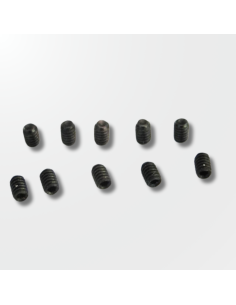
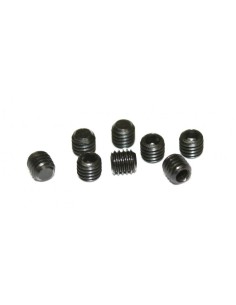
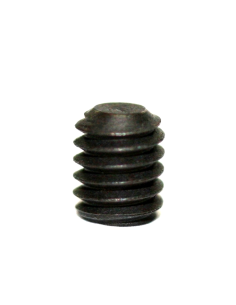
Grub screw (grub screw or set screw)
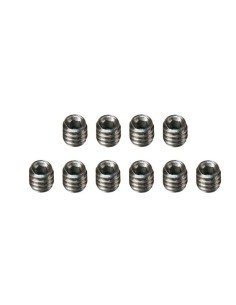
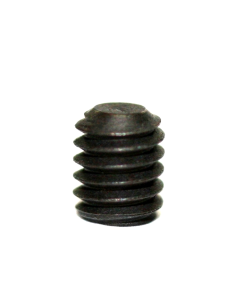
Completely threaded screw without a head that is flush with the part. Widely used to secure pinions and crowns to axles, to lock position in sliding elements, or to create adjustment stops.
Technical aspects we need to know
Working with precision screws in slot and modelling requires knowledge of some basic technical concepts that make the difference between a professional assembly and one that will cause problems:
Torque
With screws as small as M1.4 or M2, it is easy to exceed the torque and damage the thread, the part, or the screw head itself. The general recommendation is to tighten until you feel resistance and give an additional quarter turn at most, without forcing. The use of calibrated Allen keys or torque wrenches (in precision formats) is a common practice among advanced preparers.
Thread lock
In applications subject to constant vibration —such as the motor area or the axles of a competition car— it is common to apply a drop of low-strength thread lock (like Loctite blue or equivalent) to prevent the screw from loosening with use. High-strength thread lock should never be used on small precision screws: it would make subsequent disassembly extremely difficult.
Key compatibility
Allen or Torx recess sizes are standardized, but it is important to use the correct key. A slightly worn or poor-quality key can round the recess, rendering the screw unusable. In small sizes (T5, T6, 1.5 mm hex, 2 mm hex), it is worth investing in quality tools.
Metric thread vs. inch thread
Although metric screws are the norm in the European market, some manufacturers of Anglo-Saxon or American origin may use inch threads. If the screw does not enter smoothly into the thread when turned with your fingers, it is a sign that there may be a standard conflict: never force it, as you will damage the female thread.
Practical tips for use, maintenance, and preparation
- Organise by metric and length. Storing screws in a labelled compartment organiser saves you time and avoids assembly errors. Mixing M2 with M2.5 in the same container is a common source of problems.
- Check the screws before each racing session. Vibration can loosen screws that seemed well tightened. A quick check with the Allen key before running is a habit that every serious preparer adopts.
- Carry spares in your workshop bag. Losing a screw during a session or having the head round off at the worst moment is more common than it seems. Having a small assortment of the most used sizes can save your race.
- Clean the threads before assembling. Residues of old grease, dirt, or machining burrs hinder tightening and can give false torque readings. A thread tap or simply running the screw dry several times can resolve small obstructions.
- Do not reuse damaged screws. A screw with a slightly rounded head or deformed thread is a sure source of problems. In screws of these metrics, the replacement cost is very low: change it without hesitation.
Common mistakes to avoid
Using the wrong key
This is the most common mistake and the one that causes the most damage. An Allen key of 1.5 mm in a 2 mm recess, or a Torx T6 in a T8 socket, rounds the head in a couple of turns. Always identify the correct size before tightening.
Confusing similar metrics
M2 and M2.5 are visually very similar. Forcing an M2.5 into an M2 thread —or vice versa— irreparably damages the socket. Use a caliper or check the label on the packaging before assembling.
Tightening dry on plastic or resin without testing the thread
Some chassis or resin parts have helical threads that require very controlled tightening. Entering too quickly with the key without having verified that the screw enters smoothly with your fingers can destroy the thread of the material, which does not always have an easy solution.
Ignoring thread lock in critical areas
The motor area, guide support, or axles are points where vibrations act constantly. Not applying thread lock in these areas when appropriate is a mistake that often costs dearly in the middle of a race.
Replacing without verifying the length
A screw that is too long can collide with electronics, the motor, or moving elements of the chassis. Before mounting a replacement screw, compare it with the original or verify that the length is compatible with the application.
Recommendations for beginners and advanced users
If you are starting
The most important thing is not to improvise with screws. If you are unsure of the size, remove the original screw and take it as a reference. Get a basic set of precision Allen keys (from 1 mm to 4 mm) and, if your chassis or cars use Torx, add a set of bits from T5 to T10. Buying a small assortment of M2 and M2.5 in the most common lengths (3, 4, 5, 6 mm) will get you out of more than one jam.
Before tightening any screw on plastic or resin, always test if the thread enters cleanly with your fingers. If it does not enter smoothly, something is wrong: do not force it.
If you already have experience
At the competition level, it is worth exploring options in high-strength stainless steel or titanium for the most critical points of the chassis, where every gram counts. Also consider standardising the screws in your car: using a single size of Allen or Torx in all points that allow it simplifies work in the pits and reduces the risk of errors under pressure.
More advanced preparers often have a protocol for checking screws after each session: visual tightening, checking with the key, and, at points with thread lock, verifying that there is no play. It is a simple habit that prevents unnecessary retirements.
Comparative table: most common types of screws in slot and modelling
| Head type |
Tool |
Common use |
Main advantage |
| Cylindrical Allen |
Hex key (imbus) |
Mounts, supports, axles |
Versatility and availability |
| Cylindrical Torx |
Torx bit/key |
Precision components |
Greater resistance to slipping |
| Countersunk Allen |
Hex key (imbus) |
Bodies, covers |
Flush mounting |
| Button Allen |
Hex key (imbus) |
Plastics and resins |
Wider support surface |
| Grub screw |
Small hex key |
Pinions, crowns, stops |
Completely recessed |
Frequently asked questions
What is the most common metric in competitive slot chassis?
Sizes M2 and M2.5 are the most frequent in brands like NSR, Slot.it, Avant Slot, and Scaleauto. Some smaller components, like certain guide supports or body elements, may use M1.4 or M1.6. It is advisable to always verify with the original screw.
Can I replace an Allen screw with a Torx of the same diameter?
Yes, as long as the metric, thread pitch, and length are identical, and the accommodation of the part allows it (for example, that the head is not larger). The thread is standard; what changes is only the type of head drive.
What key do I use for a 1.5 mm Allen?
An Allen key of 1.5 mm, also called an imbus key of 1.5. It is one of the smallest and most common sizes in competitive slot racing. Ensure that the key is in good condition: at this size, a worn key easily rounds the screw head.
Is it necessary to use thread lock on all screws in the chassis?
Not on all. It is especially recommended in areas subject to intense vibration: motor, guide, rear axle support. On screws that are frequently adjusted (for example, braid tension or guide height), it is preferable not to use it to facilitate readjustments.
How do I extract an Allen screw with a rounded head?
There are several techniques depending on the degree of damage: using an eraser or strong adhesive tape between the key and the screw for better grip, using a slightly larger key and forcing the fit, or resorting to a precision screw extractor. In extreme cases, a dremel with a cutting disc can create a slot for a flat screwdriver.
Are the screws sold by slot brands of standard metrics?
Generally yes: European and Japanese slot brands (NSR, Slot.it, Avant Slot, Scaleauto) use standard ISO metric screws. This means you can replace them with generic screws of the same metric, which greatly facilitates maintenance and reduces costs.
What is the difference between a screw and a grub screw?
In colloquial workshop language, they are used interchangeably, but technically the grub screw is the one without a head and is completely flush with the part. The screw in the strict sense is a threaded rod at both ends. In the context of slot, "screw" usually refers to any Allen or Torx recessed screw.
How often should I check the screws on my slot car?
Before each running session and after any impact or accident. In competition, many preparers do a quick check between sessions as well. It is a habit that takes less than two minutes and can prevent avoidable retirements.
Can I use normal steel screws instead of stainless steel?
Yes, but untreated carbon steel can rust if there is moisture in the environment or if it comes into contact with lubricants that promote rusting. For intensive use or prolonged storage, stainless steel is more practical, although it is usually slightly more expensive.
Are there aluminium Allen or Torx screws to lighten the car?
Yes, although they are less common and more delicate. Anodized aluminium is significantly lighter than steel, but also softer: it can be damaged more easily and does not tolerate the same torque. They are used in very specific applications where weight savings justify greater care in handling.
What size of Torx is most common in slot components?
Sizes T6 and T8 are the most frequent in slot and precision modelling components, although some manufacturers use T5 in the smallest screws. It is advisable to have at least these three sizes available in the workshop kit.
Can I use the same screws for static models and slot cars?
Yes, as long as the metric and length are suitable for the specific application. Allen and Torx precision screws are transversal to many modelling disciplines: the difference lies in choosing the correct size for each use, not in the type of hobby.