If you have ever noticed that one car runs with millimetric smoothness while another seems to drag resistance on every inch of track, the difference is almost always in the bearings. They are small, almost invisible parts, but their impact on performance is disproportionate to their size. An axle that rotates on quality bearings minimizes friction, transfers the motor's power more efficiently, and prolongs the lifespan of the entire drivetrain.
In the world of slot racing, technical preparation makes the difference between a car that simply rolls and one that competes. Bearings are, along with tyres and the gear ratio, one of the three factors that most influence actual speed on track. It doesn't matter if you have a powerful motor if the axle doesn't spin freely: part of that power is lost as heat and friction before it reaches the ground.
But bearings are not just for competition. In any collection or regular use car, replacing the original plastic bushings with metal bearings is one of the most cost-effective upgrades you can make. The car rolls better, sounds different, and in many cases, the difference is even noticeable to the naked eye when pushed with a finger.
In this section, you will find bearings for the most common axle sizes in slot 1/32 and 1/24, both in steel and in materials specifically designed for high-precision applications. If you are looking for a quick upgrade with concrete results, you are in the right place.
What are bearings and why are they so important
A bearing is a mechanical element that allows an axle to rotate with minimal friction. Instead of the axle rubbing directly against the car's structure, the bearing interposes a series of metal balls or rollers that distribute the load and reduce surface contact to tiny points.
In a slot car, bearings are placed in the rear axle supports — and sometimes also in the front — so that the wheels spin with the least possible resistance. The difference compared to the plastic bushings that many cars come with from the factory is significant: plastic has a higher coefficient of friction, wears out with use, and can deform with the heat generated by the motor.
A well-mounted steel bearing, on the other hand, maintains its properties for thousands of hours of use, tolerates working temperatures better, and offers virtually free rotation. In competition, where tenths of a second are measured, that difference translates into consistently lower lap times. In recreational use, it results in a car that feels more alive and responds better.
There is more than just pure performance: bearings also protect the axle and the chassis. When there is play or wear in the axle supports, the axle itself can vibrate, affecting traction, the contact of the tyres with the track, and the wear of the crown gear. A well-fitted bearing eliminates that play and stabilizes the entire assembly.
How to choose the right bearings
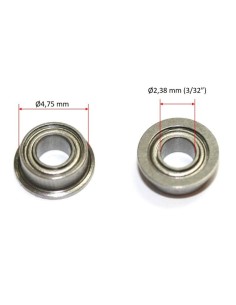
The choice of a bearing depends on several factors. The first and most important is the size: the inner diameter must match exactly with the diameter of the axle you are going to mount, and the outer diameter must fit into the chassis or chassis support. The most common sizes in slot 1/32 are for axles of 2.38 mm (3/32") and 3 mm, although there are variations depending on the manufacturer and model.
The second factor is the material and quality of the bearing. Chrome steel bearings are the most common and cover most applications. For intensive competition use, some preparers prefer bearings with special treatments or harder materials that withstand heat and lateral load better.
The third element to consider is lubrication. Bearings can come with factory grease (sealed) or without lubricant (open). For slot racing, open or minimally lubricated bearings are generally preferred, as excess grease can act as a brake at high revolutions. A drop of light precision oil is usually sufficient.
Finally, consider compatibility with your chassis. Brands like NSR, Slot.it, Scaleauto, or Avant Slot have specific housing sizes, and their own bearing catalogs are designed to fit without the need for adaptations. If you are preparing a car from these brands, the simplest approach is to start from their own references.
Main types and differences
Not all bearings are the same, and knowing the differences will help you choose better:
- Steel ball bearings: The most widespread in the slot hobby. They offer a good balance between precision, durability, and price. They are the standard option for most setups.
- Stainless steel bearings: Greater resistance to corrosion and heat. Recommended for competition cars that are used intensively or in environments with some humidity.
- Ceramic or hybrid bearings: The balls are ceramic and the outer ring is steel. They further reduce friction and tolerate high revolutions better. They are the premium option for high-level competition.
- Sintered bushings: Technically not ball bearings, but porous bronze bushings impregnated with oil. They offer less precision than a ball bearing but are economical, quiet, and suitable for less demanding uses.
- Flanged bearings: They have a flange on one of the rings that facilitates positioning within the housing. Widely used in supports where it is important that the bearing does not move axially.
In practice, for a competition car in 1/32, the usual choice is between precision steel bearings and ceramic hybrid bearings. For a recreational car or a basic upgrade, standard steel bearings are more than sufficient.
Technical aspects we need to know
There are some technical concepts that are useful to understand before mounting or replacing bearings:
Tolerances and fit
The fit between the bearing and its housing can be of three types: loose fit (the bearing enters easily), neutral fit (fits snugly without forcing), or press fit (a tool is needed to insert it). In slot racing, the usual fit is a neutral or slightly press fit in the chassis housing, and a neutral fit on the axle. A bearing with too much play in the chassis will transmit vibrations; one that is excessively tight on the axle may compromise free rotation.
Axial and radial play
Axial play is the movement of the axle in the longitudinal direction (forward-backward); radial play is the movement perpendicular to the axis of rotation. Both should be minimal. Excess axial play causes the wheels to move laterally, affecting trajectory; radial play causes vibration and noise.
Initial running-in
A new bearing needs a progressive running-in period for the balls and raceways to settle. It is advisable to perform the first sessions of use without forcing the motor, allowing the assembly to reach working temperature gradually. This prolongs the life of the bearing and optimizes its long-term performance.
Influence on the gear ratio
Although it may seem that bearings only affect friction, a correct assembly also influences the alignment of the crown gear relative to the pinion. If the bearings do not hold the axle in its correct position, the engagement between the pinion and crown gear will not be optimal, leading to noise, premature wear, and loss of transmitted power.
Practical tips for use, maintenance, and preparation
- Clean the bearings before mounting: New bearings often come with preservation grease that may be too thick for our use. Clean them with an appropriate solvent or cleaning oil and re-lubricate with a drop of light precision oil.
- Check the condition periodically: A bearing that is starting to wear sounds different: a slight crunch or roughness appears when turning it with your fingers. Replace it before the wear affects other parts.
- Do not over-lubricate: More oil does not mean less friction. Excess lubricant acts as a brake at high speeds and can attract dirt, accelerating wear.
- Check the fit in the chassis: After mounting the bearing, the axle should spin completely freely, without drag or hard spots in any angular position. If there is a hard spot, the bearing may be slightly misaligned or there is dirt between the balls.
- Use the right tools: To press-fit bearings, use a mounting tool or a bushing of the outer diameter of the bearing. Never hit directly on the inner ring: you will damage the balls and raceways.
- Store bearings properly: If you have spare bearings, keep them in a dry, dust-free place. Humidity and dirt are their main enemies.
Common mistakes to avoid
Over the years of preparing slot cars and talking with enthusiasts of all levels, we have seen the same mistakes repeated over and over:
- Choosing the bearing by price, not by size: A cheap bearing of the correct size is always better than an expensive one that does not fit well. Always check the inner diameter, outer diameter, and width before buying.
- Mounting bearings without cleaning the preservation grease: That grease is meant for storage, not for operation at high RPM. Always clean before mounting.
- Ignoring the axial play of the axle: An axle that moves side to side even when it spins freely will affect cornering behavior and tyre wear. Ensure that the axle-bearing-chassis assembly does not have excessive axial play.
- Not replacing both bearings at the same time: If one is worn, the other probably is too. Always replace them in pairs to ensure balanced rotation.
- Forcing the mounting with the wrong tool: Using screwdrivers or pliers to press-fit bearings is the quickest way to damage them or deform the chassis housing.
- Mixing bearings of different tolerances on the same axle: If the two bearings holding an axle have different tolerances, the axle will not spin straight and vibration will occur. Always use bearings of the same reference and manufacturer on each axle.
Recommendations for beginners and advanced users
If you are starting out
The best approach is to start with steel bearings from brands you already know: NSR, Slot.it, and Scaleauto have specific references for their own chassis, ensuring that the size and fit are correct without complicating things. They are affordable, easy to mount, and already represent a significant improvement over factory bushings. Gain confidence with the assembly, learn to distinguish when a bearing spins well and when it has problems, and then you can explore more advanced options.
If you already have experience
At this level, the choice of bearing is part of the overall tuning of the car. Consider ceramic hybrid bearings for high-power motors or high-speed tracks, where the difference in friction translates into real lap times. Pay attention to the surface treatment of the raceways and the preload level of the bearing: a slight pre-adjustment can improve cornering stability at the expense of a small loss of top speed, a compromise that only makes sense depending on the type of circuit and the applicable competition regulations.
For preparers and competitors
In competition, the key is consistency: two bearings that function identically throughout an entire race session are worth more than one excellent and one mediocre. Establish inspection routines, define how many hours or sessions each reference can withstand before replacing it, and always carry spares to the pit. The difference between a car that finishes the race and one that does not is often in the details of maintenance.
| Type of bearing |
Material |
Friction |
Durability |
Indicative price |
Recommended use |
| Standard steel |
Chrome steel |
Low |
High |
Economical |
General use, basic upgrade |
| Stainless steel |
Stainless steel |
Low |
Very high |
Medium |
Regular competition |
| Ceramic hybrid |
Steel + ceramic |
Very low |
Very high |
High |
High-level competition |
| Sintered bushing |
Porous bronze |
Medium |
Medium |
Very economical |
Standard cars, recreational use |
| Flanged steel |
Chrome steel |
Low |
High |
Economical-medium |
Supports with axial positioning |
Frequently asked questions about bearings
What bearing size do I need for my car?
It depends on the manufacturer and model. The most common axles in slot 1/32 are 3/32" (2.38 mm) and 3 mm. Check the specifications of your chassis or review the spare parts catalog of the brand. NSR, Slot.it, Scaleauto, and Avant Slot have their own references with specific sizes.
Is it worth mounting bearings on a beginner's car?
Yes, and it is one of the upgrades with the best cost-benefit ratio. Even in low-end cars, replacing plastic bushings with steel bearings makes the car roll noticeably better and respond more agilely.
Do bearings need lubrication?
Yes, but in moderation. A drop of light precision oil is sufficient. Too much lubricant generates more friction, not less, and can stain the tyres or the track.
How long do bearings last in a competition car?
It depends on use, track type, and maintenance level. Under intensive use conditions, it is advisable to inspect the bearings after each race session and replace them when roughness or excessive play is noticed. There is no universal number of hours: learn to diagnose them by spinning them with your fingers.
Can I use bearings from another manufacturer in my brand chassis?
Yes, as long as the sizes are identical. The important thing is that the inner diameter, outer diameter, and width match the housing and axle of your car. Bearings are standardized parts, so it is common to use high-quality generic references in chassis of any brand.
What is the difference between an open bearing and a sealed one?
An open bearing has no side shields: it is easier to clean and lubricate, and with the right oil, it offers less friction. A sealed bearing has caps that protect the balls from dirt, but also make subsequent lubrication more difficult. For slot racing, open or semi-open bearings are preferred.
Are ceramic bearings really better?
In competition conditions, yes. Ceramic balls have less mass, are harder, and generate less heat due to friction. At typical recreational track speeds, the difference is noticeable but not dramatic. Their greatest advantage is felt in high-power motors and high-speed circuits.
Can I clean and reuse worn bearings?
If the bearing shows roughness, hard spots, or noise when spinning, cleaning will not recover it: the raceways or balls are already damaged. Cleaning is useful for preventive maintenance, not for recovering a bearing that has already failed.
Do bearings influence the sound of the car?
Yes, significantly. A car with bearings in good condition and well-lubricated is quieter. When a bearing starts to fail, a slight buzzing or crunching sound appears that is clearly distinguishable from the normal sound of the motor and transmission. Learning to listen to the car is part of the preparation experience.
Are flanged bearings better than standard ones?
They are not better in terms of friction, but more practical in certain setups. The flanged edge facilitates positioning and prevents the bearing from moving within the housing. They are especially useful in supports where axial adjustment is critical.
What happens if I mount bearings with different tolerances on the same axle?
The axle will not spin straight: there will be a slight misalignment that translates into vibration, noise, and accelerated wear of the crown gear and pinion. Always use bearings of the same reference on each axle.
Is it difficult to change bearings for the first time?
Not particularly. With the right tools and following the manufacturer's instructions, it is an operation within the reach of any enthusiast with some skill. The most important thing is not to force the mounting and to ensure that the bearing is well seated and aligned in its housing.