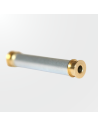
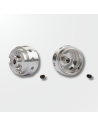
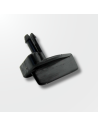
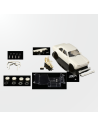
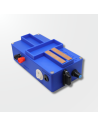
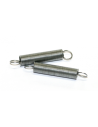
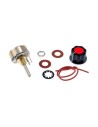
There are adjustments you can see and adjustments you can feel. Bearings, stoppers, and spacers belong to the second category: they do not attract attention in the paddock, but they are responsible for ensuring that the rear axle rotates accurately, that the crown does not move a millimetre from its position, and that the chassis is perfectly centred with respect to the wheels. When something goes wrong in the mechanics of a slot car —unexplained vibrations, loss of traction, imbalance in corners— the cause is often one of these three components.
In the world of competitive slot racing, the difference between a mediocre setup and a finely tuned one often comes down to tenths of a millimetre. A 0.1 mm spacer placed incorrectly can alter the chassis' pivoting, a worn bearing introduces extra friction that the motor has to overcome, and a poorly adjusted stopper causes the crown to wobble and lose clean contact with the pinion. They are small parts, sometimes even invisible from the outside, but their impact on performance is enormous.
Whether you are tuning a car for competition or simply want your slot car to run smoothly and without strange noises, this section offers everything you need: bronze bearings, brass bearings, and high-precision ball bearings, aluminium stoppers to fix the lateral position of the axle, and spacers in multiple thicknesses for precise centring adjustments. We work with references from NSR, Slot.it, Scaleauto, and Avant Slot, brands that professional tuners use on tracks around the world.
What are bearings, stoppers, and spacers and why are they important
Although all three are part of the rear axle, each serves a distinct function and they are not interchangeable or secondary:
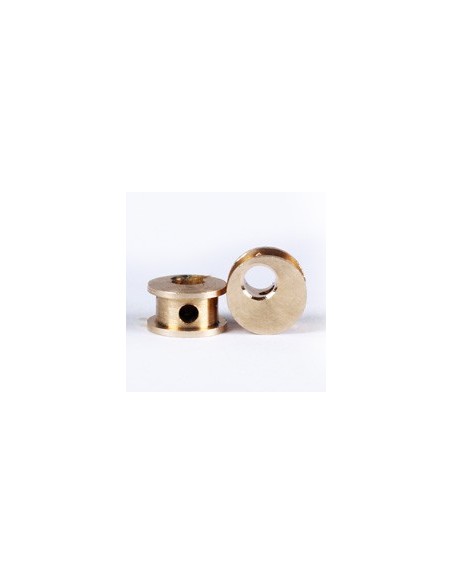
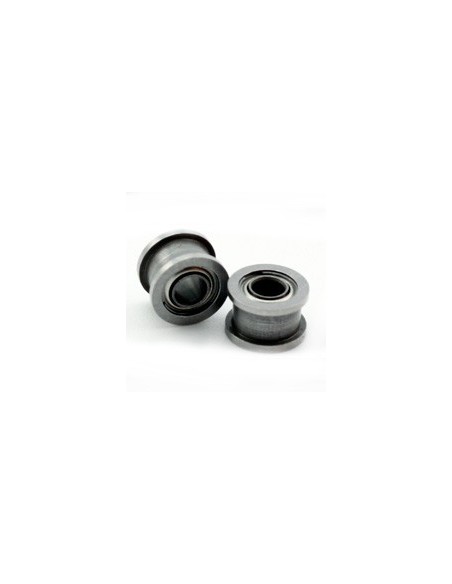
- Bearings (bushings / ball bearings): They house the rear axle within the bracket or chassis. Their main mission is to reduce friction between the rotating axle and the fixed structure of the car. A good quality bearing spins freely, with no lateral play and no hard spots. The difference between a pressed bronze bearing and a stainless steel ball bearing can mean several milliseconds per lap on technical tracks.
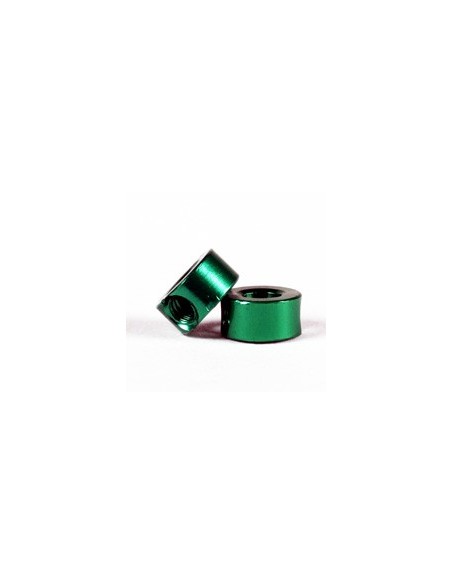
- Stoppers: Parts that are fixed onto the axle (usually via a set screw or precision fit) to prevent lateral movement of the axle-crown-wheel assembly. Without a properly placed stopper, the axle moves side to side with the lateral forces of the corners, causing irregularities in the transmission and premature wear.
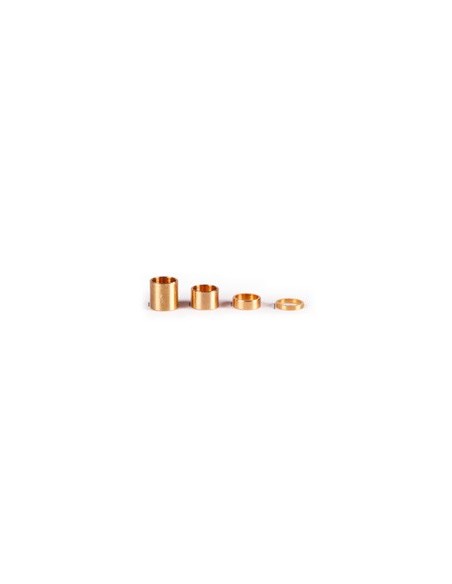
- Spacers (spacers / washers): Adjustment washers in different thicknesses —from 0.1 mm to several millimetres— that are interposed between parts of the rear axle to centre the chassis between the wheels, adjust the lateral play of the axle, or modify the position of the crown relative to the pinion. They are the fundamental tool for fine tuning.
Together, these three components determine the geometry of the rear axle. A poorly adjusted axle transmits vibration to the chassis, asymmetrically loads the tyres, and can even affect the guide's contact with the rail. It is not an exaggeration to say that it is worth checking and updating these components before any important competition session.
How to correctly choose these components
Before purchasing, it is advisable to have three basic data clear: the axle diameter, the chassis model, and the transmission system (inline, sidewinder, or anglewinder). Each combination may require bearings of specific sizes or stoppers with different fastening systems.
Axle diameter
The most common standard in 1/32 is the 3 mm axle (both steel and tungsten), although there are 2.38 mm (3/32") axles frequently found in Anglo-Saxon competition cars. Before ordering bearings, check the inner diameter of the one already mounted: the new bearing must match exactly.
Bearing material
Sintered bronze bearings are the most common and offer a good balance between cost, durability, and ease of oil impregnation. Brass bearings are slightly harder and more precise. Stainless steel or regular steel ball bearings offer the least friction possible and are the usual choice in competition setups, although they are more sensitive to dirt and require more frequent maintenance.
Chassis compatibility
Not all chassis accept the same outer diameter of bearing. Injected plastic chassis (like those from Scalextric or Ninco) usually have less precise housings than competition plastic chassis from Slot.it, NSR, or Scaleauto. In the latter, the tolerance is so tight that the type and size of bearing directly influence the free rotation of the axle.
Stoppers: fastening and weight
Choose aluminium stoppers if the weight of the rear assembly is a variable in your setup —which it usually is in competition. Brass stoppers are heavier but more robust against impacts. Check the fastening system: some use a direct Allen screw on the axle, while others are mounted with interference. The former are more convenient for adjustments in the pits.
Spacers: have assortments on hand
If you are a regular tuner, the most practical thing is to have an assortment of spacers in different thicknesses (0.1 / 0.2 / 0.3 / 0.5 / 1 mm) to be able to combine them on the fly. Adjusting the chassis centring on track without the appropriate spacer at hand is a waste of time and nerves.
Main types and differences
Sintered bronze bearings
The classic of all time. They are made by sintering bronze powder, which gives them a porous structure that retains lubricant. They are easy to reassemble, inexpensive, and sufficiently precise for non-competitive use or for categories with material restrictions. Their main disadvantage compared to ball bearings is the higher static friction.
Ball bearings
They consist of two concentric races separated by steel balls that roll freely. The friction is minimal and constant. They are the standard in any high-performance setup. They come in open version (easier to clean and lubricate), with a metal shield (better protection from dust), or with a rubber seal (greater tightness). For slot racing, the metal shielded or open types are the most common.
Aluminium vs. brass stoppers
Aluminium predominates in competition due to its lightness. Brass adds mass to the rear assembly, which can be useful in setups seeking more traction through inertia, but it adds grams in a place where lightness is usually sought. Both exist in slotted or smooth versions depending on the fastening system.
Flat vs. conical spacers
Flat spacers are the most common and serve to adjust lateral position. Conical or fine adjustment spacers are used in situations where small deviations of the axle need to be compensated. For most setups, flat spacers in a variety of thicknesses are more than sufficient.
Technical aspects we need to know
Understanding how these components interact with each other is key to making the most of the adjustment:
Axle lateral play
Lateral play is the axial movement of the axle within the bearings. Too much play causes the crown to shift and lose uniform engagement with the pinion. Too little play generates friction and can lock the rotation if the axle expands due to temperature. The goal is minimal play, barely perceptible to the touch but present. Stoppers and spacers are the tools to achieve this.
Bearing preload
In some high-precision setups, a slight preload is applied to the ball bearings to eliminate even the slightest axial play. This technique requires high-quality bearings and is more typical of very advanced preparations.
Influence on dynamic behaviour
A perfectly centred axle distributes the traction load symmetrically between the two rear wheels. Any deviation —even tenths of a millimetre— causes one wheel to work harder than the other, resulting in drift or imbalance in fast corners. Spacers are the direct solution to this problem.
Compatibility between motorisation systems
In a sidewinder configuration (motor parallel to the rear axle, transverse), the axle and crown work with one orientation; in an inline configuration (longitudinal motor, perpendicular to the axle), the effective length of the axle changes and may require stoppers and spacers with different positioning. In an anglewinder, the crown is tilted with respect to the axle, making the precision of lateral positioning especially important to maintain correct engagement.
Practical tips for use, maintenance, and preparation
- Regularly clean the bearings: On tracks with a lot of rubber dust, ball bearings get dirty quickly. A cleaning with a specific degreaser and a drop of fine oil every few sessions keeps them in optimal condition.
- Check the lateral play before each race: With the car in hand, try to move the axle side to side. If there is noticeable movement, check the position of the stoppers. If there is no movement and the axle turns with resistance, the stoppers are too tight.
- Use a caliper to measure the spacers: Differences of tenths of a millimetre matter. Check the actual thickness of each spacer before mounting it, especially if they are from third-party manufacturers.
- Soak the bronze bearings in oil before mounting: Sintered bronze must be lubricated from the very first moment. Soak it for a few minutes in light silicone oil before pressing it into the chassis.
- Do not overtighten the stoppers: Excessive tightening can deform the axle or create hard spots in the rotation. Tighten just enough to eliminate play, no more.
- Replace the bearings if you notice hard spots: A bearing with a hard spot does not recover by lubricating; it must be replaced. The cost is minimal compared to the tenths it can cost in a race.
Common mistakes we should avoid
Mixing bearings of different tolerances
Mounting a ball bearing on one side and a bronze bearing on the other causes the axle to rotate unevenly. The differential friction between both sides generates a small torque that the car tries to compensate for by veering. Always use the same type and quality on both sides.
Ignoring chassis centring
Many enthusiasts adjust the crown and pinion but forget to centre the chassis between the wheels. The result is a car that runs but with constant lateral friction of the body or chassis against the wheels. A couple of spacers of the appropriate thickness solves the problem in minutes.
Not checking the wear of bronze bearings
Bronze bearings wear out with use and the inner diameter gradually increases, introducing radial play (vertical) in the axle. That play causes the crown to wobble up and down as well as laterally. If the axle has radial play in the bearing, it is time to change it.
Placing stoppers without verifying the alignment of the crown
Stoppers fix the position of the axle, but if you place them without first verifying that the crown is perfectly aligned with the pinion, you will be fixing an incorrect position. Always check the engagement before tightening the stoppers definitively.
Using spacers that are not flat
A spacer with a slightly warped or dirty contact face introduces a minimal tilt in the axle. In short axles, that tilt amplifies to the point of contact with the track and can cause one wheel not to support correctly.
Recommendations for beginners and advanced users
If you are starting
You do not need to change everything at once. Start by checking if the bearings on your car have noticeable radial play and if the axle moves laterally more than reasonable. If so, a basic assortment of ball bearings of the appropriate diameter and a couple of stoppers will be your first investment. To choose correctly, note the chassis model and consult the compatible references from NSR, Slot.it, or Scaleauto according to your car's brand.
For centring, acquire an assortment of spacers in varied thicknesses. You will be able to combine them to achieve the exact adjustment without having to search for specific measurements over and over again.
If you already have experience
In competition, consistency between sessions is key. Keep a record of the spacers used on each car (left side / right side) to replicate the exact setup after a review. Consider having pre-used bearings on hand —that is, with some time of use— because a new bearing sometimes takes a few laps to perform at its best.
For advanced preparations on anglewinder chassis, pay special attention to the lateral positioning of the crown: the motor's tilt means that the tolerance at this point is lower than in sidewinder or inline configurations. A poorly positioned stopper can cause incorrect contact between the crown and pinion, manifesting as noise or excessive motor heating.
| Component |
Common material |
Main advantage |
When to use it |
| Bronze bearing |
Sintered bronze |
Economical, self-lubricating |
Recreational use, restricted categories |
| Ball bearing |
Steel / stainless steel |
Minimal friction |
Competition, performance setups |
| Aluminium stopper |
Aluminium |
Lightweight, precise |
Competition, minimise inertial weight |
| Brass stopper |
Brass |
Robust, adds rear mass |
Setups seeking more traction through inertia |
| Thin flat spacer (0.1–0.3 mm) |
Steel / brass |
Micrometric adjustment |
Fine centring of the chassis, crown adjustment |
| Standard spacer (0.5–1 mm) |
Steel / plastic |
General position correction |
Initial assembly, coarse adjustment |
Frequently asked questions
What is the difference between a bronze bearing and a ball bearing?
The bronze bearing is a solid piece with a hole in which the axle rotates; it works by direct contact between lubricated surfaces. The ball bearing interposes steel spheres that roll between two races, drastically reducing friction. For competition, ball bearings are clearly superior; for recreational use, bronze bearings are more than sufficient.
How do I know what diameter bearing I need?
The inner diameter must match that of your car's rear axle (usually 3 mm or 2.38 mm in 1/32). The outer diameter depends on the housing in the chassis. Consult the specifications from the chassis manufacturer or measure the housing with a caliper.
Can I mix bearings from different brands on the same axle?
Technically yes, as long as the measurements are identical. However, to have symmetrical axle behaviour, it is advisable to use the same model on both sides.
How often should I change the bearings?
It depends on usage and type. Well-maintained ball bearings can last many hours of running. Bronze bearings wear out faster, especially on abrasive tracks. Check them when you notice unusual vibrations or noise in the rear end.
Should stoppers be tightened a lot?
No. Just enough to eliminate lateral play without generating friction in the axle. Excessive tightening can mark the axle or hinder free rotation. A small torque is sufficient.
What happens if I do not use stoppers?
The axle moves laterally under the forces of inertia in corners. This causes the crown to lose uniform engagement with the pinion, generating irregularities in the transmission, noise, and premature wear of both parts.
How many spacers do I need to centre the chassis?
It depends on the car and the standard assembly. The most practical way is to have an assortment of different thicknesses and combine them until the chassis is centred between the two wheels with the same space on each side.
Do spacers influence track behaviour?
Directly. An off-centre chassis puts more weight on one side, generating asymmetric friction and irregular traction. Additionally, it affects the chassis' pivoting and can modify the height of the guide relative to the rail.
Are these components compatible with all track systems?
The bearings, stoppers, and spacers are components of the car, not the track, so their compatibility depends on the model's chassis and not on the rail system you use (whether Scalextric, Ninco, Scaleauto, or Carrera).
What lubricant should I use on bronze bearings?
Light silicone oil or specific slot oil. Avoid overly thick lubricants (like petroleum jelly or universal greases) because they attract dust and can increase friction instead of reducing it.
Do ball bearings need lubrication?
Sealed types come pre-lubricated from the factory and under normal conditions do not require frequent maintenance. Open types benefit from a drop of fine oil now and then, especially after cleaning with a degreaser.
What should I do if the axle spins but has a hard spot?
A hard spot almost always indicates a damaged, dirty bearing or one with a faulty ball. First, clean with a degreaser; if the hard spot persists, replace it. There is no way to "repair" a bearing with internal mechanical damage.