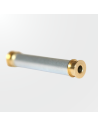
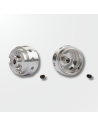
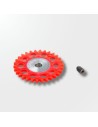
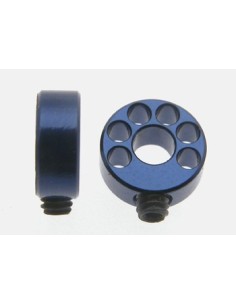
There are parts that go unnoticed until they fail. The stopper —also called a prisoner, positioner, or axle collar— is one of them. Small, almost invisible inside the car, but responsible for keeping each rotating component exactly where it needs to be. Without it, crowns, pinions, and axles shift by tenths of a turn, which affects performance, wear, and sometimes leads to abandonment.
If you are preparing a competition car, adjusting the distance between the crown and pinion, or ensuring that the rear axle does not migrate laterally in a curve, stoppers are the answer. And although they may all seem the same, there are differences worth knowing before reaching into the drawer.
In this category, you will find prisoners with an inner diameter of 2.38 mm (the standard 3/32" in the 1/32 slot world), in various designs and materials, intended for both street setups and high-level preparations. Below, we explain everything you need to know to make the right choice.
What is a stopper and why is it so important
A stopper is a small cylindrical element —generally metallic— that slides over an axle and is fixed in a specific position using a lateral tightening screw (the prisoner itself) or through a retention slot. Its function is to prevent the axial displacement of any component mounted on that axle: crowns, wheels, pinions, spacers, or brackets.
Why is it so critical? Because in a slot car, the exact position of the crown relative to the pinion determines the engagement. A too-loose engagement generates noise, tooth skipping, and loss of efficiency. A too-tight one produces friction, heat, and premature wear. The stopper is responsible for maintaining that distance without allowing vibration, heat, or impacts to modify it.
The same applies to the wheels: if the axle shifts laterally, the wheel changes position relative to the body and may rub against the chassis or the inside of the fender. A well-tightened prisoner eliminates that problem at its root.
In competition, where adjustments are measured in hundredths and every gram of friction counts, stoppers are part of the preparation process just like tire selection or axle alignment. They are not a minor part: they are a precision component.
How to correctly choose your stoppers
The first criterion is the inner diameter. 1/32 slot cars predominantly use 3/32" (2.38 mm) axles, which is the standard measurement used by brands like NSR, Slot.it, Avant Slot, or Scaleauto. Before purchasing, check the diameter of your car's axles: although 3/32" dominates the market, some models from other scales or systems may use different measurements.
The second criterion is the outer diameter. A very thick stopper can interfere with the chassis, the bracket, or the internal sides of the body. Check the available space in the setup before choosing.
The third criterion is the fastening system. Stoppers with a prisoner screw allow for finer adjustments and can be repositioned without special tools, making them ideal for setups that are frequently reviewed. Pressure stoppers or those that use the material's own elasticity are quicker to mount but less precise for fine tuning.
Finally, the material. Machined aluminium offers lightness and precision; steel provides greater hardness and wear resistance. For competition, quality anodized aluminium is the usual choice. For more intensive use or high-torque axles, steel may be more suitable.
Main types and differences
Not all stoppers are the same, although they may seem so at first glance. Here are the variants you will find most frequently:
- Stoppers with prisoner screw (hex socket): The most common type in competition slot racing. They are fixed using a small Allen screw that tightens against the axle. They allow for millimetric adjustment and can be loosened and repositioned without damaging the axle if done carefully.
- Pressure or snap stoppers: They fit into a machined slot on the axle. They are quicker to mount but require the axle to have the correct slot and do not allow for positional adjustment.
- Integrated axle collars: Some competition axles come with the stopper machined as part of the axle itself. They offer maximum precision but are not interchangeable.
- Nylon or technical plastic stoppers: Less common in competition, but useful when wanting to avoid scratches on delicate axles or when weight is a critical factor.
For the vast majority of 1/32 slot setups, the anodized aluminium stopper with a prisoner screw is the most versatile choice and is used by reference preparers from brands like NSR or Slot.it.
Technical aspects we need to know
Correctly mounting a stopper requires attention to a few details that make the difference between an adjustment that lasts the entire race and one that loosens in the first chicane.
Tightening the prisoner screw: The most common mistake is over-tightening or under-tightening. If you over-tighten, you can mark the axle and make future removal difficult; even deform it if the material is not hard enough. If you under-tighten, the stopper migrates. The key is to use the correct Allen key (generally 0.9 mm or 1.0 mm) and apply a firm but controlled tightening. Some preparers add a microdrop of low-resistance thread locker for added security without losing the ability to disassemble.
Correct position: The stopper should be in direct contact with the piece it wants to retain (crown, wheel, spacer) but without generating axial pressure on it. If it is too far apart, it does not fulfill its function. If it presses directly on the piece, it can generate friction or hinder free rotation.
Cleaning the axle: Before mounting the stopper, clean the axle with a dry cloth or a little isopropyl alcohol. Any residue of lubricant or dirt under the prisoner screw significantly reduces grip capacity.
Verification after mounting: Once installed, check that the axle rotates freely (without axial friction generated by the stoppers) and that the retained components have no lateral play. This two-second check avoids surprises on the track.
Practical tips for use, maintenance, and preparation
Stoppers do not require special maintenance, but they do deserve attention at each car review. Here are the habits that make a difference:
- Check the tightening of the prisoners every few sessions, especially if the car has suffered impacts or if you notice unusual noise in the transmission.
- If you frequently disassemble the rear end to change crowns or adjust the differential, consider using stoppers of slightly higher quality: repeated cycles of tightening/loosening affect softer aluminium models more.
- When replacing a stopper, take the opportunity to inspect the axle in the contact area. If there is a deep mark, the axle may have lost roundness at that point, which will affect vibration during operation.
- In competition cars with adjustable wheelbase or floating brackets, stoppers are part of the setup: a millimetre of lateral displacement of the crown can change the car's behaviour in a curve.
- Always keep a small stock of spares. They are tiny parts that are easily lost in the workshop, and when it comes time to mount, it is frustrating not to have them on hand.
Common mistakes to avoid
Although stoppers are simple parts, there are mistakes that are repeated even among experienced users:
- Using an incorrect inner diameter: A stopper with an inner diameter slightly larger than the axle will not secure properly even if the screw is tightened. Always check that the inner diameter fits precisely before mounting.
- Confusing the positioning function with torque transmission: The stopper retains position, it does not transmit rotational force. If you use it to try to "lock" a crown that slips on the axle, the result will not be reliable. The crown must be secured to the axle by its own system (pin, technical adhesive, or interference), and the stopper only ensures it does not migrate laterally.
- Forgetting to check interference with the chassis: Especially in plastic chassis or in fine adjustment brackets, a stopper with an excessive outer diameter can rub against some chassis element and generate an invisible brake.
- Mounting without cleaning the axle: As mentioned, lubricant or dirt reduces the grip of the prisoner. This is not an optional step.
- Reusing damaged prisoner screws: The Allen screw of a stopper is tiny, and its inner hex can deteriorate if a poorly fitting key is used. A screw with a rounded hex is impossible to tighten or loosen correctly: replace it.
Recommendations for beginners and advanced users
If you are starting
The first time you open a slot car to adjust the transmission, stoppers may seem like a minor detail. They are not. As a starting point, get a basic assortment of 3/32" axle stoppers with a prisoner screw: they are the most versatile and the ones you will find in the vast majority of market references. Learn to use the correctly sized Allen key (do not improvise with pliers or screwdrivers) and practice tightening on a spare axle before mounting on the final car.
If you have doubts about which stopper is compatible with your car or rear end, consult us: at Ministry of Hobby, we have been helping preparers of all levels for some time and know exactly what each setup requires.
If you already have experience
For advanced users, stoppers are part of fine tuning. Playing with the position of the crown in tenths of a millimetre, adjusting the lateral play of the axles, or managing the distance between the wheel and the chassis are operations executed with precision stoppers. At this level, it is worth investing in machined models with tighter tolerances from brands like NSR or Slot.it, which guarantee repeatability between setups.
It is also the time to consider using low-resistance thread locker on the prisoner screw for long-duration races and to always bring a spare set to the pit in case the rear end needs to be redone between heats.
Reference table: most common measurements in slot
| Scale |
Common axle diameter |
Inner stopper |
Reference brands |
| 1/32 |
3/32" (2.38 mm) |
2.38 mm |
NSR, Slot.it, Avant Slot, Scaleauto |
| 1/24 |
1/8" (3.17 mm) or 3/32" |
According to model axle |
Check with manufacturer |
| 1/32 (some Scalextric) |
3/32" (2.38 mm) |
2.38 mm |
Compatible generic parts |
Frequently asked questions about slot stoppers
What is the difference between a stopper and a prisoner?
In the slot world, both terms are used to refer to the same piece. Technically, the "prisoner" is the lateral tightening screw that holds the stopper, but in everyday use, both terms designate the complete assembly. You will also find the term "positioner" with the same meaning.
Are all stoppers compatible with any 3/32" axle?
Generally yes, as long as the inner diameter of the stopper is exactly 2.38 mm. What may vary is the adjustment tolerance: some have a looser fit and others a tighter one. For competition, the tighter the inner diameter to the axle, the better.
Can I use thread locker on the prisoner screw of the stopper?
Yes, and in competition, it is a common practice. Always use low-resistance thread locker (blue type), not the permanent fixing one, so you can disassemble without damaging the screw or the axle.
How many stoppers does a slot car normally need?
It depends on the design of the rear end, but typically in a 1/32 competition car, between two and four stoppers are used on the rear axle: one on each side to retain the wheels and, depending on the design, one or two more to position the crown and spacers.
Can the stopper affect the car's behaviour in a curve?
Indirectly, yes. If the stoppers do not properly retain the lateral position of the crown or wheels, the imbalance can be felt in a curve as instability or vibrations. A well-positioned setup contributes to the car rolling more consistently.
What happens if I over-tighten the prisoner screw?
You can mark the axle and, in extreme cases, slightly deform it. This generates vibrations and points of greater resistance to rotation. With good quality steel, the risk is lower, but with aluminium axles or poor-quality screws, the problem is real. Firm tightening, not brutal.
Are there specific stoppers for each car brand?
Not exactly. Most are generic parts that fit any car with a 3/32" axle. Some brands like NSR or Slot.it sell their own stoppers with tolerances optimized for their axles, and they are usually the first choice if you use cars from those brands.
Are aluminium stoppers better than steel ones?
It depends on the use. Anodized aluminium is lighter and offers a precise finish; steel is harder and better withstands repeated tightening cycles. For regular competition, aluminium is sufficient and lighter. For very intensive use or high-torque axles, steel may last longer.
Can I reuse a disassembled stopper?
Yes, as long as the prisoner screw is not damaged and the body of the stopper shows no deformations. Inspect the inner hex of the screw before reusing it: if it is worn, replace it.
Can they be used on the front axle?
Yes. Although the most critical function is usually in the rear end, stoppers are also used on the front axle to position the wheels or guide spacers in some chassis designs.