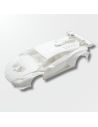
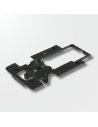
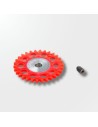
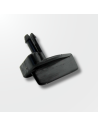
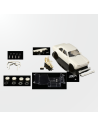
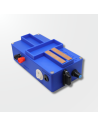
When we talk about preparation in slot racing, there are parts that go unnoticed until something fails or until we start to fine-tune properly. The motor mount is one of them. Without a well-chosen and correctly mounted motor mount, the motor does not transmit the rotation efficiently, the alignment of the rear axle suffers, and the car loses consistency on the track. It doesn't matter whether you are running on a home track or competing in a federated championship: the motor mount is the foundation on which the entire rear transmission system rests.
In this section, you will find motor mounts for the most common systems and formats in the market, with options for different motor configurations (sidewinder, inline or anglewinder) and for the brands and chassis most widespread among enthusiasts. Whether you are building your first competition car or have been preparing slot cars for years and want to fine-tune to the maximum, here you have what you need to do it right.
The spare parts market for slot racing is not always easy to navigate: there is technical terminology, compatibilities that are not always well documented, and differences between parts that at first glance seem identical. Therefore, in addition to the catalogue, we provide real context so you can make informed decisions and not act blindly.
What is a motor mount and why is it important
The motor mount is the structure that houses and secures the motor within the slot car chassis. Its main function is to keep the motor in the correct position so that the pinion meshes precisely with the crown gear of the rear axle. It seems simple, but in practice, it is one of the parts that most influences the overall performance of the car.
A poorly adjusted or incompatible motor mount causes power loss due to unnecessary friction, excessive noise in the gearing, premature wear of both the pinion and the crown gear, and in extreme cases, vibration that affects cornering stability. Conversely, a well-designed and correctly mounted motor mount allows the power from the motor to be transmitted to the axle with minimal mechanical losses, which directly translates into top speed and lap consistency.
In competition cars from brands like NSR, Slot.it, or Scaleauto, the motor mount is part of a very precise transmission system. The level of machining of these parts is not comparable to that of entry-level cars: the tolerances are minimal, the materials are chosen to reduce weight without sacrificing stiffness, and the geometry is designed to optimise the gearing in each available motor configuration.
How to correctly choose a motor mount
Before purchasing a motor mount, you need to have clear answers to three fundamental questions:
- What chassis do you have? The motor mount must be compatible with your car's chassis. Each manufacturer designs their motor mounts for their own chassis, and although there are some more universal parts, it is usual to fine-tune the choice by model.
- What motor are you going to mount? The size and geometry of the motor mount depend on the motor. It is not the same to mount a standard can motor as it is to mount a motor with a larger diameter or length. Always check the motor specifications before choosing the motor mount.
- What motor configuration do you want? Sidewinder, inline, or anglewinder are different configurations that require different motor mounts. A mistake here can result in the motor not fitting or the gearing being misaligned from the start.
In addition to these three points, it is advisable to pay attention to the material of the motor mount. The most common options are high-precision technical plastic and machined aluminium or composite material mounts. Aluminium mounts provide greater stiffness and better heat dissipation generated by the motor, but they are heavier. High-quality technical plastic mounts offer a good balance between weight and precision for most uses.
Finally, check if the motor mount allows for motor position adjustment. Some designs incorporate adjustment systems that facilitate the gearing adjustment (the distance between the pinion and the crown gear), which is especially useful when working with different combinations of pinion and crown gear to fine-tune the gear ratio.
Types and main differences
Motor mounts for slot racing can be classified in several ways. The most relevant from a practical standpoint is by motor configuration:
Motor mounts for sidewinder motors
In the sidewinder configuration, the motor is mounted parallel to the rear axle, that is, transversely to the direction of travel of the car. It is the most common configuration in current competition cars because it allows for balanced weight distribution and reduces the overall length of the transmission system. Sidewinder mounts are by far the most common in the spare parts market.
Motor mounts for inline motors
In the inline configuration, the motor is placed perpendicular to the rear axle, in line with the longitudinal axis of the car. This lowers the centre of gravity compared to other configurations, which can favour stability on certain tracks. Although less frequent in modern competition cars, it still has its followers, and there are brands that offer it as an option.
Motor mounts for anglewinder motors
The anglewinder is an intermediate configuration in which the motor is mounted at an angle to the rear axle. It combines some advantages of both sidewinder and inline, and is common in cars that seek a compromise between compactness and centre of gravity. It requires specific mounts designed for that particular angle.
Motor mounts by brand and chassis
Beyond the motor configuration, motor mounts are also differentiated by the brand they are intended for. NSR, Slot.it, Avant Slot, and Scaleauto have their own chassis designs, and their motor mounts are designed to fit precisely into those specific chassis. Mixing parts from different manufacturers without verifying compatibility is one of the most common sources of problems in the workshop.
Technical aspects we should know
To work well with motor mounts, it is useful to understand some basic technical concepts:
The gearing: pinion and crown gear
The motor mount determines the distance between the motor shaft (where the pinion goes) and the rear axle (where the crown gear goes). If that distance is not correct for the combination of pinion and crown gear you are using, the gearing will operate with too much play (which produces noise and wear) or with too much pressure (which generates friction and heat). A good gearing adjustment is one of the most important steps in preparing any competition slot car.
Lateral play and alignment
The motor mount also influences the lateral play of the motor, that is, how much the motor can move side to side within its housing. Too much play produces inconsistency; too much pressure can generate rubbing. Some motor mounts incorporate fixing or lateral adjustment elements to resolve this precisely.
Materials and stiffness
The stiffness of the motor mount directly affects the consistency of the gearing. A motor mount that flexes under load (for example, during hard braking or high-speed corners) can alter the engagement point and cause erratic behaviour. Therefore, in competition applications, rigid materials are preferred even if they are somewhat heavier.
Compatibility with the track system
Although the motor mount does not interact directly with the track, the motor and transmission configuration can influence the car's behaviour on different systems. Competition-prepared cars are usually optimised for a specific type of track, and the choice of motor mount is part of that overall optimisation.
Practical tips for use, maintenance, and preparation
Here are some tips that we apply ourselves and that make a difference in the day-to-day running of the workshop:
- Check the gearing before each session. Heat, vibrations, and wear can alter the gearing adjustment over time. A couple of seconds checking that the pinion and crown gear mesh correctly can save you a failure during a session.
- Clean the motor mount regularly. Dust from the track, lubricant residue, and wear particles from the gearing accumulate on the motor mount and can affect its operation. Periodic cleaning with the right products keeps the part in optimal condition.
- Do not overtighten the fixing screws. Especially in technical plastic mounts, excessive tightening can deform the motor housing and alter the gearing geometry. Tighten just enough so that the motor has no play but without forcing the material.
- When changing the motor, check the motor mount. A new motor may have slightly different dimensions even within the same family. Always check that the new unit fits correctly before finishing the assembly.
- Keep used motor mounts in good condition. If you change configuration or motor, the old motor mount may still be useful. Store it clean and protected so you don't have to buy a new one if you return to that configuration.
Common mistakes to avoid
In the world of slot racing, there are mistakes that are repeated more often than it seems, even among experienced preparers. These are the most common related to motor mounts:
- Buying a motor mount without verifying compatibility with the chassis. Not all motor mounts from the same manufacturer are interchangeable between different chassis models. Always check the exact reference before purchasing.
- Ignoring the motor configuration. Installing a sidewinder mount on a chassis configured for inline (or vice versa) is an error that may seem obvious but occurs when purchases are made lightly.
- Forcing a motor mount that does not fit well. If the motor mount does not fit easily into the chassis, check if it is the correct part before forcing it. Forcing can damage both the motor mount and the chassis.
- Not adjusting the gearing after installing the motor mount. Installing the motor mount and assuming that the gearing is already correct is a common mistake. The gearing adjustment should always be checked and regulated after assembly.
- Mixing motor mounts and motors of very different qualities. A high-precision motor mount combined with a low-quality motor (or vice versa) rarely yields good results. It is better to build a balanced set across all its components.
Recommendations for beginners and advanced users
If you are just starting
If you are new to the world of slot racing and are building or modifying your first car, it is advisable not to complicate things too much. Choose a motor mount from the same brand as your chassis, verify that it is compatible with the motor you have, and follow the assembly instructions to the letter. Brands like NSR or Slot.it have clear documentation and a well-structured catalogue that makes choosing much easier.
Do not rush to mix parts from different brands until you have more experience and fully understand the implications of each decision. What seems compatible in theory may not be in practice, and resolving those issues requires knowledge and tools that you may not yet have.
If you already have experience
For advanced users, the motor mount is one of the parts with the most room for optimisation. It is worth exploring options for machined aluminium mounts or high-stiffness composite materials, especially if you compete in championships where every hundredth counts. It is also interesting to study the different gearing adjustment options offered by more elaborate mounts, as they allow fine-tuning the transmission for each combination of track and gear ratio.
In competition, many preparers test several motor mount configurations throughout a season to find the optimal point for each circuit. There is no perfect motor mount for everything: some mounts are more suitable for fast tracks with few curves, while others work better on technical circuits with many slow corners. Experimenting with criteria and documenting the results is the best way to evolve.
| Motor configuration |
Motor position |
Main advantage |
Common use |
| Sidewinder |
Parallel to the rear axle (transverse) |
Balanced weight distribution |
GT, Le Mans, rally competition |
| Inline |
Perpendicular to the rear axle (longitudinal) |
Lower centre of gravity |
Formula cars, certain GTs |
| Anglewinder |
At an angle to the rear axle |
Compromise between compactness and CG |
Compact cars, certain sedans |
Frequently asked questions about motor mounts
What is the difference between a sidewinder mount and an anglewinder mount?
In the sidewinder mount, the motor is parallel to the rear axle (transverse position), while in the anglewinder mount, the motor is mounted at an angle to that axle. This implies different chassis geometries and gear positions, so they are not interchangeable.
Can I mount an NSR motor mount on a Slot.it chassis?
In general, no. Each manufacturer designs their motor mounts for their own chassis, and the dimensions of the housings are usually specific. There are some exceptions and adaptations, but as a general rule, it is better to use mounts from the same manufacturer as the chassis.
How do I know if the gearing is well adjusted?
The well-adjusted gearing should turn smoothly, without excessive noise and without noticeable play. A simple test is to turn the rear axle by hand with the motor mounted: it should roll smoothly and without jerks. If there is a "clacking" noise, there is too much play; if there is notable resistance, the gearing is too tight.
Is an aluminium motor mount worth it for recreational use?
For use on a home track or in occasional sessions, a quality technical plastic motor mount is more than sufficient. Aluminium mounts are designed for competition demands where stiffness and thermal dissipation make a real difference.
How often should I check the motor mount?
It depends on usage. In competition cars, a quick check of the gearing before each session is a good practice. A more detailed inspection of the motor mount (play, wear, fixing) can be done every 5-10 sessions or whenever you notice a change in the car's behaviour.
Does the motor mount affect the total weight of the car?
Yes, although the impact is relatively small. In categories with a minimum weight limit, it can be a factor to consider: aluminium mounts are somewhat heavier than technical plastic ones, which can be an advantage if the car is below the minimum regulatory weight.
What happens if the motor mount has too much lateral play?
The motor may move laterally during operation, altering the position of the pinion relative to the crown gear and causing inconsistent gearing. This translates into variable noise, irregular wear, and loss of efficiency in the transmission.
Can I use a mount designed for inline motors with a sidewinder motor?
No: they are incompatible configurations. The motor housing and the position of the gearing are completely different in each type of mount. Trying to mount a motor on a mount designed for another configuration will not work.
Are there universal mounts that work for several brands?
There are some motor mounts from generic spare parts manufacturers designed to be compatible with several chassis, but in practice, the fit is usually less precise than that of a specific mount. For competition, it is always preferable to use the correct mount for each chassis.
Does the motor mount influence the operating temperature of the motor?
Indirectly, yes. A motor mount that holds the motor loosely can cause vibrations that generate additional heat. Additionally, aluminium mounts dissipate heat from the motor better than plastic ones, which can help maintain operating temperature within more stable ranges during long sessions.