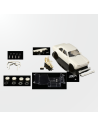
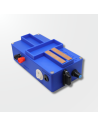
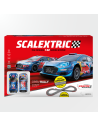
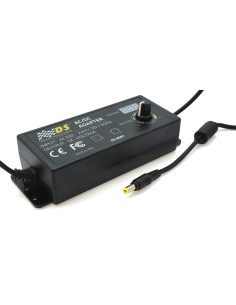
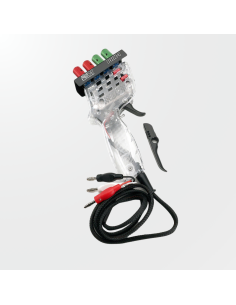
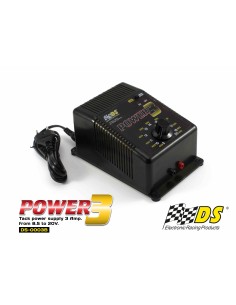
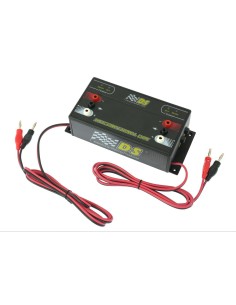
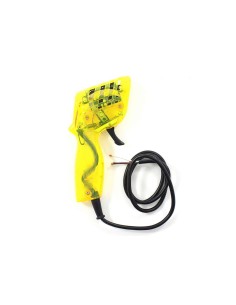
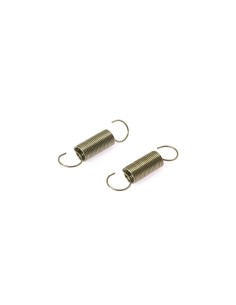
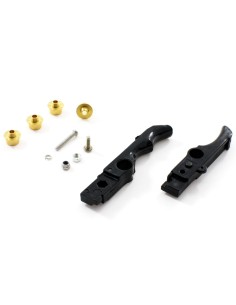
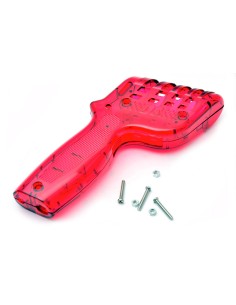
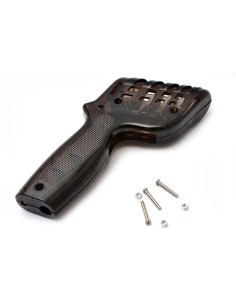
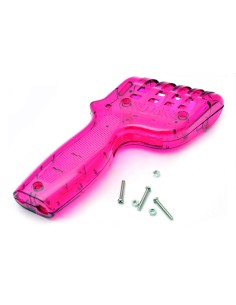
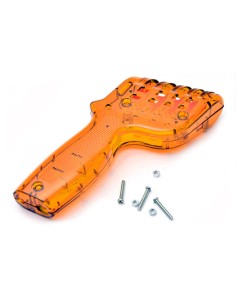
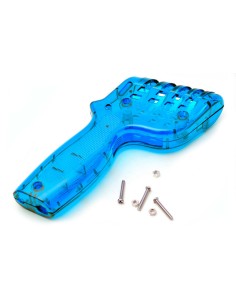
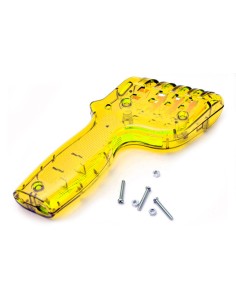
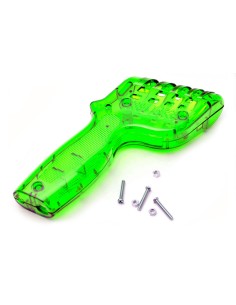
When you have been in the slot world for a while, you know that the car is just one part of the equation. The controller you hold in your hands and the power supply that feeds the circuit are the two electronic factors that most influence the driving experience and are often the most undervalued by newcomers. A controller with a well-calibrated response curve and a stable power supply can make the difference between going off track in every tight corner or running consistently lap after lap. At Ministry of Hobby, we have gathered a selection of controllers and power supplies designed to cater to everyone from the driver setting up their first home circuit to the regular competitor looking to extract the last tenth of a second in their local championship.
The control electronics in slot racing have evolved enormously in recent years. Simple trigger-style analogue controllers have given way to controllers with brake regulation, sensitivity adjustment, interchangeable resistors, and ergonomics designed for long driving sessions. Similarly, power supplies have transitioned from simple transformers to regulated current converters that provide stable voltages even under maximum load, which is critical when you have several cars on track simultaneously. Understanding what each product offers and what use it is designed for is the first step to making the right purchase.
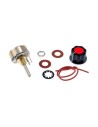
In this section, you will find professional racing controllers for scales 1:32 and 1:24, housings and spare components to maintain or customise your controllers, and power supplies compatible with the main track systems on the market. All with the guarantee of having passed through a technical selection filter: if we wouldn’t recommend it ourselves on track, it’s not in the catalogue.
What are controllers and power supplies in slot racing and why are they so important
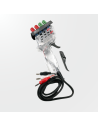
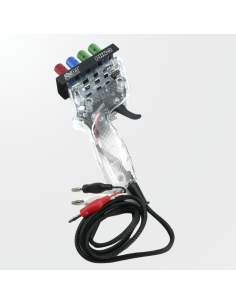
The slot controller —also called a controller or simply control— is the device that the driver uses to regulate the power that reaches the car's motor. The more the trigger is pulled, the more current reaches the motor and the higher the vehicle's speed. It sounds simple, but the quality of that regulation is everything. A good controller not only allows you to accelerate and brake: it enables precise modulation, controls rear slip in corners, doses power on exits, and manages the rheostat brake to slow down the car without locking the wheels.
The power supply, on the other hand, is the energy heart of the system. Its function is to convert the alternating current from the domestic electrical network into direct current at the appropriate voltage for the circuit. Most domestic slot systems operate between 12 V and 18 V in direct current, although in competition, different voltages may be used depending on the category and regulations. A poor-quality power supply that does not maintain stable voltage under load introduces variability in the car's behaviour: what seems like a lack of skill from the driver is sometimes simply unstable electronics.
Both elements work together. A competition controller connected to a power supply that drops voltage as soon as the car accelerates fully is of no use. And vice versa: an excellent power supply connected to a controller with worn resistance or excessive trigger play wastes all its potential. That’s why the most experienced enthusiasts always evaluate these two components as a system, not in isolation.
How to correctly choose controllers and power supplies
The choice mainly depends on three factors: the type of use, the track system, and the driver's level of demand.
Type of use: domestic or competition
For domestic use and occasional sessions, a controller with standard carbon resistance and a power supply between 14 V and 16 V is usually more than sufficient. Ergonomics matter, but they are not critical if the sessions are short. In contrast, for competition or long sessions, the ergonomics of the controller become fundamental: grip, trigger travel, trigger point, and total weight influence driver fatigue and consistency of lap times.
Compatibility with the track system
Slot controllers connect to the track system via a specific connector. Most domestic circuits —Scalextric, Ninco, Carrera— use standard connectors, but in club or competition environments, it is common to find systems with different connectors or even controllers with banana plugs. Before purchasing, check the type of connector you need or if the controller includes adapters.
Power of the supply
The necessary power depends on the number of lanes in simultaneous use and the cars that will be running. A circuit with two competition cars can demand considerable current peaks. As a general rule, a supply of 3 A per lane is a reasonable starting point, although in cars with high-power motors, it is advisable to scale that figure. The output voltage must be stable: a variation of just 0.5 V under load can be noticeable in the car's behaviour.
Level of adjustment of the controller
Entry-level controllers usually do not offer adjustments: the resistance they come with is what it is. Competition models, on the other hand, allow you to adjust the sensitivity of the trigger, replace the resistance with one of a different ohmic value depending on the motor used, and modify the rheostat brake. If you compete in championships with restricted motor regulations, ensure that the controller you choose is compatible with the resistance values specified by the regulations.
Main types and differences
Controllers by type of resistance
The resistance is the key element of the analogue controller. It determines how much current passes to the motor at each position of the trigger. There are several types:
- Carbon resistance (carbon track): the most widespread in mid and high range. It offers a smooth and progressive response curve, with good durability. It is the standard in competition.
- Wire wound resistance: more common in budget or entry-level controllers. The response may be less linear and wear tends to be faster.
- Electronic controllers (digital): in digital track systems —such as Scalextric Digital or Carrera Digital— the controller sends digital signals to the car's decoder. Modulation is managed electronically, opening possibilities such as driving multiple cars on the same lane.
Controllers by ergonomics and format
- Pistol controllers: the classic format. The hand wraps around the body of the controller and the index finger operates the trigger. They are the most common in competition.
- Lever or slider controllers: less frequent, used by some veteran drivers who prefer to control with their thumb.
- Ergonomic competition controllers: bodies designed to reduce fatigue, with non-slip surfaces, adjustable travel triggers, and reinforced wiring.
Power supplies
- Linear transformers: robust, silent, and with good voltage stability. Bulkier and heavier, but very reliable in the long term.
- Switching power supplies: more compact and lighter. They offer good voltage regulation and are the most common option today for domestic and club use.
- Adjustable power supplies: allow you to adjust the output voltage. Useful when you want to adapt the circuit's power to different categories or motors.
Technical aspects we should know
The resistance of the controller and its relation to the motor
Each slot motor has an internal resistance and a characteristic torque curve. The resistance of the controller acts as a current limiter: the higher its value in ohms, the smoother and more controllable the response is, but also the slower the maximum acceleration. In competition categories with high-torque motors, lower value resistances are often used to take full advantage of the power. In slower categories or with stock motors, a higher resistance gives the driver greater control.
Voltage and amperage: what each means
Voltage (volts) determines the potential speed of the car on track. Amperage (amperes) determines the power supply's ability to deliver current without degrading that voltage. A power supply that "drops" voltage under load —that is, that falls below its nominal volts when the motor demands a lot of current— introduces inconsistency in behaviour. Always look for power supplies with good load regulation.
The rheostat brake
Many competition controllers incorporate a brake rheostat independent of the trigger. This brake acts when the driver completely releases the trigger, partially short-circuiting the motor and generating a resistance to movement that simulates engine braking. Correctly adjusting the brake level is one of the most important skills in a slot driver's setup: too much brake and the car destabilises when releasing the throttle; too little and the car does not slow down enough before the corner.
Connectors and compatibilities
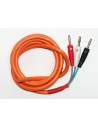
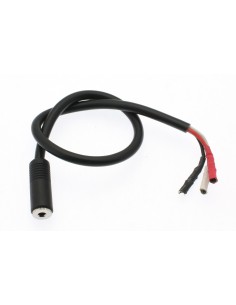
In the domestic world, the most common connectors are the 3.5 mm jack (headphone type) and the DIN connector. In club competition, the use of 4 mm banana plugs is common, allowing for a more robust connection that is less likely to loosen during the race. Always check what type of connector your circuit uses before acquiring a controller.
Practical tips for use, maintenance, and preparation
Maintenance of the controller
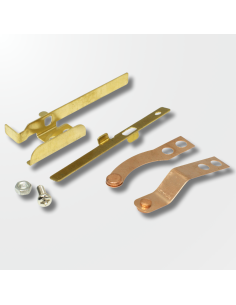
The carbon resistance of a competition controller is a consumable item. With use, the carbon track wears out and the response curve changes. It is advisable to visually inspect the resistance every certain number of hours of use and replace it when irregular wear, response jumps, or dead zones in the trigger travel are observed. Many competition controllers are designed to facilitate this change without special tools.
The trigger and its axis also need periodic attention. A minimal lubrication point with dry grease or PTFE on the trigger pivot keeps the travel smooth and prevents lateral play that can introduce inaccuracies.
Adjusting sensitivity
If your controller allows it, experiment with different positions of the response curve adjustment screw. A very sensitive trigger in the first part of the travel can make the car difficult to handle in slow corners. A more progressive trigger, with power concentrated in the second half of the travel, usually provides more control on technical circuits.
Protection of the power supply
Avoid leaving the power supply connected to the mains when the circuit is not in use. Switching power supplies handle on and off cycles well, but keeping them unnecessarily powered accumulates operating hours. Also, ensure that the supply has short-circuit protection: in slot racing, derailments and cars going off track can generate momentary short circuits that, without protection, could damage the supply.
Cables and connections
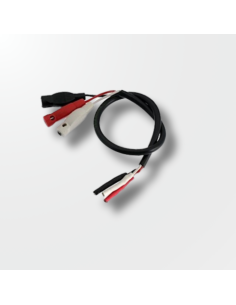
Periodically check the condition of the controller's cable, especially at the connector area and at the exit from the body of the controller, which are the points of greatest mechanical stress. A damaged cable can introduce parasitic resistances that degrade the response or cause intermittent contact losses, which can be very frustrating and difficult to diagnose in competition.
Common mistakes we should avoid
- Buying the most powerful controller without considering the system: a high-end competition controller connected to a beginner circuit will not deliver the expected improvement if the power supply or the wiring of the circuit itself is the bottleneck.
- Ignoring the resistance value relative to the motor: using a resistance that is too low with very powerful motors can result in impossible control for a driver with little experience. The appropriate resistance depends on the motor, not just the controller.
- Not checking the connector before buying: there are several connector standards on the market. An incompatible controller may require adapters that introduce contact losses or may simply not be possible to connect without modifying the wiring.
- Underestimating the importance of the power supply: many enthusiasts invest in high-end cars and controllers but neglect the power supply. An unstable supply can ruin the performance of the best car in the pack.
- Not adjusting the brake to the type of circuit: the optimal brake level varies depending on the layout. A very technical circuit with many slow corners requires a different brake adjustment than a high-speed oval. Spending time on brake setup before each session is good practice.
- Leaving the worn resistance because of not knowing how to change it: changing the resistance of a competition controller is simple and the replacements are inexpensive. There is no reason to continue competing with a worn resistance that penalises the response.
Recommendations for beginners and advanced users
If you are just starting
The priority is to familiarise yourself with the response curve of the controller before worrying about fine adjustments. A mid-range controller with carbon resistance and comfortable ergonomics is sufficient to learn to modulate acceleration and braking. Avoid controllers with very low resistance until you have enough experience to handle the sensitivity they imply. As for the power supply, a regulated unit between 14 V and 16 V with short-circuit protection is more than enough to start.
A practical tip: do not set the rheostat brake to maximum from the beginning. Start with a moderate brake level and gradually increase it as you learn to anticipate braking points on your circuit.
If you already have experience
At this level, the details make the difference. Experiment with different resistance values depending on your category's motor. Record the adjustments you use on each circuit —brake level, sensitivity screw position— so you can replicate them. Consider investing in an adjustable power supply if you compete in several categories with different voltages.
For club or federated competition, a controller with an ergonomic body, quality carbon resistance, adjustable travel trigger, and good gauge wire is the minimum standard. Ergonomics are not a luxury: in two-hour race sessions, the fatigue in the hand holding the controller directly influences the consistency of lap times.
| Type of controller |
Typical resistance |
Level of adjustment |
Recommended profile |
| Beginner / domestic |
Basic wire or carbon |
No adjustments |
Beginners, occasional use |
| Mid-range |
Standard carbon |
Adjustable brake |
Regular enthusiasts, club |
| Competition |
High-quality, interchangeable carbon |
Brake + sensitivity + interchangeable resistance |
Competitors, championships |
| Digital |
Digital electronics |
Depends on the system |
Scalextric, Carrera digital circuits |
Frequently asked questions
Which controller is compatible with my Scalextric circuit?
Scalextric Sport circuits use a standard 3.5 mm jack connector. Most competition controllers on the market are directly compatible or include an adapter. Always check the type of connector before buying.
Can I use my Scalextric circuit controller on a Carrera circuit?
The systems have different connectors. Scalextric uses a 3.5 mm jack and Carrera uses its own system. Adapters exist, but electrical compatibility must also be checked. It is safest to consult before connecting.
How many amperes does my power supply need?
As a general reference, count on at least 3 A per active lane. If the cars you are going to use have high-power motors, scale that figure. For two-lane circuits with standard competition cars, a 5-6 A supply is usually sufficient.
What voltage should I use on my circuit?
Most domestic and club circuits operate between 12 V and 18 V in direct current. Check your category's regulations if you compete: many championships specify the maximum allowed voltage.
When should I change the resistance of my controller?
When you notice dead zones in the trigger travel, irregular response, or behaviour differences that cannot be explained by the car. A visual inspection can also reveal wear on the carbon track.
Does the rheostat brake damage the motor?
Well adjusted, no. The rheostat brake simply partially short-circuits the motor when the trigger is released, generating a braking force. The problem arises when excessive brake levels are used for long periods: it can generate additional heat in the motor. With a reasonable adjustment, it poses no problem.
Is a linear or switching power supply better?
Both have their virtues. Linear supplies are quieter and very stable, but bulkier and heavier. Switching supplies are more compact and efficient. For most slot uses, a good switching supply with load regulation is more than sufficient.
Can I use a computer power supply for my circuit?
Technically it is possible, as they offer 12 V outputs with good amperage, but they are not designed for that use and do not have the appropriate connectors. They require adaptations and do not always regulate well under variable loads. It is preferable to use a power supply specifically designed for slot racing.
Do competition controllers work for scale 1:24?
Yes, as long as the connector is compatible with the 1:24 track system you use. The main difference is that 1:24 motors usually demand more current, so it may be necessary to use lower value resistances in the controller.
What happens if I connect a controller with higher resistance than recommended?
The car will lose maximum power but gain controllability. It is not harmful to the motor; it simply limits the maximum current it can receive. In restricted competition categories, this can even be a tactical advantage if the circuit is technical.
Is it worth investing in a competition controller if I only race at home?
If you enjoy the hobby regularly and want to improve your control on track, yes. The difference in response between a beginner controller and a competition one is noticeable from the first lap. It is not an expense exclusive to competitors: it is a real improvement in the driving experience.
How do I know if my power supply is failing?
The most common symptoms are: the car loses speed under load even though the power supply is on, the voltage measured on the rails drops significantly from the nominal, or the power supply shuts down due to protection against current spikes. A multimeter is the basic tool for diagnosing these problems.