When we have been in the slot world for a while, we come to an inevitable conclusion: the car matters, the tyres matter, the track matters… but the control in your hands is the starting point of everything. A poorly chosen transmitter limits the driver even before the car completes the first corner. And a well-chosen one, calibrated to your liking, makes a real difference on the clock and in the enjoyment of each session.
Slot transmitters have evolved enormously in recent decades. We have moved from simple resistors with triggers to digital systems with telemetry, customisable driver profiles, adjustable braking, and bidirectional communication with the controller. But this evolution has also generated legitimate doubts: what technology do I really need? Is it compatible with my track? Is it worth investing in a competition transmitter if I race in a local league? In this category, we help you answer those questions rigorously.
Whether you have just set up your first oval at home or have been competing in federated championships for years, you will find transmitters here adapted to your level. From analogue controllers with clean response and solid construction to programmable digital units with multiple profiles, including ergonomic trigger or lever options, the catalogue covers all the needs of the modern driver.
Throughout this guide, we review what differentiates one transmitter from another, what technical aspects condition compatibility and performance, and how to get the most out of your controller from day one. If you already know what you are looking for, go ahead with the catalogue. If you have doubts, keep reading.
What is a slot transmitter and why does it matter so much
In the context of slot racing, the term transmitter refers to the control unit that the driver uses to regulate the speed of the car. In traditional analogue systems, the transmitter acts as a rheostat or potentiometer that varies the current delivered to the car through the track. In digital systems, the transmitter sends coded signals to the controller, which translates them into instructions for the decoder installed in the car.
Although in colloquial language the terms controller, transmitter, and remote are used interchangeably, in the more technical realm —especially in competition— the term transmitter is used to refer to the more precise controls, with their own electronics and advanced adjustments. This distinction is useful for understanding the range of prices and features available in the market.
The importance of the transmitter is directly proportional to the level of involvement of the driver. For domestic and occasional use, a mid-range controller works perfectly. For competition, where tenths of a second separate positions and fatigue in a two-hour session is real, ergonomics, trigger progression, and electronic stability make the difference between winning and being left behind.
How to correctly choose a transmitter
The first criterion we must be clear about is compatibility with the controller. Not all transmitters work with all systems. Before buying, it is advisable to identify:
- Whether your track is analogue or digital.
- What brand and model of controller you are using (Scalextric Sport, Carrera Digital 132, Ninco, SCX Digital, etc.).
- Whether the transmitter you are interested in works with that signal standard or requires adapters.
In analogue systems, compatibility is generally simpler: most transmitters connect via a standard 3.5 mm jack or universal connection terminals. In digital systems, things get complicated because each manufacturer tends to use its own protocol.
The second criterion is ergonomics. Slot transmitters come in two main formats: trigger (gun) and lever. Trigger transmitters are the most widespread and are intuitive for those coming from real motorsport or driving video games. Lever transmitters have a tradition in certain competition circuits and offer very fine control with the tip of the finger. Both have their passionate defenders; the best thing is to try both before deciding.
The third factor is internal resistance or electronics. The most basic transmitters use a wound or carbon resistor. Competition transmitters incorporate electronic circuits that allow adjusting the minimum power delivered (braking), the response curve, and the sensitivity of the trigger. These adjustments are key to adapting the controller to the demands of each car and each track.
Main types and differences
Analogue transmitters
These are the simplest and most commonly used in home circuits. They work by varying the electrical resistance that reaches the car through the track. Within this group, there are notable differences:
- Fixed resistance transmitters: the most economical, sufficient for occasional use. Little customisation.
- Transmitters with adjustable braking: allow you to regulate how much brake current reaches the motor when releasing the trigger. Very useful for adapting behaviour in corners.
- Analogue electronic transmitters: incorporate their own circuitry for a more linear and progressive response. They are the preferred option in serious analogue competition.
Digital transmitters
Designed to work with digital controllers, these transmitters send signals to the system to identify and control cars individually on the same track. They allow, depending on the system, advanced functions such as lane changing, maximum speed adjustment per driver, or basic telemetry. They require strict compatibility with the controller.
Wireless transmitters
Some systems —especially in club installations and permanent tracks— use transmitters with infrared or radio frequency communication, eliminating the physical cable between driver and controller. They provide freedom of movement but require specific infrastructure and are less common in domestic use.
Technical aspects we should know
Beyond format and compatibility, there are a series of technical concepts that every enthusiast should understand before buying or adjusting a transmitter:
Trigger response curve
The response curve defines how the power delivered to the car varies as we pull the trigger. A linear curve offers constant progression; an exponential curve accumulates power at the end of the travel. Electronic transmitters allow modifying this curve according to the driver's preferences or the demands of the track.
Minimum and maximum adjustment
The minimum adjustment (or brake) determines how much current passes to the motor when the trigger is at rest. A high minimum produces active braking when released; a low minimum allows the car to roll more freely. The maximum adjustment limits the total power delivered, useful for very fast cars on technical tracks or to level forces in a competition between cars of different power.
Internal resistance
In analogue transmitters, the internal resistance (measured in ohms) conditions the available power. A resistance that is too high can deprive the car of power; too low can generate harmful current spikes. Competition circuits usually specify homologated resistance ranges to equalise conditions.
Cable and length
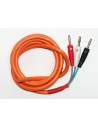
In large circuits or with fixed driving positions, the length of the cable can be limiting. Many transmitters offer interchangeable cables or extensions. In competition, a quality cable that does not introduce signal loss or parasitic resistance is always sought.
Practical tips for use, maintenance, and preparation
A well-maintained transmitter lasts for years without problems. Some simple habits make a difference:
- Clean the contacts regularly. Dirt and oxidation on the jack or connection terminals degrade the signal. A little electrical contact cleaner does the job.
- Check the cable periodically. The points of greatest tension are the input to the transmitter and the input to the controller. A frayed or micro-cracked cable generates response losses that can be confused with car problems.
- Calibrate the braking adjustment according to the track. What works on a fast oval may not work on a technical layout with tight chicanes. Spend a few minutes at the start of each session adjusting this parameter.
- Protect the trigger from impacts. The trigger mechanism is the most mechanically delicate point. Avoid leaving the transmitter on surfaces where it can fall or receive lateral pressure on the trigger.
- Store the transmitter in its case or pouch. Dust and moisture are the enemies of electronics. If you are not going to use the transmitter for weeks, store it protected.
Common mistakes to avoid
Buying without checking compatibility
This is the most common mistake. Before acquiring any transmitter, check that it is compatible with your controller and your track system. Mixing components from incompatible systems (Scalextric, Carrera, Scaleauto, Ninco) without informing yourself can result in the transmitter not working at all or damaging the system.
Ignoring ergonomics
A technically perfect transmitter but uncomfortable in the hand hinders performance in long sessions. If you have the opportunity to try before buying —in a club, at a fair— don’t miss it.
Always setting the braking to maximum
Many people believe that more braking is always better. In reality, excessive braking can destabilise the car on corner entry or cause spins if the rear end locks up abruptly. The correct adjustment is one that allows the car to slow down smoothly, not one that stops it dead.
Neglecting the cable
The cable is the most sacrificed part of any transmitter. Pulling it any old way, wrapping it tightly, or stepping on it generates internal breaks that are not always visible. Wrap it loosely and avoid sharp bends.
Not trying different adjustments according to the car
The same transmitter may need different configurations depending on the car's motor we are using. A fast inline motor requires more smoothness in the response curve than a competition anglewinder motor with all its power available from the start. Experiment.
Recommendations for beginners and advanced users
If you are starting now
For a driver new to slot racing, the most sensible option is to choose a mid-high quality analogue transmitter, with adjustable braking and ergonomic construction. There is no need to spend on advanced electronics when you are still learning to read the braking points of the track and manage power in corners. A solid and simple transmitter will give you the feedback you need to progress without technical distractions.
If your track is digital from the start, make sure that the transmitter you buy is the official one or homologated for that controller. In this case, the initial investment is somewhat higher, but it saves you from incompatibilities from day one.
If you already have experience
The experienced driver knows what they are looking for: progression, durability, fine adjustment capability, and a response that feels the same in the tenth session as in the first. At this level, it makes sense to explore electronic transmitters with programmable response curves, independent minimum and maximum adjustments, and construction designed for intensive use in competition.
If you compete in a league, inform yourself about the regulations of your championship regarding homologated transmitters. Some championships regulate the type of controller allowed to ensure equal conditions.
| Type of transmitter |
Recommended use |
Adjustments |
Compatibility |
| Basic analogue |
Domestic / beginner |
None or fixed braking |
Universal analogue |
| Analogue with adjustable braking |
Advanced domestic / club |
Adjustable braking |
Universal analogue |
| Analogue electronics |
Analogue competition |
Curve, minimum, maximum |
Universal analogue |
| Digital |
Digital circuits |
Variable by system |
Specific by controller |
| Wireless |
Club installations |
Variable |
Specific by system |
Frequently asked questions about slot transmitters
Does an analogue transmitter work on a digital track?
Generally, not directly. Digital systems need transmitters that communicate with the controller in a specific way. Some systems offer analogue compatibility modes, but this is not the norm. Always check the specifications of your controller before buying.
What is the real difference between a €20 transmitter and a €100 transmitter?
The difference lies in the quality of the components, ergonomics, the possibility of fine adjustment, and durability. For occasional domestic use, a basic transmitter may be sufficient. For competition or intensive use, the investment in a higher-end transmitter is noticeable in performance and product lifespan.
Can I use the same transmitter for cars from different brands?
Yes, as long as the system is compatible. In analogue tracks, a good transmitter works with any car regardless of its brand. What changes are the optimal adjustments according to the motor and chassis of each model.
Is the trigger format better or the lever format?
It depends on the driver. The trigger is more intuitive for most; the lever offers very precise control with the index finger. Many experienced competitors prefer the lever for the finer dosage feel, especially on technical layouts. If you can, try both.
What is the braking adjustment and how does it affect the car?
The braking adjustment controls the current that the motor receives when releasing the trigger. With high braking, the motor acts as an active brake when acceleration stops. With low or no braking, the car rolls freely. The optimal point depends on the track, the car, and each driver's driving style.
Can I repair a transmitter if it stops responding well?
In many cases, yes. The most common problems are dirty contacts, damaged cable, or worn potentiometer. The first two have simple solutions; the third requires soldering a new component, which is affordable if you have minimal experience with electronics. In high-end transmitters, manufacturers usually offer spare parts and technical service.
Is there any homologation standard for competition?
It depends on the championship and the organising club. Some championships regulate the minimum resistance of the controller to equalise conditions; others are completely free. Inform yourself with the specific regulations of your league before investing in a competition transmitter.
Does the length of the cable affect performance?
In theory, a longer cable introduces more parasitic resistance. In practice, with quality cables and usual lengths (2-4 metres), the difference is negligible. Where it is noticeable is with low-quality cables or in conditions of sustained high power.
What should I do if the trigger has play or the response is irregular?
First, check the contacts and the cable. If the problem persists, open the transmitter and check for dirt on the potentiometer or if any component is loose. Often, a cleaning with contact spray resolves response irregularities without the need for further intervention.
Do wireless transmitters have perceptible latency?
Modern infrared and radio frequency systems have latencies so low that they are not perceptible under normal playing conditions. In high-level competition, some drivers still prefer the cable for the certainty of instant response, but this is more of a psychological issue than a technical one in current systems.
Can I connect any transmitter to the controller that comes in starter sets?
In analogue starter sets, most transmitters with the appropriate connector are compatible. If the set includes a digital controller, you will need to use transmitters designed for that system. Check the type of connector and the protocol of the controller before buying a third-party transmitter.
Is it worth customising or tuning a transmitter?
For domestic use, it is usually not necessary. For competition, small modifications such as replacing the potentiometer with a higher quality one, improving the cable, or adjusting ergonomics with additional grip can make a difference in long sessions. It is an exciting area for those who enjoy both the workshop and the track.