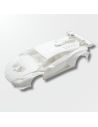
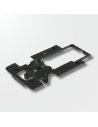
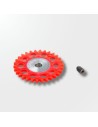
The motor is the heart of any slot car, but without the right accessories surrounding it, that power does not reach the track cleanly. Crown gears, pinions, motor mounts, supports, spur gears, adapters… each of these components has a specific role in transmitting energy from the motor to the rear wheels. Choosing them correctly is what separates a car that runs well from one that truly competes.
In the world of slot racing, mechanical preparation is as exciting as driving. Many enthusiasts discover that adjusting the gear ratio, changing the motor position, or experimenting with different materials in the crown can completely transform the car's behaviour. We are not just talking about going faster: we are talking about fine-tuning cornering response, improving acceleration traction, and reducing wear in the medium term.
This category is designed for both those starting to prepare their first car and the experienced driver looking for that fine adjustment before a race. Here you will find motor accessories compatible with the most established brands in the market: NSR, Slot.it, Avant Slot, Scaleauto… each with its standards and particularities, which are worth knowing before purchasing.
If you have just discovered the world of slot preparation, don’t worry: the learning curve is part of the hobby. And if you have been in the paddock for years, you will appreciate a catalogue with real depth, quality parts, and references that do not run out in two days. Let’s get into the details.
What are motor accessories and why do they make a difference
When we talk about motor accessories in slot racing, we refer to all the components that work alongside the motor to ensure the transmission functions correctly. The motor generates movement, but it needs a well-adjusted gear, a mount that holds it in the correct position, and a transmission system that delivers that energy to the tyres without unnecessary losses.
The main motor accessories include:
- Crown gears: the gear mounted on the rear axle that receives movement from the motor pinion. The number of teeth and the material determine the gear ratio and durability.
- Pinions: the small gear that is directly coupled to the motor shaft. Together with the crown, it defines the transmission ratio.
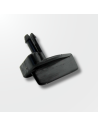
- Motor mounts and supports: the pieces that fix the motor to the chassis and determine its position (sidewinder, inline, or anglewinder). They are essential for gear centring and mechanical stability.
- Adapters and spacers: precision parts that allow adjustment of the spacing between gears or adaptation of components from different brands.
- Plates and tubs: chassis elements that work together with the mount to house the power unit.
Each of these components influences the car's behaviour: acceleration, top speed, smoothness of operation, heat generated, and wear. Paying attention to this part of the car is, in many cases, more cost-effective than changing the motor.
How to correctly choose motor accessories
The first criterion is compatibility. Before buying any pinion, crown, or mount, you need to know what motor your car uses and what transmission system it employs. Not all pinions are interchangeable: they depend on the diameter of the motor shaft, the gear module, and the type of fixation.
The module is one of the most important concepts. It defines the size of the gear teeth. The most common in 1/32 slot racing are module 0.5 and module 0.6. Mixing crowns and pinions of different modules is a mistake that can damage both parts. Always check that the pinion and crown share the same module.
The second criterion is the transmission ratio, that is, the relationship between the number of teeth on the pinion and the number of teeth on the crown. A longer ratio (more teeth on the crown compared to the pinion) provides more top speed but less acceleration. A shorter ratio does the opposite. The circuit you will be racing on, the length of the straights, and the number of curves are the factors that determine which ratio suits you.
The material also matters. Engineering plastic crowns and pinions are lightweight and quiet, ideal for home driving or entertainment circuits. Metal parts —steel, aluminium, brass— are more durable and precise, but add weight and can be more demanding in terms of adjustment. Brands like NSR or Slot.it offer extensive ranges in different materials for you to choose from based on your context.
Finally, consider the motor position. In a sidewinder setup, the motor is parallel to the rear axle; in inline, it is perpendicular, in line with the car, which lowers the centre of gravity; in anglewinder, it is at an intermediate angle. Each configuration requires a specific mount and conditions the available space in the chassis.
Main types and differences
Crown gears
Crown gears are primarily classified by the number of teeth, module, and material. The most common in 1/32 range from 27 to 40 teeth. A 32-tooth crown combined with an 11-tooth pinion offers a ratio of 2.9:1, common in balanced configurations for mixed circuits. NSR stands out for its range of ultra-light crown gears in technical plastic, while Slot.it offers aluminium versions for greater precision and durability.
Pinions
Pinions typically range from 8 to 14 teeth in 1/32. They are fixed to the motor shaft by pressure or screw. It is essential that the fit is firm: a slipping pinion or one with too much play generates premature wear and energy loss. Some manufacturers include pinions of different materials in the same kit to facilitate experimentation.
Fixed and floating mounts
There are fixed mounts and floating mounts. Floating mounts allow a small movement of the power unit, which helps the gear self-adjust and reduces noise. They are especially useful in competition cars where the mounting precision is not always perfect. Fixed mounts offer greater rigidity and are preferred when the chassis is already perfectly aligned.
Adapters and spacers
Small but essential. They allow the mounting of components from different brands, adjust the lateral spacing of the motor, or correct the alignment of the gear. In advanced setups, using precision spacers to the tenth can make a difference in noise and smoothness of operation.
Technical aspects we need to know
One of the most overlooked concepts by beginners is backlash, that is, the play between the teeth of the pinion and the crown. Excessive backlash generates noise, wear, and loss of efficiency. Insufficient backlash produces friction, heat, and can lock the assembly. The correct adjustment is one in which the gear turns smoothly, with no noticeable play but without resistance.
To check it, the simplest technique is to manually turn the motor with the car in hand: the movement should be smooth, without jerks or hard spots. If you notice irregularities, check the alignment of the mount and the lateral position of the pinion on the shaft.
Another relevant technical aspect is the alignment of the motor shaft with respect to the rear axle. If both shafts are not parallel (in sidewinder) or perpendicular (in inline), wear will be uneven and the transmission will lose efficiency. Well-manufactured mounts facilitate this alignment, but it is always advisable to verify it with the car assembled.
Heat is the great enemy of gears and mounts. In long sessions or with demanding ratios, the power unit can heat up significantly. Proper lubrication and the use of suitable materials help control temperature and prolong the life of the components.
Practical tips for use, maintenance, and preparation
- Lubricate regularly: apply a minimal amount of specific slot gear lubricant to the crown and pinion. Too much lubricant accumulates dirt; too little generates wear. A small drop every few sessions is usually sufficient.
- Check the pinion adjustment: periodically check that the pinion has not shifted laterally on the motor shaft. A mispositioned pinion can come out of the gear during a race.
- Visual inspection of the teeth: with a magnifying glass or mobile camera, observe the condition of the crown and pinion teeth after several sessions. Asymmetrical wear indicates an alignment problem; homogeneous wear simply indicates the normal life cycle of the component.
- Keep records of your configurations: note the ratios you use on each circuit and the results you obtain. Over time, you will have a history that allows you to make quick decisions without starting from scratch each time.
- Clean the mount when changing the motor: taking advantage of a motor change to clean the mount and check its condition is a good practice that many overlook and that prevents future problems.
Common mistakes to avoid
Mixing different modules is the most common mistake among beginners. Buying a crown of module 0.5 and a pinion of module 0.6 (or vice versa) means that the teeth do not fit correctly, generating instant wear. Always use the same module for pinion and crown.
Ignoring the compatibility of the mount with the motor. Not all mounts accept all motors. The diameter of the motor casing and the fixation system vary between manufacturers. Before buying a mount, confirm that it is compatible with your specific motor.
Over-tightening the pinion screw. In pinions with a set screw, over-tightening can deform the motor shaft or damage the pinion. Tighten just enough to prevent slipping, without forcing.
Not checking the backlash after assembly. Assembling a new car and going to the track without checking the gear is risky. Take two minutes to manually turn the assembly and confirm that everything works correctly before plugging it in.
Using the same accessories on all circuits without adjusting the ratio. A ratio valid for a high-speed oval can be counterproductive on a technical circuit with many slow curves. Learn to vary and experiment.
Recommendations for beginners and advanced users
If you are starting out
The most sensible approach is to start with the accessories recommended by the car manufacturer. If you have an NSR, use NSR crown and pinion; if you have a Slot.it, start with the transmission that comes from the factory or with the references that Slot.it recommends in its catalogue. Once you have a clear understanding of the car's base behaviour, start experimenting by changing only one variable at a time: first the ratio, then the material of the crown, and then the mount.
Do not try to prepare the entire car at once. Progressive preparation teaches you more and allows you to understand what has changed and why.
If you already have experience
At advanced levels, the choice of motor accessories becomes a race strategy tool. Adjusting the ratio for each track, combining crown and pinion materials based on the expected temperature in the room, or experimenting with floating mounts in cars that normally use fixed ones… are decisions that make a difference in real competition.
Brands like NSR, Slot.it, Avant Slot, and Scaleauto offer technical catalogues with which you can build very specific configurations. It is worth knowing them in detail and not limiting yourself to the standard setup.
| Component |
Key variable |
Main effect |
Reference brands |
| Crown gear |
Number of teeth / material |
Transmission ratio, durability, weight |
NSR, Slot.it, Scaleauto |
| Pinion |
Number of teeth / module |
Transmission ratio, acceleration response |
NSR, Slot.it, Avant Slot |
| Fixed mount |
Compatibility with motor and chassis |
Rigidity, precise alignment |
NSR, Slot.it, Scaleauto |
| Floating mount |
Degree of movement allowed |
Self-adjustment of the gear, noise reduction |
NSR, Avant Slot |
| Adapters / spacers |
Thickness / material |
Lateral alignment of the gear |
NSR, Slot.it |
Frequently asked questions
What module do I need for my slot car?
The most common modules in 1/32 are 0.5 and 0.6. Check the specifications from your car manufacturer or the motor you are using. The most important thing is that the pinion and crown share the same module.
Can I use motor accessories from one brand on a car from another?
Yes, as long as the module matches and the diameter of the motor shaft is compatible with the pinion. In the case of mounts, compatibility also depends on the chassis. Check the technical sheets before purchasing.
What is the difference between a fixed and floating mount?
The fixed mount holds the motor rigidly: it requires very precise assembly but offers maximum consistency. The floating mount allows a small movement of the motor, which facilitates the self-adjustment of the gear and reduces noise, at the cost of some rigidity.
How does the transmission ratio affect the car's behaviour?
A longer ratio (crown with more teeth) favours top speed but reduces acceleration. A shorter ratio improves corner exit and acceleration but limits maximum speed on the straight. The circuit and your driving style determine the optimal ratio.
How often should I lubricate the gear?
It depends on usage, but as a general reference, a small application of lubricant every 3-5 race sessions is usually sufficient. Always use specific slot gear lubricant: generic lubricants can damage technical plastics.
Does the material of the crown significantly influence performance?
Yes. Technical plastic crowns are lighter and quieter, ideal for recreational use. Metal ones —aluminium, brass, steel— last longer and transmit energy better, but add rotational inertia. In competition, the choice depends on the regulations and usage conditions.
Can I mount a sidewinder motor in a chassis designed for inline?
No, not directly. The motor position (sidewinder, inline, anglewinder) determines the chassis design and the mount. Changing the motor configuration usually requires a different chassis or significant modifications.
What should I do if the gear makes a lot of noise after assembly?
First, check the backlash: it may be too tight or too loose. Second, verify that the pinion and crown are of the same module. Third, ensure that the mount is correctly aligned. A small lateral adjustment of the pinion on the motor shaft usually resolves most noise issues.
Are NSR crowns and pinions compatible with Slot.it cars?
In many cases yes, as long as the module matches. However, mounts and supports are usually brand-specific. Check the specific references before making the combination.
What ratio do you recommend for beginners?
For a first car on a mixed circuit, a ratio between 2.7:1 and 3.2:1 is usually balanced and easy to control. From there, experiment by increasing or decreasing based on the track and the motor you use.
Is it necessary to change the pinion when changing the motor?
Not always, but it is advisable to check that the new motor has the same shaft diameter and that the existing pinion shows no wear. If the pinion has been used for many hours, taking advantage of the motor change to renew it is a good practice.
Where will I notice the most difference when improving motor accessories?
The most noticeable improvement is usually in the smoothness of operation, the noise of the car, and the consistency from lap to lap. In competition, also in the stability of lap times over a long session.