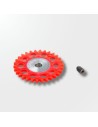
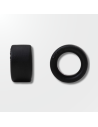
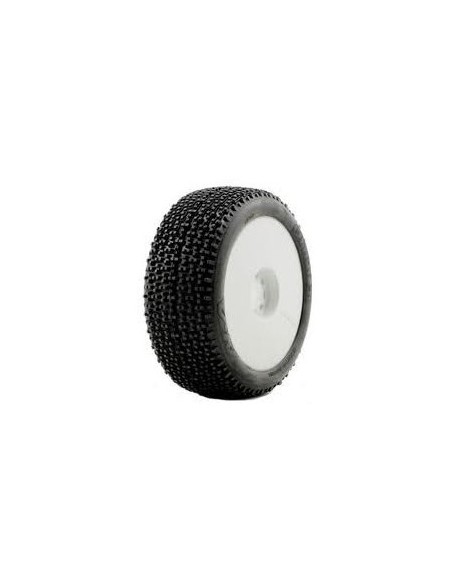
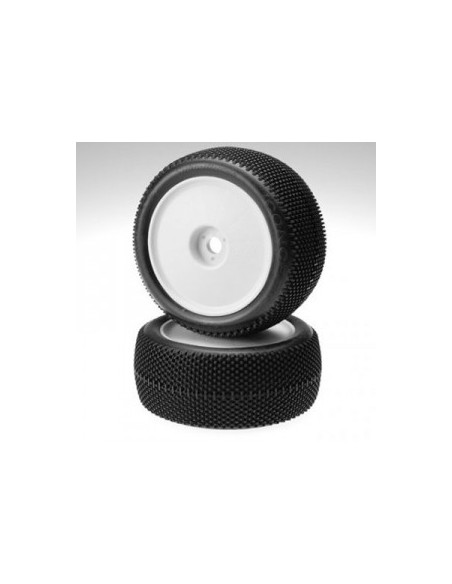
If there is one component that determines how a slot car behaves on the track, it is the tyres. It doesn't matter how much you have invested in the chassis, motor, or electronics: if the tyres are not in good condition or are not suitable for the type of track and scale, the car will not deliver its potential. Grip, cornering stability, consistency over a long run, and throttle response largely depend on that small rubber ring that touches the rail.
The same applies to the wheels: the diameter, width, material, and fit with the tyre directly influence the dynamic behaviour of the car. Choosing a wheel that is too wide or with an incorrect diameter can cause rubbing, affect the turning radius, or unbalance the rear end.
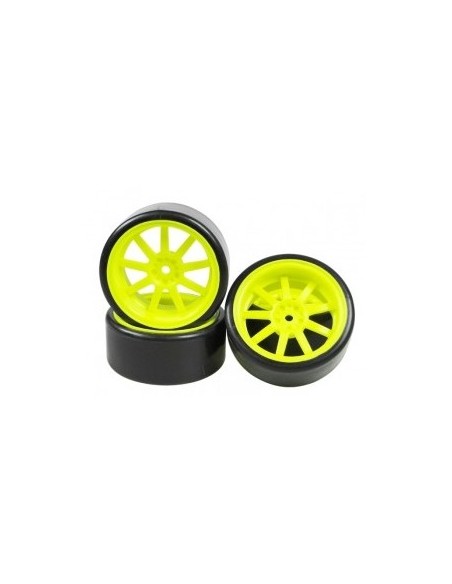
In this section, you will find everything related to tyres and wheels for slot cars: from silicone or urethane competition tyres to plastic or machined aluminium wheels, as well as spare tyres for the most common brands. Whether for a beginner Scalextric, a competitive NSR, or a long track Slot.it, here are the references you need.
If you are looking to improve the performance of your car or simply replace worn tyres, this guide will help you understand what to look for before adding to your cart.
What are tyres and wheels for slot and why are they so important
In scale slot cars, the contact between the tyre and the track surface is the only point where traction is transmitted. There is no active suspension, no intelligent differential: all the physics of motion passes through that pair of rear tyres. That is why an appropriate tyre makes the difference between a car that holds its line in the corner and one that slides out at every acceleration.
Tyres serve several functions at once: they provide grip, absorb micro-irregularities of the track, maintain the guide height relative to the rail, and, in combination with the wheel, define the wheel radius. A larger radius implies more top speed with the same motor, but also more inertia. A smaller radius improves acceleration and stability but may limit top speed.
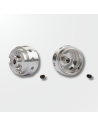
The wheels, on the other hand, are the structure on which the tyre is mounted. Their inner diameter must fit the axle, and their outer width must be compatible with the space available within the body. Machined aluminium wheels offer superior concentricity, which reduces vibrations at high speeds. Injected plastic wheels are more economical and sufficient for recreational use or stock categories.
How to correctly choose tyres and wheels for your slot car
Before buying, there are four parameters you should check:
- Scale: tyres for 1/32 are not interchangeable with those for 1/24. The external measurements, width, and inner diameter differ significantly between scales.
- Outer diameter: measured in millimetres. A tyre with a 19 mm outer diameter mounted on a car that originally has 20.5 mm changes the height of the car and can affect the guide's contact with the rail.
- Width: more width usually means more contact surface and more grip, but also more lateral rubbing on the wheel if there is not enough space in the body.
- Compatibility with the wheel: the inner diameter of the tyre must match the outer diameter of the wheel. Many manufacturers like NSR, Slot.it, or Scaleauto publish compatibility charts. Always consult them before mixing references from different brands.
In addition to size, the tyre compound directly influences performance. For competition on plastic tracks, high-grip silicone compounds or treated urethane compounds are the most common. For recreational use or on cloth-covered wooden tracks, harder and more wear-resistant compounds may be more practical.
Main types and differences
By material
- Silicone: high grip, soft to the touch, prone to accumulating dust. Widely used in competition. Require frequent track cleaning.
- Urethane / polyurethane: greater durability than silicone, good balance between grip and wear. Popular in plastic and wooden track categories.
- Hard rubber (OEM style): those fitted on factory cars. Suitable for recreational use, but rarely optimal for competition.
By profile
- Slicks: maximum contact surface, better grip on dry. They are the most common in slot.
- With tread: found on rally or off-road scale cars, primarily aesthetic function although they can improve grip on rough surfaces.
By type of wheel
- Injected plastic: lightweight, economical, sufficient for casual use. Less precise in concentricity.
- Machined aluminium (CNC): greater precision, less vibration, greater durability. Essential in competition.
- Nylon / resin: intermediate solution, common in brands like Avant Slot or Scaleauto in their more complete ranges.
Technical aspects we need to know
One of the most important concepts in wheel preparation is truing: the process of equalising the diameter of both rear tyres using a slot sander or lathe. If the two tyres do not have exactly the same diameter, the car will tend to pull to one side constantly. In competition, truing is a common practice before each race.
The gluing of the tyre to the wheel is also relevant. Some tyres are mounted under pressure and hold themselves; others require a drop of cyanoacrylate glue to prevent them from spinning freely on the wheel when the motor applies traction. Once glued, it is important to check that the assembly is perfectly centred before truing.
Regarding the mounting of the wheel on the axle, the axial play should be minimal but without excessive tightening. A wheel that rubs against the inside of the body loses energy and can wear the paint. A wheel with too much axial play generates instability in corners.
It is also worth noting that the diameter of the rear tyres directly affects the effective gear ratio: if you switch to a smaller tyre, the car accelerates faster but loses top speed, similar to downshifting in a real car.
Practical tips for use, maintenance, and preparation
- Regular cleaning: silicone tyres easily accumulate dust. Clean them with a cloth slightly dampened with water or with a specific slot tyre cleaner. Avoid aggressive solvents that may alter the compound.
- Break-in: new tyres, especially silicone ones, improve their performance after a few laps of moderate speed. During this process, the surface settles and grip increases.
- Storage: store unmounted tyres in an airtight bag, away from direct sunlight and heat sources. Ozone and UV rays degrade the compound.
- Truing: if you have access to a slot lathe or tyre sander, always true before a competition race. Differences of tenths of a millimetre between both sides are enough to notice the imbalance.
- Periodic inspection: check the tyres before each session. A cut, a local flattening, or a deformation due to improper storage can cause the car to vibrate at high speed.
Common mistakes to avoid
- Buying for visual appearance: a tyre may look identical to another and have a different inner diameter. Always check the measurements before ordering.
- Mixing compounds between front and rear: in slot cars that mount tyres on all four wheels, mixing compounds of different hardness can generate unpredictable behaviour during braking or cornering.
- Ignoring differential wear: if one rear tyre wears more than the other (due to asymmetry on the track, for example), the car will start to pull. Replace both rear tyres at the same time.
- Over-tightening the wheel on the axle: can deform the plastic wheel and generate eccentricity, exactly the opposite of what we want.
- Using excessive glue: a single drop of cyanoacrylate is sufficient to secure the tyre. Excess can create imbalances due to mass accumulation or stain the track.
- Not checking compatibility with the track system: although tyres do not have a direct relationship with the rail, the total width of the wheel does influence rubbing against the walls or side guides of the circuit. Verify that the measurements are suitable for your track.
Recommendations for beginners and advanced users
If you are starting out
If you have a beginner Scalextric or Ninco car and want to improve without complicating things, the easiest option is to look for the original replacement tyres for your model or, if your car already accepts aftermarket tyres, opt for a standard urethane reference from NSR or Scaleauto in the correct diameter. There is no need to go straight to competition silicone: good quality urethane offers very solid performance and is easier to maintain.
For the wheels, the plastic ones already fitted on your car are perfectly functional at first. When you notice that the car vibrates more than usual or that the tyres fit with difficulty, it will be time to consider more precise wheels.
If you already have experience
In the competitive arena, brands like NSR, Slot.it, and Scaleauto offer very comprehensive catalogues of tyres and aluminium wheels for practically all their models. Before each championship, it is common to prepare several sets of trued and numbered tyres by diameter, to choose the most homogeneous set for each race.
If you prepare cars for regulated categories, check the specifications of the regulations regarding maximum diameter and allowed compound type. Some championships limit the use of silicone or establish minimum diameters to avoid advantages derived from extreme modifications.
The fine-tuning of the contact pressure of the tyre with the track, combined with the hardness of the chassis spring and the total weight of the car, is one of the areas where the most time can be gained per lap once the fundamentals are mastered. It is a task of many sessions and tests, but it is precisely what makes the technical preparation of slot so exciting.
| Material |
Grip |
Durability |
Maintenance |
Recommended use |
| Silicone |
Very high |
Medium |
Frequent cleaning |
Competition / plastic track |
| Urethane |
High |
High |
Low |
Competition and recreational use |
| OEM rubber |
Medium |
High |
Low |
Recreational use / beginners |
Frequently asked questions about tyres and wheels for slot
Do 1/32 tyres fit 1/24 cars?
No. The scales differ in actual physical measurements: 1/24 cars are larger and require tyres with a larger outer diameter and width. Using tyres of the incorrect scale may prevent mounting or cause rubbing issues with the body.
What is the difference between silicone and urethane tyres?
Silicone offers more immediate grip but quickly accumulates dust and requires a well-cleaned track. Urethane has slightly less maximum grip but is more consistent over a long session and wears more evenly.
Is it necessary to true the tyres?
For recreational use, it is not essential, although it always improves behaviour. For competition, truing is practically mandatory: it ensures that both rear tyres have exactly the same diameter and prevents the car from pulling to one side.
Can I mount NSR tyres on Slot.it wheels?
It depends on the measurements. Both brands publish their dimensions accurately. If the inner diameter of the NSR tyre matches the outer diameter of the Slot.it wheel, mounting is possible. Always check the technical sheets of each reference before mixing.
When should I change the tyres?
When you notice a constant loss of grip that does not improve with cleaning, when the diameter has been reduced by truing to the point of significantly altering the height of the car, or when cuts, flattened areas, or visible deformations appear.
Do aluminium wheels really improve performance?
Yes, especially at high speeds. The superior concentricity of CNC machined wheels reduces vibrations, resulting in greater stability and more consistent tyre contact with the track. On slow tracks or for casual use, the difference is less noticeable.
Do I need to glue the tyre to the wheel?
It depends on the type of tyre and the fit. Some stay under pressure without issue; others, especially softer silicone ones, may spin on the wheel if not glued. A drop of cyanoacrylate is sufficient and does not add noticeable weight.
What happens if I mount tyres with a larger diameter than recommended?
The car physically rises, which may cause the guide not to sit properly on the rail. Additionally, it changes the effective gear ratio: more diameter means more top speed but less acceleration. If the tyre rubs against the body, it also generates power loss and uneven wear.
Do front tyres influence performance?
To a lesser extent than the rear, as in most slot cars the traction is exclusively rear. However, front tyres influence rolling resistance and cornering stability. Front tyres that are too wide or have too much grip can make the car less agile in slow corners.
Are there differences between tyres for plastic and wooden tracks?
Yes. Cloth-covered wooden tracks usually have more grip by themselves, so harder compounds can be used without losing adhesion. On plastic tracks, especially the smoother ones, soft silicone or high-grip urethane compounds make a bigger difference.
Can I use any tyre if I race in a championship?
Not necessarily. Most championships have a technical regulation that specifies the allowed tyres, whether by brand, specific reference, or diameter limits. Always consult it before preparing the car for a race.
How often should I clean silicone tyres?
Ideally, before each session and, if the track is not perfectly clean, also midway through a long run. Dust and dirt adhered to the silicone significantly reduce grip and are the most frequent cause of performance loss in tyres that are still in good condition.