In any respectable workshop —whether for slot cars, static models, figures, dioramas, or diecast— there is a set of tools that are always present on the table. They may not be the most eye-catching, but they are the most used: the screwdriver that adjusts a chassis, the Allen key that tightens a pinion, the scalpel that precisely cuts a decal. These are the general tools, and without them, the work simply cannot be done.
This category encompasses that essential wardrobe staple: everything that doesn’t fit into a very specific family but that any hobbyist will need sooner or later. If you are setting up your first workshop or want to complete the one you already have, here you will find the utensils that make the rest of the tools make sense.
Working with miniatures, slot cars, or models requires precision. The parts are small, the screws are tiny, and the margins for error are almost non-existent. That’s why not just any DIY screwdriver or any key from the home drawer will do: you need tools designed for precision work, with tips that don’t slip, handles that transmit torque well, and finishes that withstand continuous use in the workshop.
Throughout this page, we explain which general tools are truly useful in the hobby, how to choose them well, what mistakes to avoid, and what differences exist between the various options on the market. Whether you are new to this or have been tuning competition cars for years, you will find practical information that will help you equip yourself wisely.
What are general tools and why are they important
When we talk about general tools in the context of the hobby, we refer to all those cross-functional utensils that do not belong to an exclusive discipline. They are equally valid for adjusting the chassis of a slot car, assembling a static model airplane, finishing a miniature figure, or checking the internal mechanisms of an articulated diecast.
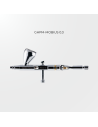
Their importance lies precisely in that versatility. Unlike a highly specialized tool —such as a depth gauge for measuring axle play or an airbrush for painting— general tools accompany every work session, regardless of the project you have at hand.
Among the most common, we find:
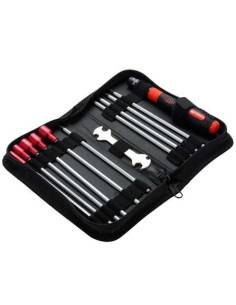
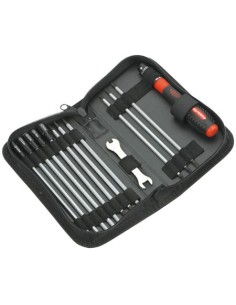
- Precision screwdrivers: flat, Phillips, and Torx, in sizes adapted to the tiny screws of the hobby.
- Allen keys (hexagonal): essential for hollow head screws, very common in competition chassis and slot spare parts.
- Needle-nose and cutting pliers: for holding, bending, or cutting delicate components without damaging them.
- Scalpels and precision cutters: essential in modeling for trimming chassis parts, cleaning burrs, or applying decals.
- Tweezers: in various formats (straight, curved, needle-nose), ideal for manipulating small parts without leaving fingerprints or risking deformation.
- Detail files and sandpaper: for adjusting joints, removing excess material, and preparing surfaces before painting.
- Hand drills and precision bits: for opening cable passages, creating anchors, or adjusting tolerances in printed or resin parts.
None of these tools are ancillary. They form the foundation upon which any well-done work in the workshop is built.
How to correctly choose general tools
The temptation to buy a generic hardware toolkit is understandable, but in the hobby, that approach often proves costly in the long run. Tools that are too large or poorly finished can damage delicate parts, slip on small metric screws, or simply not fit in the workspaces.
Here are the keys to choosing well:
- Size appropriate to the task: in slot and modeling, work is typically done with screws M1, M1.2, M1.5, and M2. Ensure that the screwdrivers and Allen keys cover that range.
- Tip quality: a worn or soft steel tip ruins the screw head on the first use. Opt for CrV (chrome-vanadium) steel or S2 steel, which are much more durable.
- Ergonomic handle: in long tasks, a handle that transmits force well without fatiguing the hand makes a difference. Hexagonal-section handles or those with rubber grips are more comfortable.
- Sets vs. individual units: if you are starting out, a complete precision set (screwdrivers + Allen keys + scalpel) is a good initial investment. Over time, you will complete it with individual pieces according to your actual needs.
- Compatibility with the type of work: preparing a competition car —where loosening and tightening is frequent— is not the same as assembling a static model that you barely touch once assembled. Adapt the required quality to the use you will give.
A simple trick: before buying, think about the last three projects you have done and note which tools you missed or that failed you. That is exactly what you need to buy.
Main types and differences
Within general tools, there are important differences between families that are worth knowing before equipping yourself:
Precision screwdrivers
They come in flat, Phillips, Torx, and Pozidriv. In the hobby, the most used are the flat (for general adjustments) and the Phillips (very common in the screws of imported models). The Torx appears in some track systems and electronic controllers. It is advisable to have at least a basic set that covers all four types in small sizes.
Allen keys
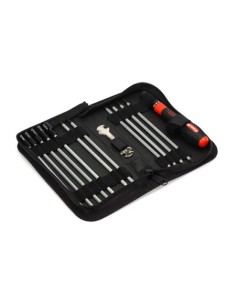
They come in L-shaped sets, T-shaped (with a handle, much more comfortable), or in interchangeable tool holder format. For regular work in slot and models, T-shaped sets or tool holders with interchangeable tips are the most practical. The most commonly used sizes in the hobby range from 0.9 mm to 3 mm.
Pliers and tweezers
Needle-nose pliers allow for holding and bending. Flush cutting pliers are essential for separating parts from the chassis without leaving burrs. Tweezers, on the other hand, are indispensable for placing decals, manipulating braids, or positioning small parts during assembly.
Cutting tools
The scalpel with interchangeable blades is the king of modeling. It allows for precise cutting, scraping surfaces, and cleaning joints. Blades dull quickly: it is advisable to have spares on hand and change them frequently to maintain cutting precision.
Detail files and abrasives
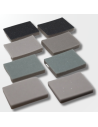
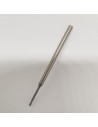
Needle files (in flat, round, triangular, and half-round sections) allow for adjusting parts in very tight spaces. Fine-grit sandpapers (400, 600, 800) are essential for preparing surfaces before applying primer or paint.
Technical aspects we should know
Beyond knowing the types, there are some technical concepts that mark the difference between a useful tool and one that ends up in the forgotten drawer:
- Steel hardness: expressed in HRC (Rockwell scale). For screwdriver tips and Allen keys, look for values between 58 and 62 HRC. Below that, the tool deforms with use on hard steel screws.
- Dimensional tolerance: in precision Allen keys, a poorly adjusted tolerance causes the key to wobble inside the screw and deteriorate it. Quality keys have tolerances of ±0.05 mm or better.
- Length of the lever arm: in L-shaped formats, the long arm provides more torque (for loosening), while the short arm gives more rotational speed (for tightening quickly). In T format, you have both options in a single tool.
- Interchangeable scalpel blades: the most widely used standard is blade no. 11 (fine tip) and no. 10 (curved). Both are compatible with most handles on the market.
Knowing these details allows you to compare tools wisely and not be swayed solely by price or visual appearance.
Practical tips for use, maintenance, and organization
A good tool that is poorly maintained ceases to be a good tool. Here are the habits that make a difference in the workshop:
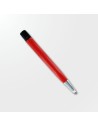
- Regularly clean the tips: residues of adhesive, grease, or accumulated dirt on the tip of a screwdriver or Allen key cause slipping. A dry cloth and, if necessary, a bit of isopropyl alcohol is sufficient.
- Store tools in order: a tool holder or a case with individual compartments prevents tips from damaging each other through contact and makes it easier to quickly find what you need.
- Never force a tool that is too small: if an Allen key has some play in the screw, use the correct size before continuing to tighten. Forcing it destroys the screw head and makes extraction much more complicated later.
- Change scalpel blades frequently: a dull blade does not cut; it pushes. This results in uneven cuts, damaged parts, and a higher risk of accidents due to the excess pressure required.
- Use the right tool for each task: do not use modeling tweezers as a twisting plier, nor a scalpel to lift thick decals. Each tool has its function, and forcing it out of that function accelerates its wear.
Common mistakes we should avoid
Over the years, we have seen the same mistakes repeated in workshops of all kinds. Here are the most common so you don’t fall into them:
- Buying tools that are too large: a hardware screwdriver is neither precise nor comfortable for working on slot or modeling parts. Size matters, and in the hobby, smaller is often more precise.
- Skimping on tip quality: the tip is the most important part and the one that does the most work. A bad tip ruins screws and parts in just a few sessions.
- Not having spare scalpel blades: they always run out at the worst moment. Having a pack of spares on hand is essential.
- Mixing tools from different systems without checking: some interchangeable tips are not universal. Before combining handles and tips from different brands, check compatibility.
- Storing tools in humid conditions: steel rusts. A closed case in a dry environment is the minimum to preserve the quality of the tips.
Recommendations for beginners and advanced users
If you are starting out
The smartest thing is to invest in a complete set of precision screwdrivers (flat + Phillips + Torx), a set of Allen keys in T or L covering from 1 to 3 mm, straight and curved tweezers, a scalpel with a pack of spare blades, and a small pair of needle-nose pliers. With that, you have covered 90% of the usual operations in any hobby project.
There is no need to spend a lot all at once. It’s better to start with a medium-high quality set and complete it over time according to what you actually need.
If you already have experience
The advanced user usually has the basic set covered and looks to complete it with more specific tools: precision tool holders with magnetic interchangeable tips, ball Allen keys (which allow working at an angle), long ergonomic handle scalpels for prolonged work, or needle files in special sections for very specific adjustments.
It is also worth investing in a good organization system: a wall-mounted holder, a modular case, or a drawer organizer with labeled compartments. When you have many tools, order is not a whim; it is efficiency.
Frequently asked questions
What sizes of Allen keys are most used in slot?
The most common sizes in slot cars and spare parts are 1 mm, 1.5 mm, and 2 mm. Some parts use 2.5 mm. It is advisable to have a set that covers at least from 1 to 3 mm.
Is there a difference between a watchmaker's screwdriver and a precision screwdriver for hobby use?
The concept is similar, but hobby screwdrivers usually have more ergonomic handles for longer tasks and tips made of harder steel, designed for steel screws and not just brass. For intensive workshop use, hobby tools are more suitable.
How often should scalpel blades be changed?
It depends on usage, but as a reference: if you notice that you need to apply more pressure than usual to cut, it’s time to change. In intensive modeling sessions, it could be every few hours of effective work.
Can hobby tools be used for other household uses?
For very delicate tasks (electronics, glasses, jewelry), yes. For general DIY, they are too delicate and would get damaged. It’s better to keep them exclusively for the hobby workshop.
Is it worth buying a set or better to get individual tools?
To start, a well-selected set is the most economical and practical option. With experience, it’s advisable to complete with individual pieces of higher quality or more specialized according to actual use.
Are all modeling tweezers the same?
No. There are stainless steel ones (non-magnetic, ideal for electronics and small metal parts), straight, curved, or angled tips, and different types of grip at the tip. For general modeling, it’s advisable to have at least one straight and one curved.
What is the difference between a flat needle file and a half-round file?
The flat file works well on flat surfaces and angles. The half-round file allows working on concave surfaces and inner curves. For adjustments in models and resin parts, the half-round is usually more versatile.
Can I use the same tools for slot as for static models?
Yes, for the most part. General tools are cross-functional. Some differences: in slot, Allen keys are used more due to the screws in the chassis; in models and figures, scalpels and files are used more. But the basic toolset is the same.
Is it necessary to lubricate or treat steel tools?
It is not essential under normal use, but applying a thin layer of neutral oil on steel tips and keys, especially if you live in a humid environment, prolongs their lifespan and prevents superficial rust.
What type of pliers is best for cutting parts from a model chassis?
The flush cutting pliers (also called flush cutters) are the most suitable. They leave a very clean cut with minimal burrs, minimizing the subsequent sanding work.