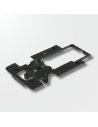
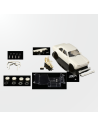
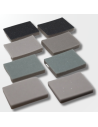
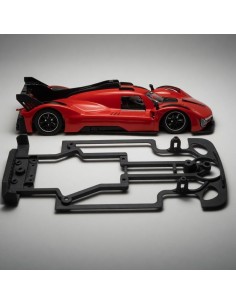
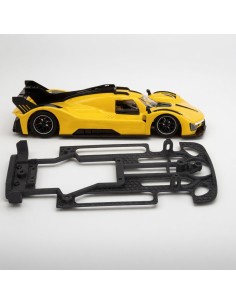
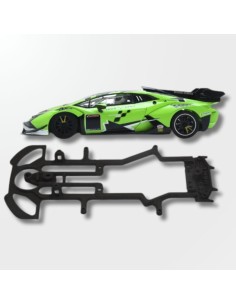
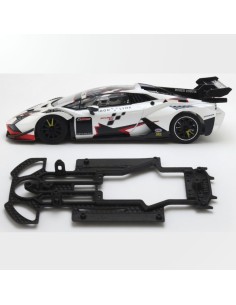
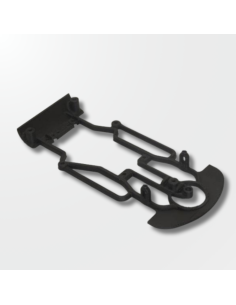
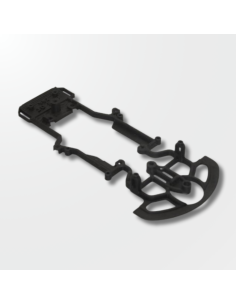
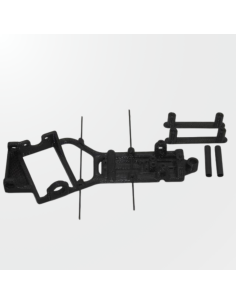
The chassis is the backbone of any slot car. Everything else —motor, tyres, guide, braids— works on it, and its rigidity, geometry, and material largely determine how the car behaves on track. For years, the standard plastic chassis was sufficient for most enthusiasts, but the tuning market has evolved so much that today it is possible to replace it with parts made through 3D printing, fibreglass laminating, or metal machining. Each technology corresponds to a different tuning philosophy and a different driver profile.
Whether you compete in organised championships or simply want to get the most out of your car on your home circuit, choosing the right chassis is one of the most important decisions you can make. It is not a cosmetic upgrade: it is a structural improvement that directly affects cornering performance, weight distribution, grip, and consistency of lap times. In this category, you will find the most valued options by tuners and competitors at a high level in Spain and Europe.
Next, we will explain what differentiates one material from another, how to choose according to your track system and level of demand, and what the most common mistakes are when making this type of upgrade.
What is an aftermarket chassis and why does it make a difference
The standard chassis that comes with a slot car is designed to provide an acceptable balance between manufacturing cost, durability, and overall performance. Major brands —NSR, Slot.it, Avant Slot, Scaleauto— have significantly improved their original chassis in recent years, but even so, there exists an ecosystem of aftermarket parts that goes a step further.
An aftermarket chassis made of fibreglass, 3D printing, or metal allows:
- Adjusting the lateral and overall rigidity of the assembly according to the type of track.
- Modifying the motor mounting geometry (inline, sidewinder, or anglewinder) without relying on the original mould.
- Lowering the centre of gravity by allowing components to be mounted in lower or more central positions.
- Customising overhangs, wheelbases, and the position of the motor mount.
- Reducing total weight or redistributing it strategically.
Not all drivers need an aftermarket chassis, but for those looking to shave off tenths in competition or simply enjoy a car with much more predictable handling, it is an investment that is noticeable from the first lap.
How to choose the right chassis
Before purchasing, you need to answer three key questions:
What is your track system?
Not all chassis are universal. Some are specifically designed for universal track (Scalextric, Ninco) and others for sport track (Scaleauto, Slot.it). Mixing a chassis designed for one system with the track of another can cause guide, body height, or erratic behaviour issues. Always check compatibility before buying.
What type of motorisation will you use?
The chassis configuration must be consistent with the motor mounting:
- Sidewinder: the motor is parallel to the rear axle (transverse). It is the most common configuration and allows for compact transmissions.
- Inline: the motor is perpendicular to the rear axle, in line with the car. It lowers the centre of gravity more and is highly valued in high-speed competition cars.
- Anglewinder: the motor is mounted at an angle to the rear axle, combining advantages of compactness and weight distribution.
Each type of aftermarket chassis is usually optimised for one or more of these configurations. Do not assume that any chassis accepts any mounting.
What is your level of demand?
For home track use with an enthusiast starting to tune cars, a 3D printed chassis is an economical, accessible, and very valid solution. For organised competition with strict regulations and demands for consistent times, fibreglass or metal are the reference. Gauge your choice according to the actual context of use.
Main types and differences
3D printed chassis
3D printing has democratized access to custom chassis. Using technologies like FDM (fused deposition modelling) or resin (SLA/MSLA), it is possible to produce chassis with geometries impossible for traditional injection moulding. The advantages are clear: low cost, extreme customisation possibilities, and very short iteration times. The most commonly used materials are PLA, PETG, ABS, and high-strength photopolymer resins.
The historical weak point of 3D chassis was rigidity and resistance to heat generated by the motor. Current materials have improved significantly in this aspect, but it remains a limitation to consider in long sessions or with high-power motors.
Fibreglass chassis
These are the most widespread option among mid-high level tuners. Fibreglass offers excellent rigidity, very low weight, and a controlled elastic response that improves grip in corners. It allows for adjusting the lateral flex of the chassis through the thickness of the laminate, which is a very powerful tuning tool. Brands like NSR and Slot.it have popularised this material in their own competition chassis.
They require more precision in assembly than plastic or 3D chassis, and are generally intended for users with experience in tuning.
Metal chassis (aluminium, brass, steel)
Metal chassis are the most rigid and durable solution. Machined aluminium offers maximum rigidity with a contained weight, while brass allows for adding mass at strategic points to improve weight distribution. They are the preferred option in competition categories where stability is prioritised over flexibility.
The main disadvantage is cost and, in some cases, added weight if regulations set limits. They also require specific tools for adjustment and assembly.
Technical aspects we need to know
The chassis does not work alone. Several technical factors condition the final result:
- Front and rear overhang: the distance between the guide axle and the front axle, and between the rear axle and the end of the chassis, directly affects cornering behaviour and stability.
- Ground clearance: determines whether the car scrapes on track and affects the centre of gravity. Aftermarket chassis usually allow for adjustment with spacers or through the design itself.
- Motor mount position: conditions longitudinal weight distribution. A more central or forward motor completely changes the behaviour.
- Compatibility with the body: not all aftermarket chassis maintain the original body mounting points. Verify that the assembly fits before buying.
- Compatibility with guide and braids: some aftermarket chassis use proprietary guide systems or have size restrictions that need to be checked.
Practical tips for use, maintenance, and tuning
Once you have the chassis, the work does not end with the assembly. Here are some recommendations that make a difference:
- Before mounting anything, check the flatness of the chassis on a reference surface. A twisted chassis will ruin the work of the other components.
- On fibreglass chassis, clean the edges with fine sandpaper to remove burrs that may interfere with the body or axles.
- On metal chassis, apply a small amount of dry lubricant at the contact points with axles and mounts, but avoid excess: lubricant on the braids reduces electrical contact.
- Periodically check the tightness of the fixing screws, especially after the first sessions. Rigid materials transmit more vibration and can loosen joints.
- If the car shows erratic behaviour in corners, before blaming the motor or tyres, check that the chassis does not have asymmetric flex due to a hit or incorrect assembly.
Common mistakes to avoid
The experience of veteran tuners agrees on several critical points that are easy to overlook when starting with aftermarket chassis:
- Buying by price without checking compatibilities: a cheap chassis that is not compatible with your track system or motorisation is money wasted. Always verify beforehand.
- Ignoring the championship regulations: many championships regulate the type of chassis allowed, the minimum weight of the car, or the materials permitted. Check before tuning.
- Mounting the motor without checking alignment: a poorly aligned mount generates friction, noise, and power loss. Take the necessary time to correctly align the crown gear and pinion.
- Confusing rigidity with quality: in slot, a stiffer chassis is not always better. On tracks with a lot of surface variation, a point of controlled flexibility improves grip.
- Not testing the assembly before a race: any new chassis needs a break-in period. Do not debut it in competition without having tested it beforehand under controlled conditions.
Recommendations for beginners and advanced users
If you are starting with tuning
The most sensible approach is to start with a 3D printed chassis compatible with your reference car. It will allow you to understand how geometry affects handling without a high investment. Once you are clear on what you want to improve, the jump to fibreglass will make much more sense.
Always work on a single reference car at first, so you can compare the behaviour before and after the chassis change objectively.
If you already have experience in tuning
The fibreglass or metal chassis will give you the necessary control for precise tuning. At this level, the choice of chassis should be accompanied by a comprehensive review of the drivetrain: pinion, crown gear, axles, and tyres must be in harmony with the rigidity and geometry of the new chassis.
Also consider working with modular chassis that allow for adjusting the position of the mount or overhang, especially if you compete on different types of circuits throughout the championship.
| Material |
Rigidity |
Weight |
Price |
Recommended profile |
| 3D Printing (resin/PLA) |
Medium |
Low-medium |
Economical |
Beginner, home use |
| Fibreglass |
High |
Low |
Medium |
Mid-high competition |
| Machined Aluminium |
Very high |
Medium |
High |
High-level competition |
| Brass |
Very high |
High |
High |
Competition, weight adjustment |
Frequently asked questions
Does an aftermarket chassis always improve performance?
Not automatically. A well-chosen and correctly mounted aftermarket chassis improves handling, but if the rest of the drivetrain is not in good condition, the result can be disappointing. The chassis is a starting point, not a magic solution.
Are 3D printed chassis valid for competition?
It depends on the championship regulations. Some allow 3D chassis without restrictions; others limit or prohibit them outright. Always check the regulations before preparing the car for an official race.
Is it complicated to mount a fibreglass chassis?
It requires more precision than replacing a plastic part, but it is not particularly difficult if you have basic tuning experience. The main challenge is to correctly align the motor mount and ensure that the axles are parallel.
Can I use a Slot.it chassis on a Scalextric car?
Generally not directly, because the body mounting points, guide position, and dimensions of the assembly differ between brands. Always check the specific compatibility of the chassis with your car model.
What practical difference is there between a sidewinder chassis and an inline one?
The sidewinder chassis mounts the motor parallel to the rear axle, resulting in a compact transmission and easier mounting. The inline chassis mounts the motor in line with the car, perpendicular to the rear axle, which lowers the centre of gravity more and can improve high-speed stability, although the mounting is more demanding.
How much weight does a metal chassis add or remove compared to the original?
It depends on the material and design. A machined aluminium chassis can be similar in weight to the original plastic one, while a brass chassis is usually significantly heavier. In competition with regulated minimum weight, this can be an advantage for adjusting ballast.
How often should the chassis be checked?
After each intensive use session, it is advisable to visually check for deformations, cracks (especially in 3D chassis), or loose screws. In metal chassis, it is also recommended to check the contact points with the axles for premature wear.
Can pieces of different materials be combined in the same chassis?
Yes, and in fact, it is a common practice. For example, a fibreglass base chassis with an aluminium mount, or a 3D chassis with metal inserts at points of higher stress. The important thing is that the assembly is coherent and well-adjusted.
Does the chassis affect the car's electrical consumption?
Indirectly, yes. A misaligned chassis generates mechanical friction that makes the motor work harder, increasing current consumption. A well-mounted chassis helps the entire system work more efficiently.
What tools do I need to mount an aftermarket chassis?
At a minimum: precision screwdrivers, a caliper to verify measurements, a flat reference surface to check the flatness of the chassis, and specific tools depending on the type of mount. For fibreglass chassis, fine sandpaper is also needed to finish the edges.
Is it worth changing the chassis on a low-end car?
This needs to be evaluated. If the base car does not have a quality transmission or the tyres are the most basic, changing the chassis will have a limited impact. Generally, it makes more sense to invest in the chassis when the rest of the drivetrain is already in good condition.
Are aftermarket chassis compatible with all bodies?
Not necessarily. Some maintain the original mounting points; others require adapting or modifying the body. Always check compatibility before buying, especially if the body is resin or has a tight design.