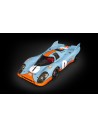
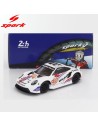
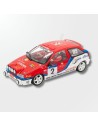
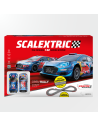
If you have been in the slot world for a while, you know perfectly what it means to arrive at a track session with a car that won't start, a temperamental trigger, or a spark plug that doesn't tolerate the cold. With electric slot cars, that scenario disappears completely. You plug it in, put the car on the track, and you’re off. It’s that simple. And it is precisely this operational simplicity —without sacrificing performance or excitement— that has made electric cars the reference option for the vast majority of slot enthusiasts, both at home and on competition circuits.
The electric slot proposal is not new, but it has matured spectacularly in recent years. Motors have gained power, linearity, and durability. Control electronics have been refined. Chassis have evolved to make the most of the immediate response of the electric motor. The result is a driving experience that is more predictable, more adjustable, and, in many cases, faster than combustion alternatives at scale.
In this category, you will find electric slot cars in different scales, disciplines, and levels of preparation: from perfect beginner models for setting up a circuit at home to competition cars prepared for racing in regulated series. Brands like NSR, Slot.it, Avant Slot, Scaleauto, or Scalextric are represented here, each with its philosophy and audience. Our role is not to list them all, but to help you find the one that fits what you are looking for.
Whether it’s your first electric car or you already have a drawer full of them and want to fine-tune your choice, this guide is designed to help you make an informed decision. We explain what differentiates an electric slot car from other formats, how to choose well according to your level and use, what types exist, what technical aspects are worth knowing, and what mistakes to avoid.
What is an electric slot car and why does it make a difference
An electric slot car is a scale vehicle that moves along a guided track —via a guide that fits into the slot of the track— and receives electrical power directly from that track through the contact braids. The electric motor converts that energy into movement immediately, without the need for prior preparation, fuel mixing, or atmospheric adjustments.
What makes an electric car special compared to other formats is not just the convenience. It is the linear and controllable response of the motor, the ability to regulate speed precisely via the controller, and the capacity to adjust the car's behaviour —grip, braking, acceleration— by modifying specific components: tyres, crown gears, pinions, springs, guides...
Maintenance is minimal compared to any combustion alternative: periodic cleaning of the braids and contact rail, checking tyres, occasional lubrication of moving parts, and little more. This makes it the ideal format for those who want to enjoy slot racing without the workshop taking more time than the track.
In competitive terms, electric cars dominate organised slot racing at national and international levels. The most demanding series —both in 1/32 and 1/24 scales— are entirely contested with electric cars, which has driven manufacturers to develop motors, chassis, and components of the highest precision aimed at real competition.
How to correctly choose an electric slot car
Choosing the right electric slot car is not just a matter of budget or whether you like the model visually. Several factors determine whether that car will work correctly on your track and with your driving level.
Compatibility with the track system
The first point —and the most important— is the compatibility between the car and the rail of your track. There are two main systems: the universal rail, used by Scalextric and Ninco, and the sport rail, used by Scaleauto and Slot.it. The dimensions of the guide and the spacing of the braids differ between systems, and mixing without being informed can cause the car to not drive correctly or not function at all. Before purchasing, confirm what system your track uses and what system the car is designed to use.
Scale
The 1/32 scale is the most widespread in home and competition slot racing. The 1/24 scale is larger, more powerful, and requires more space both on the track and for storage. There are also smaller scales like 1/43 or systems like HO, but the bulk of the quality electric slot market is concentrated in 1/32.
Level of preparation
Electric slot cars range from beginner versions with standard electronics and moderate performance to competition models with high-performance motors, magnesium or resin chassis, silicone tyres, and optimised geometry. Choosing a competition car to start with can be counterproductive: they are more sensitive to driving and require more knowledge to get the most out of them.
Discipline or race category
Are you interested in GTs, single-seaters, rally cars, or Le Mans prototypes? Each discipline has its own behavioural characteristics. A GT with a closed, low body has a different driving profile than an open prototype or an F1. If you are going to race in a local championship, check the regulations: many series specify brands, motors, or specific categories.
Types and main differences
Within electric slot cars, there is a real variety that deserves to be explained clearly, as it directly affects track behaviour.
By type of chassis
- Plastic: the most common in beginner and mid-range models. Flexible, lightweight, and easy to repair. Sufficient for home use and many competition series.
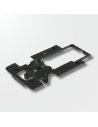
- Metal (magnesium or aluminium): greater rigidity, better heat dissipation, greater geometric precision. Common in competition ranges from NSR, Slot.it, or Scaleauto.
- Resin: allows for the reproduction of complex shapes with great detail. Avant Slot is one of the few brands that works with resin at an industrial level in the sector. More fragile against impacts, but with superior finish.
By motor placement
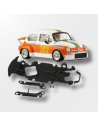
- Sidewinder: the motor is placed parallel to the rear axle (transverse). It is the most common configuration, offering good weight balance and ease of preparation.
- Inline: the motor is positioned perpendicular to the rear axle, in line with the car. It lowers the centre of gravity and favours stability in fast corners.
- Anglewinder: the motor is angled relative to the rear axle. It combines advantages of both configurations and is common in advanced competition cars.
By level of finish
- Beginner / Sport: ready to race, with balanced standard components. Ideal for starting out or for those who prioritise fun over preparation.
- Competition: factory optimised for maximum performance. Often require knowledge to set them up correctly.
- Kit or semi-kit: the enthusiast assembles or adjusts parts of the car. More common in serious competition ranges.
Technical aspects we should know
Although the great advantage of electric cars is their ease of use, knowing some technical concepts helps you get the most out of the car and understand what you are buying.
Braids and electrical contact
The braids are the metal strips that rub against the track rail and transmit current to the motor. Their condition is critical: if they are bent, dirty, or worn, the car loses contact and performance drops. Checking and cleaning the braids is the most basic and frequent maintenance you will do with any electric slot car.
Motor
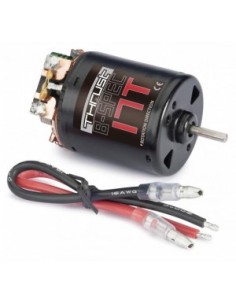
The motor is the heart of the car. In electric slots, we work with direct current (DC) motors of different revolutions per minute (rpm) and torque. A high rpm figure is not always better: it depends on the type of track (long and fast vs. technical and with tight corners), the transmission system, and your driving level.
Gear ratio (crown and pinion)
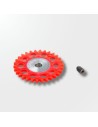
The relationship between the number of teeth on the crown and the pinion determines whether the car accelerates quickly or reaches a higher top speed. A shorter ratio (more acceleration, less top speed) is suitable for technical tracks; a longer ratio is better for fast tracks with many straights.
Tyres
Silicone tyres offer more grip and adapt better to smooth tracks. Rubber tyres are harder and more durable, suitable for tracks with more natural grip. The pressure of the tyre against the ground (achieved by adjusting the chassis height or lowering the body) directly affects cornering behaviour.
Guide
The guide is the piece that fits into the track rail and keeps the car on its trajectory. Its height, rigidity, and type of attachment influence how the car responds to the controller and how easily it derails.
Practical tips for use, maintenance, and preparation
- Clean the braids regularly. With a soft eraser or a specific cleaner. Dirty braids are the number one cause of irregular contact.
- Also clean the track rail. Accumulated dirt on the power rail affects the performance of all cars running on it.
- Lubricate sparingly. Excess lubricant on the axle or crown can attract dirt and end up causing more harm than good. Use specific slot lubricants and apply small amounts.
- Check the tyres before each session. Ensure they are not deformed (flat spot) and that they have good contact with the ground all around.
- Initial motor break-in. New motors benefit from a break-in period at low speed before demanding maximum performance. Follow the manufacturer's recommendations.
- Store correctly. Keep the cars in their box or on a specific stand to prevent the tyres from deforming due to weight or pressure.
Common mistakes to avoid
Buying without checking system compatibility
We have already mentioned it, but it is worth insisting: a car designed for sport rail will not work correctly on a universal rail and vice versa. Before buying, verify your track's system. If you have doubts, ask us.
Choosing a motor that is too powerful to start with
A motor with high rpm in the hands of someone learning to drive slot will end up in constant derailments and frustration. Start with motors of moderate performance, learn to modulate the controller, and increase the power when your wrist and instinct are ready.
Neglecting maintenance because you think "it's electric and doesn't need anything"
Electric cars are low maintenance, not maintenance-free. Dirty braids, deformed tyres, or unlubricated axles will affect performance and the car's lifespan.
Ignoring the gear ratio
Many enthusiasts modify the motor without touching the crown or pinion. The gear ratio is as important as the motor itself: a poorly geared car will not perform well even if it has the best motor on the market.
Mixing incompatible parts
Not all crowns, pinions, or guides are interchangeable between brands and systems. Before replacing a part, confirm compatibility with your specific model.
Recommendations for beginners and advanced users
If you are starting
Opt for a mid-range car from brands like Scalextric or Ninco if your track is universal, or Scaleauto if you are working with sport rail. They are balanced cars, well-finished, and with easily available spare parts. Avoid extremes: neither the cheapest (it may disappoint) nor the competition model (it may overwhelm).
Start to understand how the car works: identify the braids, guide, tyres, and motor. Get a basic maintenance kit: lubricant, track cleaner, and spare braids. With that, you are already well on your way.
If you already have experience
Brands like NSR, Slot.it, or Scaleauto offer competition ranges where each component is designed to perform at its best and is independently adjustable. If you participate in championships, check the regulations before preparing the car: many series limit the allowed motors, chassis, or tyres.
If you want to delve into tuning, work on the gear ratio, the type of tyre according to the track, and the motor configuration (Sidewinder, Inline, or Anglewinder) according to the car model and discipline. There is much room for improvement beyond simply changing the motor.
| Profile |
Recommended Scale |
Track System |
Indicative Brands |
Level of Preparation |
| Home Beginner |
1/32 |
Universal (Scalextric/Ninco) |
Scalextric, Ninco |
Standard |
| Intermediate Enthusiast |
1/32 |
Universal or Sport |
Avant Slot, Scaleauto |
Standard / Light Preparation |
| Advanced Competitor |
1/32 or 1/24 |
Sport (Scaleauto/Slot.it) |
NSR, Slot.it, Scaleauto |
Competition |
| Collector / Detailing |
1/32 |
Universal or Sport |
Avant Slot (resin) |
Standard / Display |
Frequently asked questions about electric slot cars
Does an electric slot car need pre-heating?
Not like a combustion engine, but it is advisable to do a few laps at a moderate pace before demanding maximum performance, especially with new motors or if the car has not been run for a while.
What is the difference between universal rail and sport rail?
The spacing and profile of the rail differ between systems. The universal rail is that of Scalextric and Ninco; the sport rail is that of Scaleauto and Slot.it. A car designed for one system may not work well on the other without adapting the guide and braids.
Can I mix cars from different brands on the same track?
Yes, as long as all are compatible with the rail system you use. What matters is not the brand of the car, but that the guide and braids are compatible with your type of track.
How long does an electric slot motor last?
It depends on use and maintenance. A well-maintained motor without overheating can last many track sessions. Competition motors are designed to perform at their best but wear out faster than those for home use.
What does it mean for a car to have Inline or Sidewinder configuration?
These are the positions of the motor relative to the rear axle. In Sidewinder, the motor is parallel to the axle (transverse); in Inline, it is perpendicular (longitudinal), lowering the centre of gravity. In Anglewinder, it is at an angle. Each configuration affects the car's behaviour on the track.
Is a plastic chassis better or a metal one?
It depends on use. Plastic is more flexible, lightweight, and easy to repair: sufficient for home use and many series. Metal (magnesium or aluminium) offers more rigidity and precision, ideal for demanding competition.
Are silicone tyres always better?
On smooth tracks with little natural grip, yes. On tracks with more texture or in intensive home use, rubber tyres may be more durable and sufficiently grippy. The choice depends on the track and driving style.
What controller do I need for an electric slot car?
Any controller compatible with your power supply. What matters is that the resistance (ohms) of the controller is suitable for the car's motor. Check the manufacturer's specifications or ask us before buying.
Can I prepare a beginner car for competition?
In many cases, yes, by replacing the motor, tyres, and gear ratio. But check the series regulations in which you want to participate: some limit allowed cars to specific models or ranges.
How often should I clean the braids?
It depends on usage frequency and the condition of the rail. As a reference, checking every two or three sessions is a good habit. If you notice the car is jerky or loses response, always start by checking the braids and the track rail.
Can electric slot cars be used outdoors?
They are not designed for that. Moisture, dust, and irregularities of outdoor surfaces harm both the car and the track. Electric slot racing is an indoor hobby.
What scale is best for beginners?
The 1/32 scale is the most sensible option for most: a wide variety of models, good availability of spare parts, compatible with most home and club circuits, and with a very accessible learning curve.