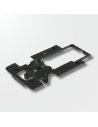
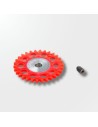
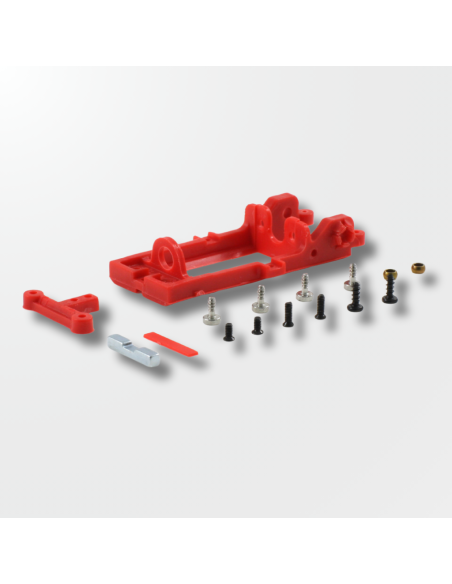
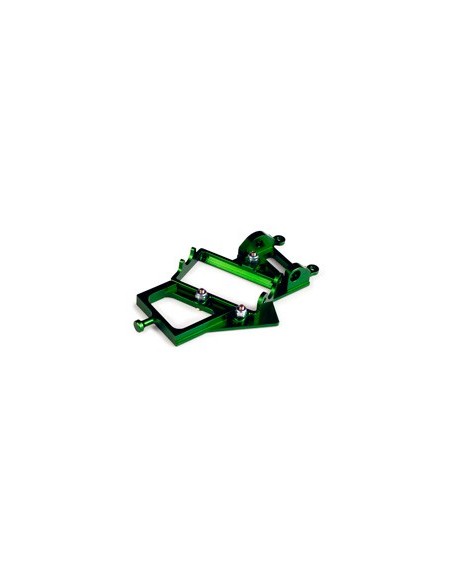
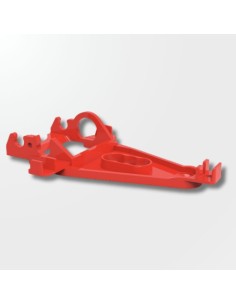
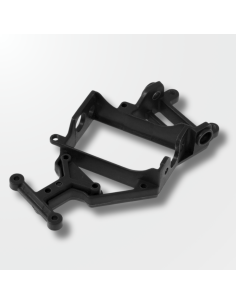
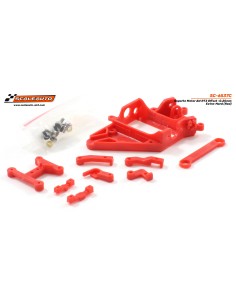
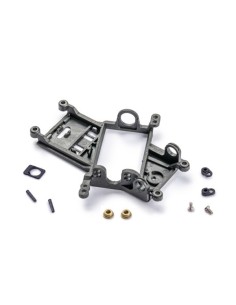
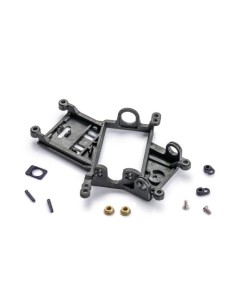
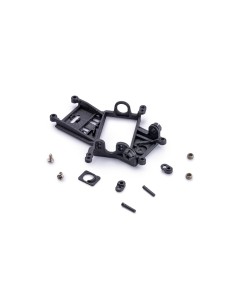
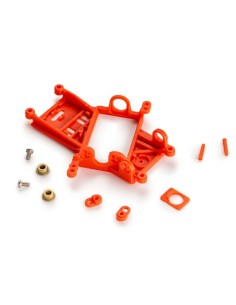
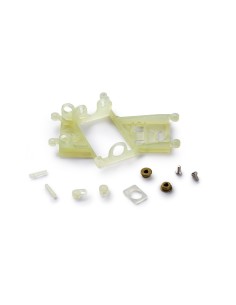
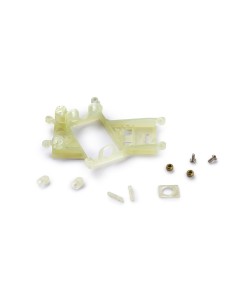
When we talk about tuning in slot racing, there are parts that define the character of the car. The chassis is one of them. It is not just a support: it is the element that fixes the geometry of the rear axle, conditions the power transmission, and depending on how you choose it, can make the difference between a car that rolls and a car that wins. If you have been in the hobby for a while, you know exactly what we are talking about; if you are starting to prepare your first chassis, this guide will give you the basics so you don't get lost.
In the category in front of you, you will find chassis for the main systems on the market —both for conventional plastic chassis and for carbon competition mounts— organised by type of motorisation and compatibility. The goal is for you to find what you need without having to guess what fits with what.
Before delving into the technical details, it is worth clarifying a starting point: the chassis is not a wear part that is changed routinely. It is a setup decision. Choosing wisely means knowing the type of motor you are using, the transmission configuration you want, the chassis you are going to work on, and, above all, what behaviour you are looking for on the track. That is why in this text we are going to review everything you need to know before adding it to your cart.
What is a chassis and why is it so important
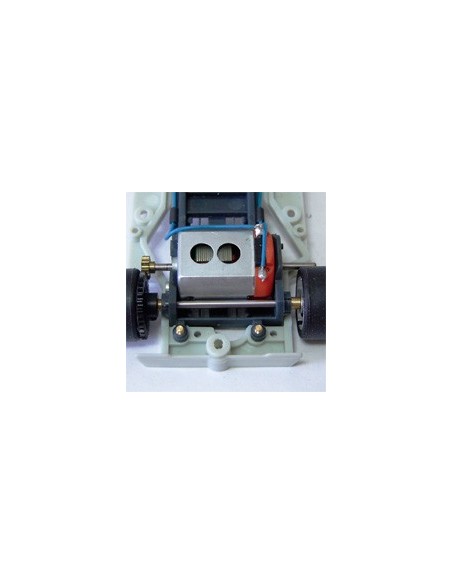
The chassis is the structural piece that simultaneously houses the motor and the rear axle of the car. Its main function is to maintain a stable geometric relationship between the pinion (attached to the motor shaft) and the crown gear (attached to the drive shaft), ensuring that the gear works correctly under any load condition.
Beyond this basic function, the chassis influences several critical aspects of the car's behaviour:
- Type of transmission: the orientation in which the motor is housed determines whether the configuration is inline, sidewinder, or anglewinder. Each has direct implications on the centre of gravity, mass distribution, and cornering behaviour.
- Offset of the axle: the vertical distance between the motor shaft and the drive shaft defines the optimal gear ratio and affects how the crown gear behaves under different track conditions.
- Chassis torsion: a chassis with some flexibility allows the chassis to work on uneven tracks, improving the contact of the four support points with the rail. A rigid chassis, on the other hand, favours precision but requires a perfectly level track.
- Vibration absorption: the material and construction of the chassis determine how many vibrations from the motor are transmitted to the chassis. Less vibration means less loss of traction and greater stability of the guide.
In summary: changing the chassis is not just changing a part, it is changing the personality of the rear axle. That is why it is one of the most valued adjustments in competition preparation.
How to correctly choose a chassis
The first step is to identify compatibility with your chassis. Not all chassis are interchangeable, and although sometimes they can be adapted with some work, it is ideal to start with a piece designed for your specific platform. Brands like NSR, Slot.it, Scaleauto, or Avant Slot manufacture specific chassis for their own chassis, although in many cases there are also universal versions that fit multiple platforms.
The second step is to decide on the type of motorisation. Here the logical order is: first the motor, then the chassis. If you are clear that you are going to race with a sidewinder motor, you need a chassis designed for that configuration. If you have a high-performance inline motor, the chassis should orient it longitudinally and manage the appropriate offset for that type of pinion and crown gear.
The third factor is the material. Technical plastic chassis offer some natural flexibility and are more affordable; carbon or reinforced composite chassis provide rigidity, dimensional precision, and greater resistance to motor heat. For occasional use or in beginner categories, plastic works perfectly. For competition or advanced tuning, it is worth investing in a higher quality chassis.
Finally, you need to consider the offset. This value indicates the height difference between the centre of the motor shaft and the centre of the rear axle. A greater offset allows the use of larger diameter crown gears; a smaller offset requires smaller crown gears. Changing the offset changes the available gear ratio and can condition the choice of pinion and crown gear.
Main types and differences
Chassis are primarily classified by the type of motorisation they accept. This is the most important criterion when choosing:
Inline Chassis
In the inline configuration, the motor is oriented perpendicular to the rear axle, that is, longitudinally with respect to the car. The motor shaft is in line with the vehicle's drive shaft. This arrangement lowers the centre of gravity of the motor compared to other configurations, which favours stability in fast corners. It is the usual option in circuit cars where low mass is a priority.
Sidewinder Chassis
In the sidewinder configuration, the motor is mounted parallel to the rear axle, that is, transversely to the car. The pinion directly engages the crown gear without the need for any intermediate gears. It is the most widespread configuration in modern competition cars due to its transmission efficiency, ease of adjustment, and good mass balance. Most cars from NSR, Slot.it, and Scaleauto offer this option.
Anglewinder Chassis
The anglewinder configuration places the motor at an angle to the rear axle, combining advantages of the two previous types: it allows lowering the centre of gravity compared to a pure sidewinder while maintaining a direct and efficient transmission. It is technically the most complex to adjust, but in expert hands, it offers very competitive results, especially on circuits with fast, consecutive curves.
Universal vs. Specific Chassis
In addition to motorisation configurations, there is a distinction between universal chassis (designed to fit several different chassis) and specific chassis (manufactured for a specific model or platform). Specific chassis offer better mounting precision and less need for adjustment; universal chassis provide more freedom for experimentation but require more setup work.
Technical aspects we need to know
There are several technical concepts that are worth mastering before working with chassis, especially if you are preparing a car for competition:
Offset
We have already mentioned it, but it deserves its own paragraph. The offset is measured in millimetres and represents the height difference between the centre of the motor shaft and the centre of the rear axle. The most common values on the market range from 0 mm to 3 mm, in increments of 0.5 mm. Changing the offset modifies the contact point between the pinion and crown gear, affecting transmission noise, wear, and efficiency. Finding the ideal offset for a specific combination of pinion, crown gear, and motor is part of the preparation work.
Dimensional tolerances
A quality chassis maintains very tight tolerances in the motor and axle bearing housings. If there is play, the gear loses precision, vibrations appear, and wear accelerates. That is why the brand and material matter: not all plastics and not all manufacturing processes offer the same dimensional consistency.
Rigidity vs. Flexibility
A rigid chassis transmits power better but is less tolerant of track imperfections. A chassis with some torsional flexibility allows the chassis to adapt better to uneven surfaces, improving tyre grip. On very technical tracks or with marked section joints, flexibility can be an ally; on smooth and well-leveled tracks, rigidity provides consistency.
Compatibility with Bearings
Many chassis are designed to work with ball bearings instead of the original bushings. This substitution reduces friction on the rear axle and improves the car's response. Before installing bearings, check that the chassis has the correct housings for the diameter you are going to use.
Practical tips for use, maintenance, and preparation
The chassis does not require intensive maintenance, but there are practices that extend its lifespan and keep performance stable session after session:
- Periodic cleaning of the gear: lubricant residues mixed with dust create an abrasive paste that accelerates wear on the pinion and crown gear. Regularly clean the transmission assembly with a dry cloth or a small brush.
- Measured lubrication: use gear lubricant in minimal amounts. A small drop on the crown gear is sufficient. Excess lubricant does not provide more protection and does introduce more dirt.
- Check the gear after setup changes: every time you change the pinion, crown gear, or adjust the offset, verify that the gear has the correct play. Too tight generates heat and wear; too loose introduces vibration and noise.
- Check the condition of the motor housing: after intense competition sessions, check that the motor has no play in its housing. A motor that moves in the chassis destroys the precision of the gear.
- Preventive replacement: if a plastic chassis has suffered strong impacts or shows visible deformations, replace it even if it is still "working". A deformed chassis can introduce alignment problems that are difficult to detect at first glance.
Common mistakes we should avoid
Most problems with chassis do not come from the component itself, but from errors in its selection or assembly. These are the most common:
- Mixing motorisation configurations: installing a sidewinder motor in a chassis designed for inline (or vice versa) not only does not work, but can also damage the motor and the chassis. Always check that the type of chassis corresponds to the type of motor you are going to use.
- Ignoring the offset: many novice preparers buy pinion and crown gear without checking if the offset of their chassis allows that gear. The result is incorrect contact between teeth that generates noise, heat, and premature wear.
- Over-tightening the fixing screws: technical plastic chassis can deform with excessive tightening. Tighten just enough so there is no play, without forcing.
- Not checking compatibility with the chassis: before buying, confirm that the chassis is compatible with your specific platform. A millimetre difference in the distance between screws can make a piece not fit.
- Neglecting the condition of the rear axle: a perfect chassis with a bent axle or worn bearings cannot perform well. The rear axle works as a unit; the chassis is just one of its elements.
Recommendations for beginners and advanced users
If you are starting
If you have just started preparing slot cars, it is most advisable to begin with a chassis specific to your chassis and in the configuration it already comes with from the factory. First, learn how the gear works, what offset is, and how the play between pinion and crown gear affects performance. Brands like Scaleauto or NSR offer very well-documented chassis kits where the chassis already comes correctly configured as a starting point.
Avoid changing too many things at once. If you modify the chassis, motor, pinion, and crown gear in the same session, you will not know which change caused each effect. Work systematically, one change at a time.
If you already have experience
For users with experience in preparation, carbon or advanced composite chassis open up a much finer adjustment range. Exploring different offsets with the same combination of motor, pinion, and crown gear can reveal very significant differences in behaviour, especially on tracks with variable radius curves.
The anglewinder is a configuration that deserves attention if you are looking for the next level of performance. The learning curve is steeper, but the results on fast circuits justify the setup work. Brands like Slot.it and NSR have very interesting options in this line.
It is also worth exploring the combination of chassis with different chassis stiffness. A rigid chassis on a flexible chassis can yield very different results compared to the same chassis on a rigid chassis. Documenting your tests is the best tool for progress.
| Configuration |
Motor Position |
Centre of Gravity |
Adjustment Difficulty |
Common Use |
| Inline |
Longitudinal (perpendicular to the axle) |
Low |
Medium |
Fast circuits, GT, Le Mans |
| Sidewinder |
Transverse (parallel to the axle) |
Medium |
Low |
General use, competition, beginners |
| Anglewinder |
At an angle to the axle |
Medium-low |
High |
Advanced competition, technical circuits |
Frequently asked questions about chassis
What is the difference between an inline chassis and a sidewinder?
The difference lies in the orientation of the motor. In the inline configuration, the motor is placed longitudinally, perpendicular to the rear axle, which lowers the centre of gravity. In the sidewinder configuration, the motor is placed transversely, parallel to the rear axle, which facilitates mounting and direct power transmission.
Can I use any chassis on my chassis?
Not necessarily. Each chassis has its own dimensions and fixing systems. It is ideal to use a chassis specific to your platform. If that option does not exist, some universal chassis can be adapted, but they require more adjustment work.
What is offset and how important is it?
Offset is the height difference between the motor shaft and the rear axle. It directly affects the gear between pinion and crown gear: it determines the contact between teeth, influences noise and wear, and conditions which pinion/crown gear combinations are compatible with that chassis.
When is it worth switching to a carbon chassis?
When dimensional precision and rigidity are priorities, such as in competition preparations or in setups with high-power motors that generate a lot of heat. For regular use or beginner categories, a quality technical plastic chassis works perfectly.
Are NSR and Slot.it chassis interchangeable?
In general, they are not directly interchangeable because each brand designs its chassis for its own chassis. However, there are models with compatible measurements that allow for some interoperability. Always check the specifications before purchasing.
What happens if the gear is too tight?
A gear with little play generates additional friction, raises the temperature of the motor and pinion, and accelerates wear on the teeth of the crown gear. In extreme cases, it can even lock the rear axle. The correct play allows the assembly to turn smoothly without noticeable vibration.
Should I lubricate the chassis?
Not the chassis itself, but the gear it houses. Use specific slot gear lubricant in minimal amounts. If the chassis has bearings, apply a minimal amount of light oil to the bearings, not grease.
Does the rigidity of the chassis affect the car's grip?
Yes, indirectly. A more flexible chassis allows the chassis to adapt better to track irregularities, favouring tyre contact with the surface. A more rigid chassis offers more consistency on perfectly smooth and well-constructed tracks.
Is the anglewinder configuration better than the sidewinder?
It is neither better nor worse in absolute terms: it is different. The anglewinder combines advantages of the inline and sidewinder, but its adjustment is more complex. For advanced competition, it may offer better performance; for general use or beginners, the sidewinder is more accessible and easier to maintain.
How long does it take for a plastic chassis to wear out?
It depends on usage, the quality of the plastic, and mounting conditions. With a well-adjusted gear and basic maintenance, a technical plastic chassis can last many sessions without issue. The greatest risk is not gradual wear, but strong impacts that can deform it suddenly.
Can I install bearings in any chassis?
Only in those that have housings designed for them. Before buying bearings, check the diameter of your chassis's housing and ensure it matches the bearings you want to use.
Where will I notice the most difference when changing chassis?
Especially in the car's response in corners, in the consistency of the gear throughout the session, and in the level of vibration transmitted to the chassis. On technical tracks with many consecutive curves, a well-chosen chassis can make a clearly perceptible difference from the controller.